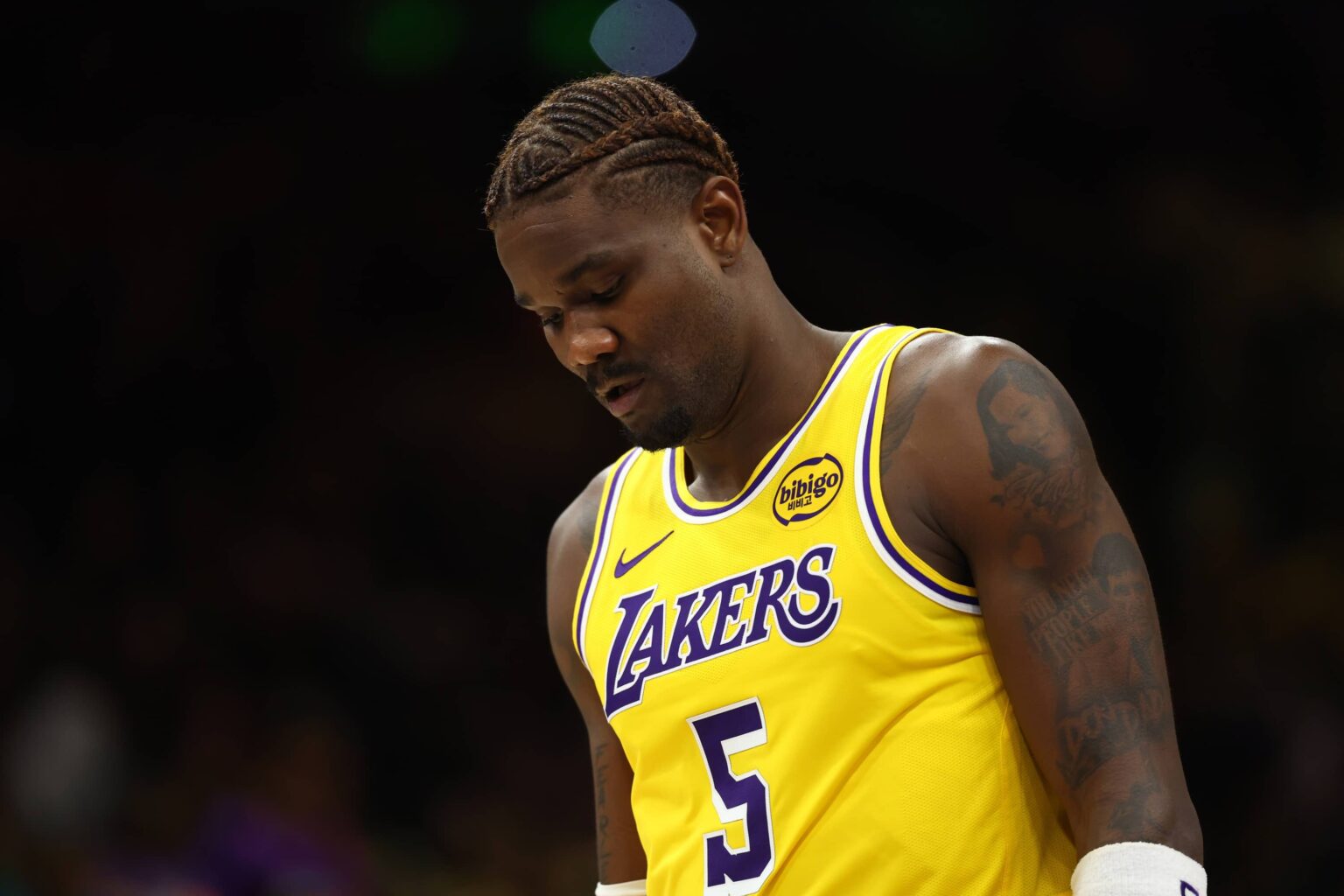
The noise around Deandre Ayton’s long-term future with the Lakers has gotten a lot louder over the last few weeks, as reporter Jake Fischer said on a recent Bleacher Report livestream that he doesn’t think “anyone in that Lakers building” views Ayton as the long-term answer at center, framing him more as a short-term bridge than a core piece next to Luka Doncic.
On paper, Ayton has done his job. He’s averaging 13.6 points, 8.6 rebounds, and 0.9 assists this season, and he’s finishing everything around the rim at an elite clip, 67.0% from the field, with about 1.0 blocks per game. It’s not star usage, but it’s real center production, and it fits next to high-usage creators when you want simple, reliable offense.
The bigger question is what the Lakers actually want from that spot when the games tighten up in April. They’re 29-19, sitting sixth in the West, and they’re good enough to think bigger than “good value starter.” If the front office believes Ayton is more of a bridge than a pillar, then the deadline becomes a chance to turn him into a cleaner fit, whether that’s a different type of big, a package that upgrades the rotation, or a move that reshapes the roster around Doncic without losing flexibility.
That’s why we’re laying out three Ayton trade ideas, deals that match the Lakers’ urgency right now while acknowledging the growing sense that this partnership might not be built to last.
Finding A True Paint Protector For The Lakers
Los Angeles Lakers Receive: Jarrett Allen
Cleveland Cavaliers Receive: Deandre Ayton, Maxi Kleber, Adou Thiero, 2031 first-round pick
If the Lakers are serious about tightening the roster around Luka Doncic and making the center spot a true playoff advantage, Jarrett Allen is the cleanest “plug-and-play” upgrade you can argue for.
He’s giving the Cavaliers 14.0 points, 8.0 rebounds, and 2.0 assists per game while shooting 60.5% from the field, basically elite efficiency in a role that scales up or down depending on who’s next to him.
The Lakers are sitting sixth in the West, so this isn’t about collecting talent, it’s about optimizing the fit. Allen gives them two things that translate immediately: a reliable rim finisher who doesn’t need touches, and a steady interior presence you can trust in higher-leverage minutes. He’s not a “post me up” big. He’s a pressure-release valve. Set a screen, dive hard, punish small lineups, clean the glass. Next to Doncic, that’s oxygen.
The financial side is heavy, but it’s structured. Allen is on $20.0 million this season. The outgoing money is basically clean matching: Kleber at $11.0 million, Ayton at $8.1 million, plus Thiero at about $1.3 million. That’s why this deal is even functional without needing extra filler.
From the Cavaliers’ angle, you only do this if you’re prioritizing flexibility and asset value over keeping your current big-man setup intact. They’re 29-21 and fifth in the East, so they’re not desperate. But if they’re looking at the roster and thinking “we need more optionality,” this is a pretty direct return: you get a first-rounder, you still have a starting-caliber center in Ayton (13.6 points, 8.5 rebounds on 67.5% shooting), and you add a usable expiring plus a young flier.
The Lakers’ side is clear; they consolidate into a higher-level center who fits the Doncic timeline, while the Cavaliers cash out Allen into a pick and maintain functional depth at the position. The obvious risk is the one every contender trade carries, you’re paying real value for certainty, and if Allen doesn’t look like a clear postseason upgrade, that first-rounder hurts.
Getting An Athletic Lob Threat From A Rival
Los Angeles Lakers Receive: Sam Hauser, Neemias Queta
Boston Celtics Receive: Deandre Ayton, Dalton Knecht, 2032 second-round pick
This one lines up with what’s been out there about the Celtics’ deadline priorities. Mike Scotto has reported the Celtics have been open to a move that upgrades the frontcourt, and the Ivica Zubac swing is the clearest example of how aggressive they’ve at least been willing to get in conversations.
Ayton gives the Celtics a real, physical center option without having to play small for long stretches, and it fits the frontcourt-upgrade theme Scotto’s been tied to. The outgoing pieces also make sense for the Lakers’ side. Sam Hauser is a clean floor-spacer on a real contract slot, putting up 9.1 points, 3.8 rebounds, and 1.4 assists per game while hitting 39.4% from three. Neemias Queta is a cheap big man you can plug into minutes when you just need size, averaging 10.0 points, 8.1 rebounds, and 1.4 assists with 1.3 blocks on 63.3% shooting.
The Dalton Knecht angle is the pressure point. There’s been reporting from Anthony Irwin that Knecht has asked for a trade and that the team is expected to accommodate it, which is exactly how you end up with a young shooter getting packaged in a deadline reshuffle. (Trevor Lane pushed back, saying that the specific claim is false, so the “asked out” part isn’t universally agreed on.)
On the court, Knecht’s been a small-role this season: 4.6 points, 1.5 rebounds, and 0.3 assists in 11.9 minutes per game, shooting 44.2% from the field and 31.9% from three.
Salary-wise, it’s tidy. Hauser is at $10.0 million, Queta is at $2.3 million. Ayton is at $8.1 million, Knecht is at $4.0 million.
The Celtics consider it because they chase the type of frontcourt piece they’ve been sniffing around all month, and they do it without giving up a core star. The Lakers turn the Ayton question into a shooter contract that helps the rotation right now, plus a cheap defensive big.
Knocking On The Mavericks Door For A Solid Starter
Los Angeles Lakers Receive: Daniel Gafford, Dante Exum
Dallas Mavericks Receive: Deandre Ayton, Dalton Knecht, Jaxson Hayes, 2026 first-round pick (swap rights)
The Daniel Gafford part is actually a possibility. Marc Stein reported that Gafford has drawn interest from teams, and his latest intel suggests the Mavericks are still exploring scenarios involving him. Tim MacMahon has also floated the idea publicly that Gafford is a name to watch as the deadline gets closer, which is exactly the kind of signal that usually precedes real calls.
From the Lakers’ perspective, this is simple: Gafford is a real rim-runner who plays fast, screens hard, and lives at the rim, which is basically the easiest type of center to build around a heliocentric creator. Dante Exum is the bonus, a low-cost guard who is sidelined for the entire season, to make the deal work.
For the Mavericks, the logic is roster construction and optionality. Ayton keeps the center spot functional, Hayes is depth, and Knecht is a young shooter you can try to grow. The swap rights sweetener is what makes it feel like a real negotiation instead of a clean one-for-one.
Salary-wise, Gafford is $14.3 million, and Exum is $2.2 million. Ayton is $8.1 million, Knecht is $4.0 million, and Hayes is $3.4 million.
This framework matches the reporting that Gafford is a live name in the market; it gives the Mavericks a way to reshape the depth chart, and it gives the Lakers the exact type of center archetype they’ve been linked to in rumors for a while.