The Miami Heat finally exhaled. After dropping five straight and watching momentum slip away, Miami responded with one of its most complete performances of the season, taking down the Cleveland Cavaliers 120-103 behind a balanced, high-efficiency offensive attack.
Instead of relying on a single star to carry the load, Miami overwhelmed Cleveland with depth, ball movement, and timely shot-making. Seven players scored in double figures, the team shot 51.9% from the field and 40.0% from three, and defensively, they swarmed the perimeter to disrupt Cleveland’s rhythm.
More importantly, this was a tone-setting win that stabilizes a spiraling team and reestablishes identity at a critical point in the season. Let’s get into the five major takeaways from this matchup.
1. Miami’s Balanced Scoring Was The Difference
This wasn’t about one dominant performance. Tyler Herro led the starters with 18 points on 6-11 shooting (4-8 from three), but he was just one piece of a much larger puzzle. Norman Powell added 19 points on 7-12 shooting, while Bam Adebayo chipped in 17 points, 10 rebounds, and 7 assists despite a rough shooting night (6-19). Even Andrew Wiggins quietly contributed 12 efficient points with strong perimeter defense.
What made this performance stand out was the bench production. Jaime Jaquez Jr. (14 points), Kel’el Ware (13 points, 11 rebounds on 5-5 shooting), and Pelle Larsson (14 points) all played major roles. Miami didn’t just score; they sustained pressure for 48 minutes. Seven players in double figures is usually a sign of elite offensive rhythm, and that’s exactly what this looked like.
2. Three-Point Shooting Flipped The Game
The math heavily favored Miami. The Heat knocked down 18-45 from deep (40.0%), compared to Cleveland’s 12-37 (32.4%). That +18 point differential from beyond the arc created a margin the Cavaliers never truly recovered from.
Herro’s four threes set the tone early, but this was a team-wide effort. Powell hit three, Davion Mitchell added two, and even Adebayo stretched the floor with a rare make. Miami generated clean looks through drive-and-kick sequences, reflected in their 31 assists.
Cleveland, meanwhile, settled for more contested attempts, particularly from Donovan Mitchell and Sam Merrill, who combined to shoot 8-19 from three, solid, but not enough to keep pace.
3. Kel’el Ware’s Impact Changed The Interior Battle
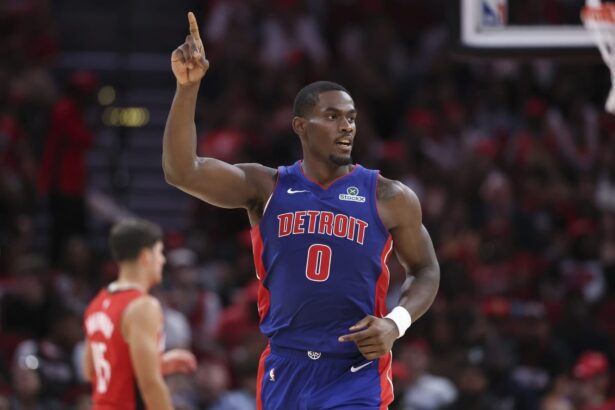
Ware’s stat line jumps off the page: 13 points, 11 rebounds, perfect 5-5 shooting, and a +32 plus-minus, the highest in the game. That’s not just efficiency, that’s dominance in his role.
His presence helped neutralize Evan Mobley, who was held to just 8 points on 3-8 shooting. Ware controlled the glass, protected the rim, and provided vertical spacing offensively. Miami didn’t win the rebounding battle (40-40 tie), but Ware’s minutes tilted the physicality in their favor. For a team searching for consistency, this kind of frontcourt production is a major development.
4. Cleveland’s Offense Was Too Mitchell-Dependent
Donovan Mitchell delivered 28 points on 12-22 shooting, but it came with limited support. James Harden added 18 points and 7 assists, but struggled from deep (3-9), while Merrill also scored 18 but shot just 4-10 from three.
The bigger issue was efficiency across the board. Cleveland shot just 43.2% from the field and had stretches where the offense completely stalled. Despite 26 assists, their possessions often ended with late-clock attempts or forced looks. When Mitchell wasn’t creating something difficult, the Cavaliers struggled to generate clean offense. Against a locked-in Miami defense, that imbalance became glaring.
5. Defensive Energy And Transition Set The Tone
Miami’s defense seemed to wake up. They were constantly changing up their defense, jumping in passing lanes, and turning defense into offense. This was reflected in the fastbreak points. Miami had 17 as compared to Cleveland’s 4 (an area of the game which typically shows a reflection of effort and urgency, rather than any preset game plan).
Miami also had good defensive perimeter performances. Mitchell, Wiggins, and Herro were good at disrupting the ball handlers. 14 of those turnovers were from Cleveland’s guards, and Miami’s defense was solid all night. This was the level of defensive engagement Miami had been looking for after a five-game losing streak, and it was safe to say they were extremely committed to their game plan.