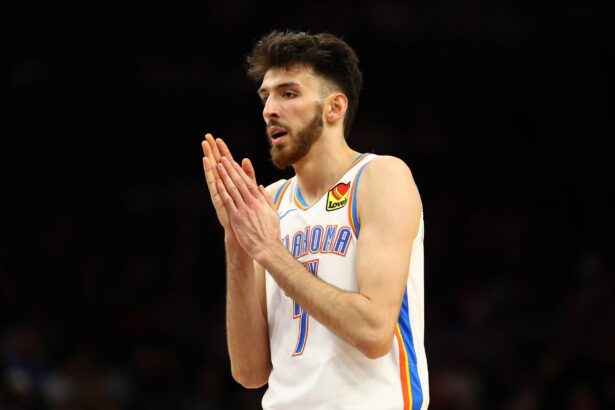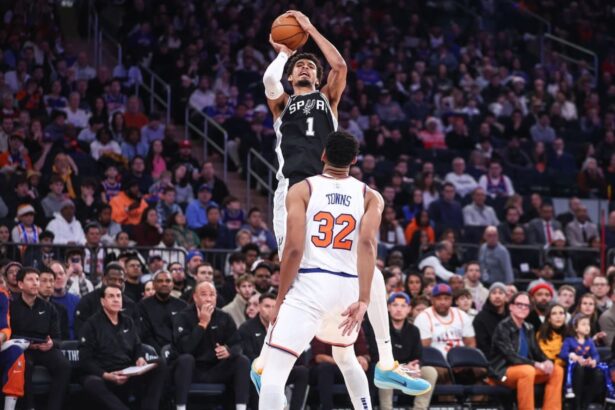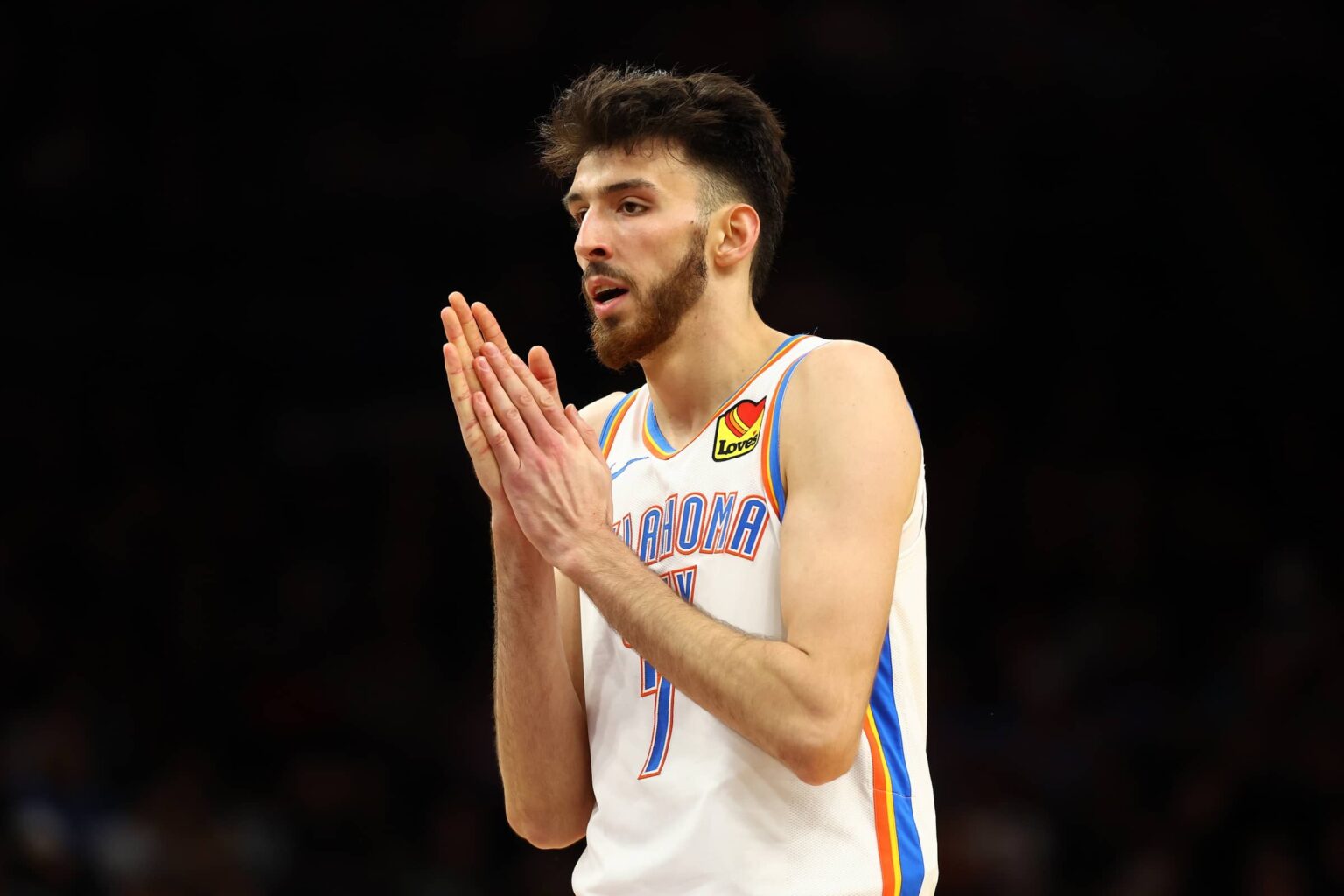
Since fading in a win-or-go-home situation in Game 7 of the Western Conference Finals, Oklahoma City Thunder star Chet Holmgren has faced immense scrutiny. While being critiqued for his poor performances against the San Antonio Spurs is an inevitable part of this process, many have even called for Holmgren to be traded this summer.
In theory, trading Chet Holmgren after a series of poor outings would seem justified, especially when considering he averaged only 10.7 points, 7.1 rebounds, 1.0 assists, and 1.1 blocks per game in the WCF. Still, the current reports indicate that OKC won’t be entertaining trades involving the DPOY-caliber big man just yet.
While the franchise’s faith in Holmgren is promising, the notion of seeing Holmgren on the trade block led many to share potential trade scenarios. On that note, NBA insider Zach Lowe chimed in and proposed his own trade idea while speaking with Chris Gorman.
“Would you do a Chet for Alperen Sengun challenge trade?” Lowe asked. “I only mention Sengun because the salaries are similar. The size element is satisfied, and Sengun seems to be the opposite of Chet in just this one specific thing. He f—ing loves going into Victor Wembanyama’s face, chest, and stomach.”
“He legitimately seems offended by the idea that people think Victor Wembanyama could do anything against his crazy pivot-y, physical, under-the-rim game. He kind of goes at him a little bit. Again, hasn’t proven the range he needs to exist with Hartenstein, but has a little bit of the DHO passing. Sometimes the three-point shot looks good.”
Lowe concluded by acknowledging that such a swap would be too “seismic” for either team to consider it. However, it can be argued that there is some real merit to making this deal.
How Can The Thunder Swap Chet Holmgren For Alperen Sengun?
Lowe’s rationale for this trade rests on two pillars, namely: the financial aspect and the Victor Wembanyama matchup. From a financial perspective, as constructed, this trade will not work.
Chet Holmgren’s five-year, $239 million extension will come into effect next season. With an expected cap hit of $41.5 million next season, Holmgren will be a difficult contract to absorb for the Rockets, who are already $19.9 million ($184.9 million) over the expected salary cap of $165 million.
Moving Alperen Sengun‘s $35.6 million contract would help the Rockets offset most of Holmgren’s cap hit, but Houston may be forced to include a player like Clint Capela ($7 million) to create more room.
Needless to say, acquiring Sengun as a replacement for Holmgren is largely favorable for the Thunder. Although the Rockets’ center lacks Chet Holmgren’s defensive upside, he makes up for it with his scoring and playmaking.
This season, Sengun averaged 20.4 points, 8.9 rebounds, and 6.2 assists per game while shooting 51.9% from the field and 30.5% from three-point range. While his perimeter shooting isn’t on par with Chet Holmgren’s (36.2% 3P%), Sengun is a far more reliable physical presence in the paint.
This is particularly important from the perspective of countering Victor Wembanyama.
In 10 games played against Wembanyama over his career, Sengun has logged a 5-5 record. In these games, Sengun has averaged 19.8 points, 9.8 rebounds, 5.2 assists, 1.6 steals, and 0.9 blocks. Overall, Sengun has averaged more points, assists, and steals than Wembanyama during their showdowns.
This is immensely favorable for the Thunder, but there are still more benefits for them in this deal.
With the arrival of Sengun and Capela, OKC gains two tough centers for the price of one. Given the Thunder’s salary cap concerns this summer, acquiring a backup center like Capela could give them the luxury to offload Isaiah Hartenstein‘s $28.5 million team option, taking some pressure off their salary cap.
Does This Trade Scenario Make Sense?
In theory, this deal works out perfectly for the Thunder, who gain a reliable center capable of holding his own against Wembanyama. Unfortunately, with the Rockets seeing virtually no benefits from acquiring Chet Holmgren outside of defensive reinforcements, this trade is wildly unlikely to go through.
With averages of 17.1 points, 8.9 rebounds, and 1.9 blocks per game, Holmgren remains an elite two-way threat. Still, his performance in the playoffs made it abundantly clear that he is more suited to being a secondary star rather than a primary option.
For OKC, trading Chet Holmgren may only be feasible if the team receiving him gains something from his arrival.
This limits the number of teams that could emerge as viable trade partners for OKC in the near future, especially considering the front office’s unwillingness to part with the big man. However, with a player like Giannis Antetokounmpo emerging on the Thunder’s radar, there is no telling what could happen next.
Given OKC’s abundance of blue-chip talent and valuable draft picks, the Thunder possess the assets to entice the Bucks. With Chet Holmgren positioned as a valuable asset for a rebuilding franchise in this scenario, Milwaukee may be more inclined to engage in further conversations.