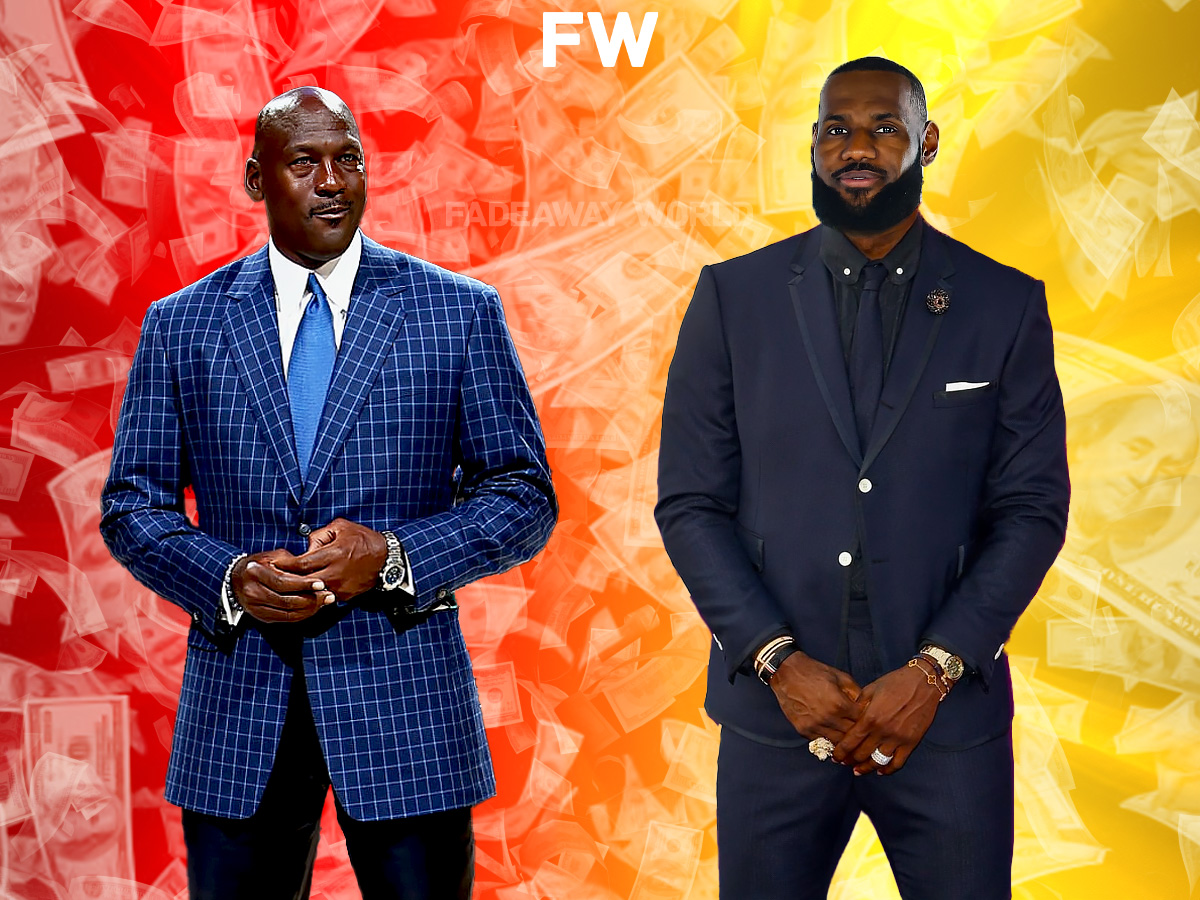
Michael Jordan quietly stepped in during one of the most difficult stretches of LeBron James’ early career, offering support at a time when criticism was at its peak. According to Michael Wilbon on First Take, Jordan personally reached out after LeBron’s 2010 playoff exit against the Boston Celtics and urged him to ‘take it easy’ on the young star.
“Early in LeBron James’ career, I remember when there was some criticism in the playoffs when LeBron did not win. It took LeBron seven years, like it took Michael Jordan. There were tough criticisms made of LeBron James.”
“Remember, he took the jersey off when he was walking out of Boston that final time when he lost to the Boston Celtics. I remember having a conversation with Michael, who said, ‘Hey, take it easy. When you talk about this tomorrow, take it easy on this kid, and here’s why.'”
“Michael had a list of reasons, things he really liked about LeBron James. He didn’t have to do that, but he understood what was going to happen publicly because he had been on the other end of that early in his career.”
“People don’t remember this. When folks said the scoring champion could never win, couldn’t beat Detroit. He lost to the Detroit Pistons three times in a row in the playoffs. So Michael understood that.”
“He wanted to soften that blow for LeBron James, who was coming up later. So if people think Jordan has somehow resented LeBron, they’re wrong. We’ve had these conversations where he said, ‘Don’t let the narrative be this on this kid.'”
The context matters. In 2010, LeBron had just endured one of the most scrutinized moments of his career. After a disappointing series loss, he walked off the floor in Boston without the usual postgame routine, a decision that drew heavy backlash. Questions about his leadership, mentality, and ability to win at the highest level dominated the conversation. For many, it reinforced a growing narrative that he could not deliver in the playoffs.
Jordan recognized the pattern immediately because he had lived it. Early in his career with the Chicago Bulls, Jordan faced similar criticism. Despite being the league’s most dominant scorer, he struggled to break through in the postseason. He was swept twice by the Celtics and lost three consecutive playoff series to the Detroit Pistons. At the time, critics questioned whether his style of play could ever translate into championships. The label was clear: great individual player, but not a winner.
Jordan did not win his first title until 1991, his seventh season in the league. LeBron followed a nearly identical timeline, capturing his first championship in his ninth season after years of playoff setbacks. That shared trajectory gave Jordan a unique perspective on what LeBron was experiencing in 2010.
Wilbon revealed that Jordan outlined multiple reasons why LeBron deserved patience, pointing to qualities in his game and approach that he respected. More importantly, Jordan understood how quickly narratives could harden. He had seen how early failures were used to define him, and he did not want the same thing to happen to LeBron before his career had fully unfolded.
The criticism did not stop there for LeBron. Later that year, he made the controversial move to the Miami Heat, forming a star trio that immediately turned him into the league’s most polarizing figure. The backlash intensified after the 2011 NBA Finals, where the Heat lost to the Dallas Mavericks, and LeBron delivered one of the weakest playoff series of his career. At that point, the narrative reached its peak, with widespread doubt about whether he could ever lead a team to a championship.
Yet, just one year later, LeBron broke through, winning his first title in 2012 and validating the belief that Jordan had quietly expressed years earlier. From that point forward, his career trajectory shifted permanently, adding multiple championships, MVP awards, and historic milestones.
That story carries added weight today because of what LeBron has recently said about Jordan and the GOAT debate, making it clear in a recent ESPN interview that he never viewed himself as competing directly with Jordan, stressing that their games are completely different. He also called the GOAT conversation ‘tiring’ and “barbershop talk.’ Jordan himself recently rejected the idea of a single GOAT, emphasizing that players across eras cannot be compared.
Wilbon’s account highlights a side of Jordan that is rarely discussed. Behind the competitive image was a player who understood the weight of expectation and the damage of premature judgment. At a time when LeBron was being defined by his failures, Jordan chose to look at the bigger picture.