After the point guards and shooting guards, power forward is the first spot on the 2026 board that looks meaningfully deeper than the wings. There are simply more playable 4s than starting-caliber small forwards, and that changes how the market should behave. Teams will have options: true 4s, small-ball 5s listed at power forward, and spacing bigs who can toggle between both frontcourt spots.
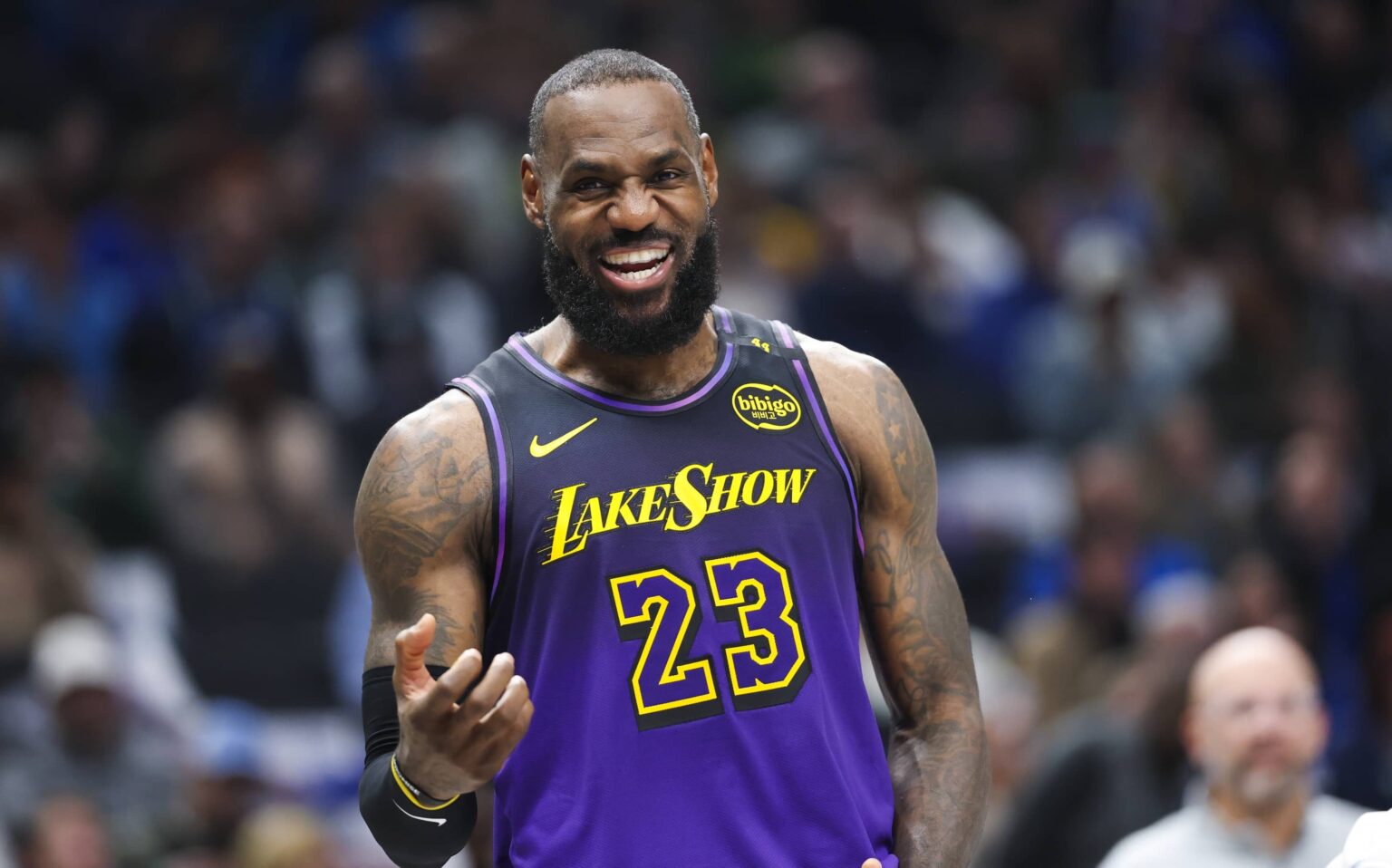
The headline name is LeBron James, who sits on the 2026 list at power forward and would immediately become the top short-term ceiling swing if he reaches the open market. Even at this stage, one decision from him can reshape the entire class because contenders treat that caliber of creator as a rare, one-move upgrade.
Because the supply is stronger than at wing, bidding wars should be narrower and more situational: a few teams chasing the same top names, then a fast pivot to mid-tier rotation forwards once the first dominoes fall.
10. Julian Champagnie
2026-27 Contract Status: $3.1 million (Team Option)
Julian Champagnie has become a real rotation forward for the Spurs because his minutes now come with two things teams pay for: volume shooting and playable size on the wing. In 2025-26, Champagnie is averaging 11.4 points, 5.8 rebounds, and 1.5 assists in 27.9 minutes. He is shooting 43.3% from the field, 38.2% from three, and 85.2% at the line, with a 61.3% true shooting mark.
Those numbers matter because he is not a high-usage player. He is living off spacing, spot-ups, quick decisions, and transition finishing. Last night’s game is also real: he just dropped 26 points on 6-of-9 from three against the Nets, a clean snapshot of the role he provides when the jumper is falling.
The contract is one of the strongest value slots in this class. Champagnie is on $3.0 million this season and has a 2026-27 team option listed around $3.1 million. For a wing producing 11-plus points per night on near-38% from three, that option is below market. It is also why “free agency” is not the likely path. The Spurs control the next step unless they choose flexibility over a cheap rotation piece.
Team context helps his evaluation. The Spurs have been winning at a high level, including an 11-game win streak that pushed them to 43-16, so these minutes are not empty. Champagnie is staying on the floor because he is fitting into lineups that need spacing around the Spurs’ high-usage core while still competing defensively.
What I think happens: the Spurs pick up the $3.1 million option, then evaluate an extension later if the shooting holds through the postseason.
9. John Collins
2026-27 Contract Status: Unrestricted Free Agent
John Collins is one of the cleanest “production vs. price” cases in this free agency tier. The production is efficient and consistent. In 2025-26 with the Clippers, Collins is posting 13.8 points, 5.2 rebounds, and 1.0 assists in 27.8 minutes.
He is shooting 56.5% from the field and 42.7% from three on 3.2 attempts per game, with a 65.9% true shooting mark. That is elite efficiency for a frontcourt scorer, and it is why he still profiles as a starter-level finisher even when he is not a focal point.
The contract piece is simple. Collins is on an expiring $26.6 million deal and is positioned to reach unrestricted free agency in 2026. That makes him a real market player, not an option decision. It also means teams will weigh him against cap space and exception spending rather than trade-matching logic.
The on-court fit is specific. Collins’ best value comes as a play-finisher next to a primary creator: rim runs, short-roll decisions, and spot-up threes that punish help. The 42.7% from three is the key, because it changes how teams can defend a frontcourt pairing, and it widens the set of lineups he can play in. Defensively, he is not a one-man scheme, but he can be functional if the roster has real point-of-attack defense and a back-line anchor.
What I think happens: he signs a short, high-money deal rather than chasing maximum years, most likely staying with the Clippers, at least for next season. My projection is 3 years, $66.0–$75.0 million, with a third-year option (team or player) depending on the bidder. The most logical buyers are teams that need a starting 4 who can score efficiently without taking touches: Warriors, Lakers, Thunder, and Heat-type roster builds, depending on cap space and exception access.
8. Tobias Harris
2026-27 Contract Status: Unrestricted Free Agent
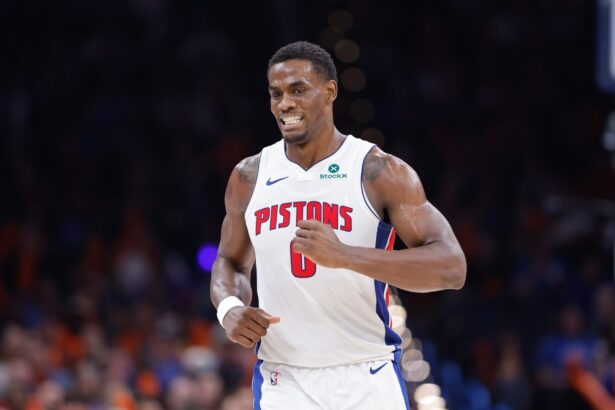
Tobias Harris is a straightforward evaluation: veteran forward, stable minutes, secondary scoring, and credible size, with a contract that ends in 2026. Harris is bringing 13.0 points, 5.2 rebounds, and 2.3 assists in 28.0 minutes for the Pistons this season. He is shooting 44.7% from the field, 34.4% from three on 3.9 attempts, and 86.7% at the line. That is playable offense, but it is not difference-making efficiency, which puts his market in the “rotation starter” lane rather than the “core piece” lane.
His contract is clean and expiring. Harris is on a two-year, $52.0 million deal with the Pistons, and the 2025-26 salary is $26.6 million. There is no option year. He will be an unrestricted free agent in 2026, which means teams can treat him as a short-term plug-in without committing future cap years.
Role translation is the key question. Harris is best as a third or fourth option who can punish mismatches, hit open threes at a respectable clip, and keep the ball moving. The 34.4% from three is fine, but not a spacing weapon, so his value rises if he is next to high-gravity stars who manufacture clean looks. Defensively, he is more about positioning than disruption at this stage, so lineup context matters. He fits better on teams with athletic defenders around him and a defined scheme.
What I think happens: he signs a short deal in the mid-tier starter range, likely 2 years, $28.0–$36.0 million to stay with the Pistons (around $14-$18 million per year), with a team option in Year 2. The most realistic targets if he goes elsewhere are contenders that need forward minutes and can keep his usage efficient: Lakers, Heat, Warriors.
7. Tari Eason
2026-27 Contract Status: $8.0 Million (Qualifying Offer)
Tari Eason’s case is simple: he is a starting-caliber forward when available, and a difficult player type to replace because he impacts possessions without needing plays run for him. For the Rockets in 2025-26, Eason is giving 11.5 points, 6.3 rebounds, and 1.6 assists per game, shooting 44.5% from the field. The spacing number is what moves him from “energy forward” to “real lineup piece.” He’s at 44.0% from three this season.
Contract mechanics drive his 2026 value. Eason is headed to restricted free agency after the Rockets declined to extend him last offseason. That structure typically favors the incumbent team unless a cap-space team is willing to write an aggressive offer sheet with high annual value and limited team control.
The evaluation points are also clear. Eason is a low-usage scorer who generates extra possessions with rebounding and an irreplaceable top defensive impact. The concern is durability and workload. Reporting around his extension talks framed availability as part of the negotiation, with the Rockets and Eason failing to reach a deal before he hit the RFA path.
What I think happens: the Rockets retain him. The most likely outcome is a matched offer or a direct deal in the “starter money with protections” lane, something like 4 years, $84.0–$100.0 million, staying in the $20-25 million figure per season, with partial guarantees or incentives tied to games played. The leverage is that he is productive and fits next to almost any roster construction, but the contract will reflect health risk.
6. Rui Hachimura
2026-27 Contract Status: Unrestricted Free Agent
Rui Hachimura is an expiring forward whose value is tied to efficient finishing and spacing, not creation. For the Lakers this season, he is averaging 11.7 points, 3.4 rebounds, and 0.9 assists per game, shooting 50.6% from the field. His three-point shooting has been a real weapon in this role, shooting a career-high 44% from deep this year.
The contract situation is clean. Hachimura is in the final season of the three-year, $51.0 million deal he signed with the Lakers, and he is scheduled to be an unrestricted free agent in 2026. At $18.3 million, he is not a bargain contract, but he is also not priced like a primary forward. Teams view him as a complementary 4 who can play next to a center, keep spacing intact, and punish mismatches against smaller lineups.
His limitations also shape the market. He is not a high-volume rebounder for the position and does not tilt offense with passing. That usually caps offers at solid starter or high-end rotation money, not top-of-market forward money. The selling point is that he fits star-driven offenses because he does not need touches to score efficiently.
What I think happens: the Lakers try to keep him if the number stays reasonable, because replacing a 44.0% floor spacer at forward is hard without cap space. If he reaches the open market, the likely range is 3 years, $45.0–$60.0 million (around $18-20 million per season), depending on how many cap-space teams miss on higher-end wings, with the Warriors, Pistons, and Raptors potentially interested.
5. Jonathan Kuminga
2026-27 Contract Status: $24.3 million (Team Option)
Jonathan Kuminga is on this power forward list because his role has leaned into frontcourt usage: attacking closeouts, living in transition, and playing as a physical scorer against smaller lineups. In 2025-26, he is averaging 13.0 points, 6.0 rebounds, and 2.6 assists per game, shooting 47.4% from the field. The three-point percentage sits at 35.0%, with 2.7 attempts per game.
The availability question is contract structure, not talent. Kuminga signed a two-year, $46.8 million deal that includes a 2026-27 club option, with the option at $24.3 million. That option is the pivot point. If it is exercised, he is not on the market. If it is declined, his camp has a path to a new deal immediately.
Recent form matters for leverage. He had an immediate impact after changing teams, including a 27-point debut and another strong line against the Wizards (17 points, nine rebounds). That is the version teams pay: downhill athleticism with enough passing growth to function in real half-court possessions.
What I think happens: the option gets used as a negotiating tool, not a final destination. The most likely outcome is a renegotiated multi-year contract with the Hawks in the $25.0–$32.0 million per year range, depending on health and how he closes the season. The scarcity of athletic forwards who can create rim pressure will keep his market strong even if he is not a consistent shooter yet.
4. Peyton Watson
2026-27 Contract Status: $6.5 Million (Qualifying Offer)
Peyton Watson is listed as a wing, but his value is power-forward adjacent because of how the Nuggets use him: big perimeter defender, weakside rim protection, and small-ball frontcourt minutes. The reason he is a 2026 free agency topic is not availability. It is leverage. He is scheduled to reach restricted free agency after 2025-26.
The financial problem is clear. The Nuggets are a high-salary team, and outside analysts have framed Watson as the next “pay or lose the player type” decision because two-way wings are hard to replace without cap tools. Their second-apron trajectory would constrain sign-and-trade routes and shrink the bidder field. League expectations are that his next number could land in the $20.0–$30.0 million per year band, which is the range that forces real sacrifices elsewhere on the roster.
That is where the rumors come in. Recent speculation has centered on the Nuggets potentially moving salary to keep Watson long-term, with moving a larger contract slot becoming the cleanest way to create breathing room. The logic is not complicated: if Watson’s market pushes into starter money, the Nuggets cannot keep every veteran deal untouched and still pay him.
What I think happens: the Nuggets keep Watson, but it comes with a cap-clearing move. The most realistic outcome is a four-year deal in the $18.0–$24.0 million annual range (between $70 to $80 million) with structure protections (front-loaded money, a team option, or partial guarantees), and at least one rotation salary moved to reduce apron pressure.
3. Draymond Green
2026-27 Contract Status: $27.7 million (Player Option)
Draymond Green is still a high-impact forward because his value is defensive organization and decision-making, not scoring. In 2025-26, he is averaging 8.5 points, 5.7 rebounds, and 5.1 assists, shooting 41.0% from the field.
The contract is straightforward. Green has a $27.7 million player option for 2026-27, with his 2025-26 salary at $25.9 million. At this stage, the option is the key variable. If he opts in, he stays on a premium one-year number. If he opts out, the market is about years and role, and won’t likely have many suitors.
The 2026 evaluation is mostly about health and playoff utility. Green has had recurring availability issues this season, including recent low back soreness that has cost him games. Teams will not pay for regular-season volume. They pay for whether he can anchor lineups defensively in May and June, switch, communicate, and play short-roll offense without turning the ball over.
What I think happens: Green opts in. The $27.7 million number is strong for a 37-year-old season and reduces long-term risk. If he reaches the market anyway, it would likely be on a short, mid-level type deal with the Lakers for his defense and passing, but the most probable outcome is staying with the Warriors on the option year.
2. Kristaps Porzingis
2026-27 Contract Status: Unrestricted Free Agent
Kristaps Porzingis is the highest-variance power forward on this list because the ceiling is obvious and the availability risk is just as obvious. He is on an expiring $30.7 million contract with the Warriors, which puts him directly into 2026 unrestricted free agency.
The on-court case is still strong when he plays. Porzingis averages 16.8 points and 4.9 rebounds in 18 games this season (12 starts). After the trade, he debuted for the Warriors on a minutes restriction and posted 12 points in 17 minutes in his first game.
The concern is medical continuity. He had a six-week absence tied to Achilles tendinitis earlier in the season. There’s also additional health management and missed games after the trade. Teams will treat him as a “shorter-term, higher annual” target rather than a clean multi-year bet.
What I think happens: the Warriors try to keep him on a short contract with protections, because it makes no sense to give away Kuminga for just a rental in Porzingis. The most realistic range is 2 years, $45.0–$54.0 million, with games-played protections or partial guarantees. If the Warriors do not retain him, the market will still be contender-driven because his skill set is additive in high-leverage playoff offense, but teams will cap the years, with likely the Celtics, Raptors, and Magic interested.
1. LeBron James
2026-27 Contract Status: Unrestricted Free Agent
LeBron James is the top name in this class because no other forward combines his creation load with his floor-raising effect in a one-signature scenario. In 2025-26, James is averaging 21.5 points, 5.7 rebounds, and 7.0 assists, shooting 49.8% from the field.
He is on a $52.6 million salary in 2025-26, and his contract expires after the season, which is why he is a real 2026 free agency variable rather than an option decision.
The noise around his next step has been consistent for weeks. There’s been “rampant speculation” that James could return to the Cavaliers for a third stint in 2026-27. The practical constraint is money and team-building: multiple reports have framed the Cavaliers’ path as requiring a significant pay cut because a straight market-value signing is not clean under cap rules.
On the Lakers’ side, the picture is not “he is gone,” it is “it depends.” Recent talk has continued to frame his future as “doubtful,” with Jeanie Buss even addressing the issue. That is the core tension: Lakers offer continuity, minutes, and a clear role; Cavaliers offer narrative gravity and a final-chapter fit, but likely at a reduced salary.
What I think happens: James re-signs with the Lakers on a short deal, most likely 1+1 (second year as an option) in the $45.0–$55.0 million range, because it preserves leverage and keeps him in a win-now environment. The Cavaliers’ outcome stays in play only if he decides the return is worth the pay cut and the team can still build a contender around the margins.