Draft night is not only about which prospects come off the board. In many cases, the real movement starts after the pick is made, when another team decides that player is worth trading up for.
That could be the case in the 2026 NBA Draft. Some teams near the top may value extra draft capital more than staying locked into one prospect, especially if the player doesn’t separate that much from others. Some teams picking later could see a player who fits their timeline, roster need, or long-term upside and decide they cannot wait.
This is not a report. It is a projection based on the current draft order, team needs, prospect value, and the way the board could shift on draft night. The top 10 usually gets unpredictable, and one early surprise can create the conditions for a trade.
Here are the prospects who could be moved on 2026 NBA Draft night.
1. Mikel Brown Jr.
Mikel Brown Jr. is one of the best names for this topic because the Clippers’ situation at No. 5 is weird, in a good way. The Clippers hold the fifth pick from the Pacers, but they are not in the same draft capital position as a rebuilding team. They can take a swing, sure. But they can also turn one premium pick into two first-round picks if a team behind them falls in love with Brown.
That is where the Thunder make sense. The Thunder have the No. 12 pick from the Clippers and the No. 17 pick from the 76ers. That is the kind of package that can start a conversation. For the Clippers, moving from No. 5 to No. 12 and No. 17 gives them two rookies in the first round. For the Thunder, moving up gives them a chance to take the guard with the best blend of size, shot creation, and upside outside the top four, as they’ll be expensive in 2026-27 and don’t need to add that many pieces anymore.
Again, this is a mock. It is not decided that Brown is going fifth. It is just a realistic pressure point. If the Clippers look at the board and don’t see a huge gap between Brown, Keaton Wagler, Kingston Flemings, Labaron Philon Jr., or Brayden Burries, trading down is very logical. The value of No. 5 is the tier. The value of No. 12 and No. 17 is optionality.
The Brown case is also very stat-driven. He averaged 18.2 points, 3.3 rebounds, and 4.7 assists at Louisville while shooting 41.0% from the field, 34.4% from three, and 84.4% from the line. That is not perfect efficiency, but the free-throw number is important. For guard prospects, free throws usually say a lot about touch. A guard who shoots 84.4% from the line and can shoot off the dribble has real projection as a long-term shooter, even if the freshman 3-point number was not elite.
The volume also matters. Brown was not just standing in the corner. He was creating pull-ups, working as a pick-and-roll handler, and making reads in live dribble situations. His 4.7 assists per game show he is not only a scoring guard, and he ended the season with nine 20-point games in only 21 games played. That is a real hit rate for a freshman guard who missed time and still made Third Team All-ACC.
The ceiling game is the one that makes teams talk themselves into moving up. Brown scored 45 points against NC State, tied the Louisville single-game scoring record, tied the program record with 10 made threes, and set an ACC freshman scoring record. He went 14-of-23 from the field, 10-of-16 from three, and 7-of-7 from the line. That is the kind of game scouts don’t forget. It shows the real shot-making ceiling, not just the theory.
The concern is also obvious. Brown played only 21 games. His field-goal percentage was 41.0%. His 3-point percentage was 34.4%. That makes him riskier than Darius Acuff as a pure production bet. If a team is drafting him in the top five, it has to believe the shot quality, spacing, body growth, and NBA development plan will push the efficiency up.
That is why the Thunder are so interesting. They don’t need Brown to be a 30-minute guard right away. They can develop him slowly, put him next to better spacing, and let his shooting and passing grow in a controlled role. The Thunder already have a deep roster, so the difference between using No. 12 and No. 17 on two rookies versus using both to chase one higher-upside guard is a real roster math question.
The Clippers’ side is just as logical. If the Clippers don’t see Brown as clearly better than the players expected from No. 10 to No. 17, taking two picks is stronger asset management. No. 12 could still bring a rotation-level prospect, and No. 17 adds another young contract. That matters for a team that needs cheap talent around expensive veterans.
Prediction: Brown is the best candidate to be part of a draft-night trade if the Clippers decide the No. 5 pick is more valuable as a trade asset than as one player. The mock idea is simple: Thunder move up for Brown, Clippers move down, and get multiple first-round picks.
2. Darius Acuff Jr.
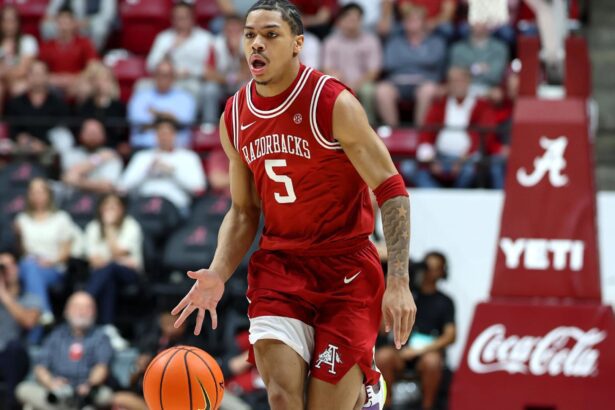
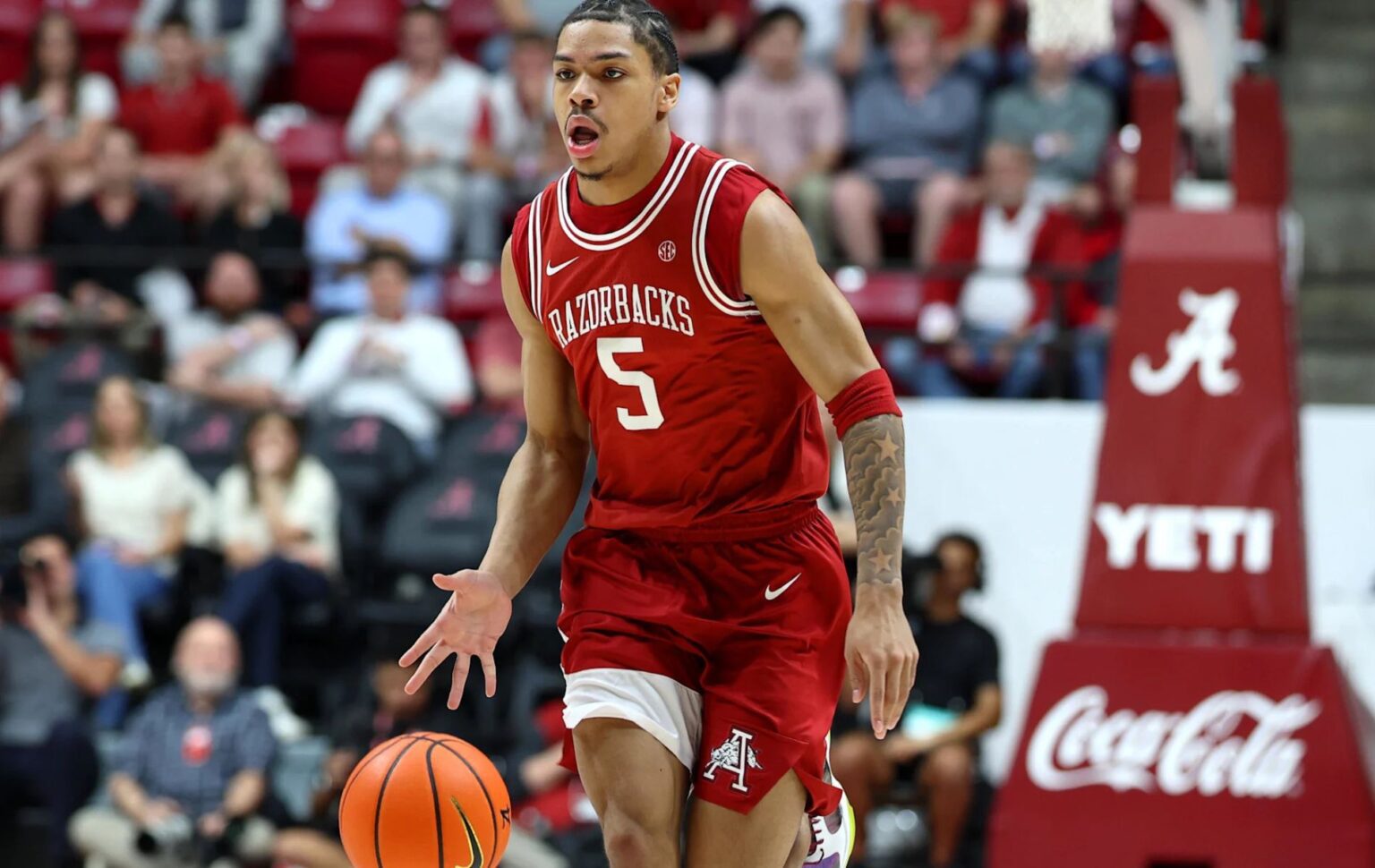
Darius Acuff Jr. is one of the most hyped prospects in the class. The production is absurd. In Arkansas, he averaged 23.4 points and 6.4 assists. He led the SEC in scoring and assists. He set Arkansas single-season records with 845 points and 232 assists. He won the Bob Cousy Award. He became SEC Player of the Year and SEC Freshman of the Year.
The shooting numbers make the case stronger. Acuff shot 48.4% from the field and 44.0% from three. He was the only player in the NCAA to average at least 20 points and 6 assists while being one of only four players to shoot at least 48.0% from the field and 44.0% from three. That is a very specific filter, and it shows why teams could get nervous.
Acuff is not just a box-score guard either. He had at least 20 points and 5 assists in 21 games, the most of any Division I player. He scored at least 20 points 26 times in 36 games. He made a three in 35 games. He led Arkansas in scoring 24 times and in assists 31 times. That is real control of a college offense, not just hot shooting.
The Nets at No. 6 and Kings at No. 7 are the obvious spots. Both can justify taking him. The Nets need high-end offensive talent and can afford to draft for upside. The Kings need a real point guard direction and have been connected to Acuff in the pre-draft cycle. If Acuff is still there at No. 7, that feels like the easiest pick on the board for the Kings.
That is also why a trade could happen. If the Nets or Kings select Acuff, teams behind them could still try to trade for his draft rights before the night ends. The Warriors at No. 11 and Heat at No. 13 make the most basketball sense.
The Warriors need a long-term guard who can pressure the rim, create paint touches, and carry the offense after the Stephen Curry era. Acuff’s numbers fit that need better than most players in this class. A freshman who can score 23.47 points per game, pass for 6.44 assists, shoot 44.0% from three, and hold up with high usage is exactly the type of guard who can shift a second unit early and grow into something bigger later.
The Heat case is different. The Heat always care about force, toughness, and late-clock creation. Acuff gives them all of that on offense. He is not a big guard, and his defense is the swing skill. But the Heat can live with a development plan if the offensive talent is real enough. In the 13 range, guards with that kind of freshman production almost never sit there unless the league is overthinking size or defense.
The trade value would not be cheap. If the Warriors want Acuff from the Nets or Kings, No. 11 alone probably is not enough. They would need to add future pick value. If the Heat want him from No. 13, the cost is even higher because the gap from No. 6 or No. 7 to No. 13 is bigger.
There is also a reason the Nets or Kings might not want to move him. Acuff’s floor is easier to see than Brown’s. Brown has more size and maybe more flexible long-term lineup value, but Acuff has the better production resume. The difference between 18.2 points on 41.0% from the field and 23.4 points on 48.4% from the field is not small. Acuff already proved he can bend a full college defense every night.
The risk is translation. Smaller guards always get tested in the NBA. Can he defend? Can he finish over length? Can he create without dominating the ball? Those are fair questions. But the shot, handle, pace, passing production, and competitive scoring profile give him a strong case.
Acuff is the most likely player to be drafted by one team and chased by another. If the Nets or Kings take him, the Warriors and Heat should at least call. I would be aggressive if I were either team, because Acuff has the best guard production profile outside the very top of the draft.
3. Cameron Carr
Cameron Carr is the one I like most as an undervalued prospect. Not safest. Not most polished. But undervalued. His profile is exactly what teams say they want in the playoffs: athletic wing, shooting, above-the-rim finishing, long arms, weak-side blocks, and enough self-creation to attack a bad closeout.
Carr averaged 18.9 points, 5.8 rebounds, 2.6 assists, and 1.3 blocks at Baylor. He started all 34 games, scored 642 points, reached double figures in 32 games, and had four double-doubles. He also shot 49.4% from the field, 37.4% from three, and 80.1% from the line. For a wing with that athletic profile, those splits are strong.
The block number is the sleeper stat. A guard or wing averaging 1.3 blocks per game is not normal. It shows timing, length, and vertical pop. Carr is not just a straight-line dunker. He can actually affect plays on defense. He still has to get stronger and stay more locked in off the ball, but the tools are there.
The Combine made his case louder. Carr measured 6-foot-4.5 without shoes with a 7-foot-plus wingspan, and he had a 42.5-inch max vertical. Then he shot 14-of-25 in spot-up drills and 22-of-30 off the dribble. That mix is why he could go earlier than the normal public projection. The body, explosion, shooting flashes, and Baylor production all point in the same direction.
This is why the Raptors, Pistons, and Lakers make sense as trade-up teams if Carr starts going higher than expected. To be clear, I have not seen rumors or reports connecting the Raptors to Carr. That part is a fit-based projection. But Carr said he met with the Pistons and Lakers at the Combine, so the interest is already there.
The Raptors hold No. 19, which is right in the range where Carr could be gone. Their need is obvious: more wing scoring, more shooting, more athletic pressure, and more players who can grow next to Scottie Barnes. Carr fits that. If he is sitting at No. 15 or No. 16 and the Raptors believe he is a top-10 talent, moving from No. 19 is not crazy.
The Pistons at No. 21 also fit. Cade Cunningham needs more shooting and more athletic finishers around him. Carr can run the floor, punish rotations, cut behind the defense, and shoot well enough to stay on the court. The Pistons also need wings who can make plays without needing the offense built around them. Carr’s 18.9 points per game show he can score, but his NBA role would probably be simpler early: space, cut, attack closeouts, defend, rebound.
The Lakers at No. 25 are the most aggressive version of this idea. They probably can’t just wait and hope Carr drops. If he is really in the 14-20 range, the Lakers would need to move up. The logic is strong because Carr gives them the type of cheap wing upside they keep needing next to their backcourt. A 6-foot-4.5 wing with a near 7-foot wingspan, 37.4% from three, 80.1% from the line, and 1.3 blocks per game is exactly the kind of player that gets expensive fast if he hits.
The concern with Carr is decision-making. He was Baylor’s main scoring option, so he had some tough-shot possessions. He also averaged only 2.6 assists, so he is not a full creator yet. If the shot is not falling, teams will ask what else he gives on offense. That is the real question. Is he a high-level role wing, or is he only valuable with touches?
I lean higher on him because the physical tools and shooting signs are too strong. The 49.4% from the field is good. The 37.4% from three is great. The 80.1% from the line is a strong indicator. He has NBA tools, NBA athleticism, and enough skill to grow into a rotation player fast.
Carr is the best bet to become the draft-night riser who makes teams panic. If he gets into the mid-first range, the Raptors, Pistons, and Lakers should all think about trading up. I would not wait until No. 25 if I were the Lakers. He probably won’t be there.