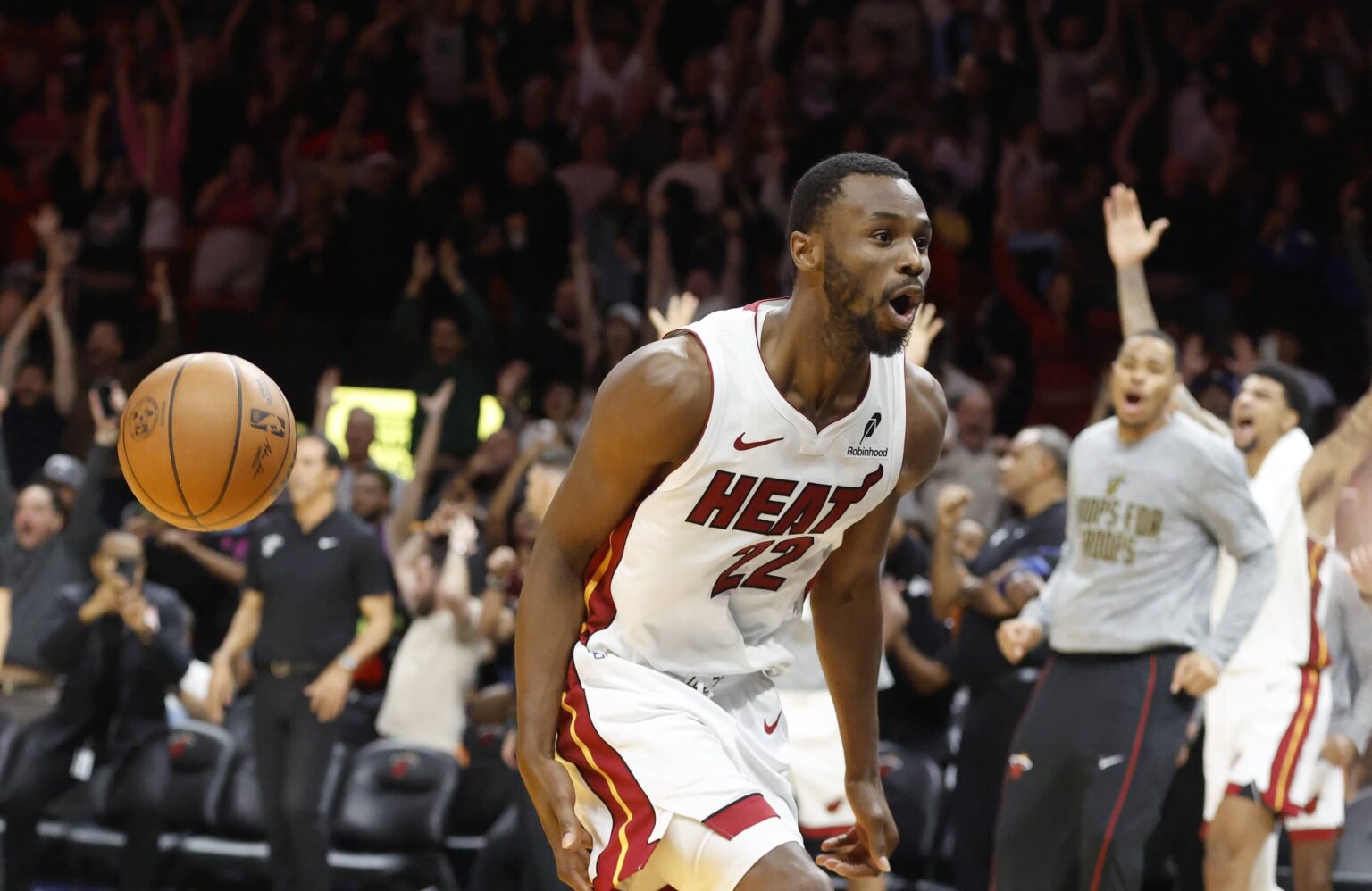
Andrew Wiggins has a simple offseason decision on paper and a harder one in real life. He can pick up his $30.2 million player option with the Heat and stay on a big expiring contract. Or he can decline it, enter free agency, and try to turn one expensive year into a longer deal with more security.
That second path is only logical if the market is interested. Wiggins is 31 now, but he still has a role that teams pay for. He averaged 15.4 points, 4.8 rebounds, 2.7 assists, 1.1 steals, and 1.0 blocks this season, shooting 47.5% from the field and 41.4% from three. His 58.6% true shooting also helps his case. He wasn’t a star, but he was efficient, useful, and still had enough two-way wing value to start for a playoff-level team.
The question is price. Wiggins probably isn’t getting $30.2 million per year again. But if a team offers three years in the $18.0 million to $25.0 million range, declining the option becomes easier. That would give him more guaranteed money, and it would give a new team a starting forward without trading assets.
There is no direct report linking Wiggins to all four teams below. This is a fit and market framework. But there has been real Wiggins noise already, with Michael Scotto reporting that the Heat gauged his trade market during the season. If he declines the option, these are the types of teams that should call first.
1. Los Angeles Lakers
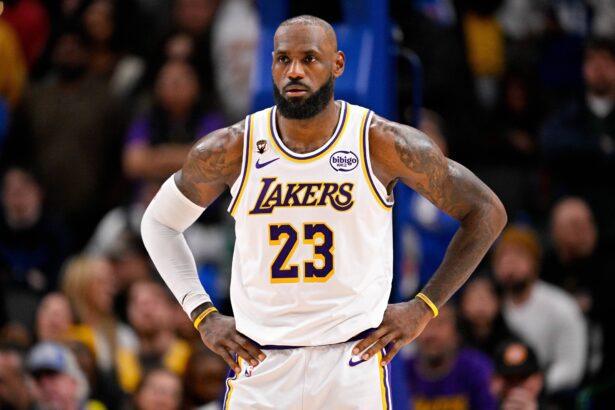
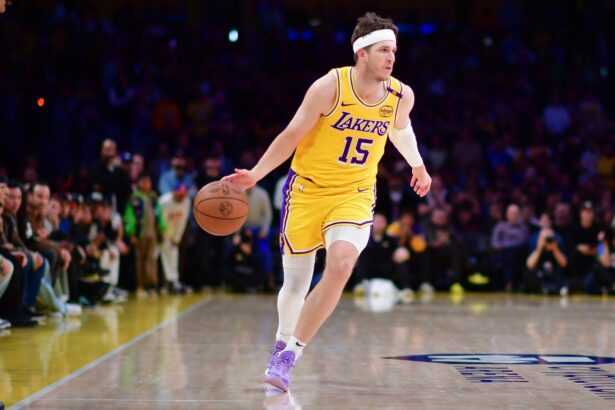
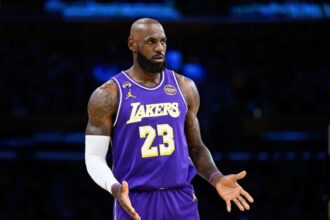
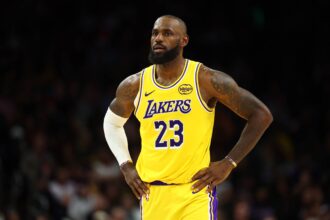
The Lakers are the easiest basketball fit. They finished 53-29, fourth in the West, and lost to the Thunder in the second round. That means they were good enough to think big, but not good enough to think the roster is at its highest point. Their core will likely be Luka Doncic and Austin Reaves. LeBron James is the major unknown, and the Lakers’ projected cap space path depends on cutting ties with James or bringing him back on a lesser deal. In that case, the Lakers could have around $49.0 million in cap space.
That is where Wiggins makes sense. Doncic led the league at 33.5 points per game, while Reaves remains a strong secondary creator. But the Lakers still need size on the wing, real defensive bodies, and players who don’t need 18 shots to be useful. Wiggins fits that part. He can guard bigger wings, switch some actions, run in transition, and live off catch-and-shoot looks. His 41.4% from three this season is very important because Doncic creates easy corner and slot threes when the defense sends help.
The fit is also simple with Reaves. The Lakers can’t put too many weak defenders around Doncic and Reaves at the same time. That was one reason their roster needed more two-way balance. Wiggins isn’t an All-Defense player at this point, but he still has a 6-foot-6 frame, a 7-foot wingspan, and enough lateral size to handle playoff wing assignments better than a small guard. He also averaged 1.1 steals and 1.0 blocks, so the defensive activity was still there.
The offensive role would be stable. Wiggins wouldn’t need to be a No. 2 option. He would be a fourth scorer most nights, maybe third depending on the final roster. That is good for him. His best NBA version was never as a full-time creator. It was as a straight-line scorer, cutter, transition finisher, corner shooter, and matchup defender. The Lakers can give him those touches without forcing him into too much self-created offense.
The cap is the only real question. If James returns at a large number, this becomes hard. The Lakers would likely need a sign-and-trade, and that is not simple under the apron rules. If James sings for less, leaves, or retires, this becomes much more realistic. A deal around three years and $60.0 million would give Wiggins security and still leave the Lakers with room to add other pieces.
My take: this is the best blend of role, pressure, and timeline. Wiggins would not be asked to save the Lakers. He would be asked to defend, shoot, and give Doncic another big wing target. That is a realistic job for him.
2. Brooklyn Nets
The Nets are purely here because they could offer him the most money. They finished 20-62, 13th in the East, so this is not the best winning fit right away. But they are projected to have one of the biggest cap-space paths in the league.
That is why Wiggins could make sense to mentor the younger players and still get his bag. The Nets need adult wing minutes. They have young pieces, but young teams can get very bad very fast when they don’t have players who understand spacing, defensive rotations, and shot selection. Wiggins would give them a real starting forward who can defend either wing spot and still score 15 to 17 points without having the offense built around him.
The contract structure would be the key. The Nets shouldn’t give Wiggins four expensive years. That would be a bad use of cap space. But three years with a team option or partial guarantee in the final season could work. Something like three years and $75.0 million is high, but not wild in a weak free-agent class. It also lets the Nets pay for competence without giving up picks.
Wiggins also fits because the Nets can absorb the risk better than most teams. A contender signing him needs him to close playoff games. The Nets would need him to stabilize the lineup, help the young players, and raise the floor. Those are different expectations. If he gives them 15.4 points, 4.8 rebounds, league-average or better defense, and 38.0% to 40.0% from three, that is enough.
The danger is direction. If the Nets are still patient, Wiggins is not the right target. He is 31, and his best years are probably now, not three years from now. But if they want to stop being a bottom-three team in the East, he is exactly the type of player they should look at. Not a star. Not a franchise face. Just a real wing who makes the roster less soft and less chaotic.
The Nets are realistic because they can pay him. This would be more about salary and role than winning. If Wiggins declines $30.2 million, the Nets are one of the few teams that can make him feel good about that decision.
3. Atlanta Hawks
The Hawks make sense only if the CJ McCollum and Jonathan Kuminga situations change. That is the first part of the Wiggins fit. Kuminga has a $24.3 million team option, and there has reportedly been mutual interest between him and the Hawks in declining that number to work on a longer deal. McCollum became a big part of their playoff creation, so he might agree to a new deal in free agency, as his contract has expired.
If that agreement happens, Andrew Wiggins will probably become harder to fit. If it doesn’t, the Hawks could need another starting-level wing with size, scoring, and playoff experience.
Wiggins would give the Hawks a steadier veteran option on the perimeter. He isn’t the same downhill athlete Kuminga is at this point, but he is the better shooter and the more proven playoff wing. That matters for a team that needs more dependable spacing around its main scorers.
The Hawks went 46-36 and finished sixth in the East, so this wouldn’t be a rebuilding move. It would be a move for a team trying to stay in the playoff field and raise its floor on both ends. Wiggins can guard wings, play some small-ball power forward, run in transition, and attack closeouts. He doesn’t need a high-usage role to help. That part is important because the Hawks already have a star who needs touches in Jalen Johnson.
The contract number is the real limit. Wiggins at $30.2 million doesn’t work here. Wiggins at $18.0 million to $20.0 million per year is different. That would still be a big investment, but not a reckless one if the Hawks lose Kuminga or decide they prefer a safer veteran instead of bringing McCollum back. A three-year structure would be the likely zone.
4. San Antonio Spurs
The Spurs are not the easiest money fit, but they may be the best basketball fit if Wiggins wants to win. They finished 62-20, second in the West, and are in the Western Conference Finals. Victor Wembanyama already looks like a franchise player in full control, averaging 25.0 points, 11.5 rebounds, 3.1 assists, and 3.1 blocks while posting a 62.6% true shooting mark.
This is the type of team where Wiggins wouldn’t need to do too much. That is the selling point. The Spurs already have Wembanyama as the main advantage. They have De’Aaron Fox for rim pressure and late-clock creation. They have Stephon Castle as a big guard who can pass, defend, and attack. They have young depth and size. What they could still use is another veteran wing who can guard playoff scorers and punish help defense.
Wiggins fits next to Wembanyama because he can play simple basketball. When Wembanyama draws two defenders, Wiggins can cut behind the help or spot up. When Fox pushes the pace, Wiggins can run the lane. When Castle handles, Wiggins can sit in the weak-side corner and attack a closeout. Nothing about that role is complicated.
Defensively, the fit is even better. The Spurs had the third-best defensive rating in the league at 110.4, and Wembanyama is the main reason. But even elite defenses need wing bodies in May and June. Wiggins can take bigger perimeter assignments, so Castle and Fox don’t have to absorb every matchup. He also helps protect Wembanyama from having to clean up every first-line mistake.
The issue is money. The Spurs sit around the mid-level exception teams, not major cap-space teams. The projected mid-level exception is around $15.1 million. If Wiggins is declining $30.2 million, he probably wants more than that. But if his market is weaker than expected, or if he wants a contender with a defined role, the Spurs can enter the conversation.
A sign-and-trade is another possible path, but that gets more complex. The Heat would need a reason to help, the Spurs would need outgoing salary, and the apron rules would compromise the deal. That is why the mid-level route is easier to explain. It is less money, but the basketball fit is strong.
I think the Spurs are realistic only if Wiggins takes less to be part of a better winning setup. If he wants the biggest contract, this probably isn’t it. If he wants a contender where he can start or close games without being overused, this is a very strong fit.
Final Thoughts
Wiggins declining $30.2 million would not be an easy decision. That is too much money to leave without confidence in the market. The most likely reason to decline is not a bigger one-year salary. It is a longer contract.
That is why the best range for him is probably three years. Two years may not give him enough security. Four years may scare teams because he is 31. Three years at $18.0 million to $22.0 million per season feels like the zone where both sides can talk. Wiggins gets more guaranteed money. The team gets a starting wing at a number below the star salary.
The Lakers are the strongest basketball and market fit if their cap path opens. Doncic and Reaves need exactly this type of wing next to them. The Nets are the strongest money fit because they can offer real cap space and a bigger role. The Hawks make sense if the roster changes. The Spurs are the best winning fit if Wiggins is willing to take a lower number.
Wiggins is not a franchise-changing free agent anymore. But he is still a 6-foot-6 wing who averaged 15.4 points on 58.6% true shooting and hit 41.4% from three. In the current NBA, that player gets calls. The only question is whether those calls are strong enough to make him walk away from $30.2 million.