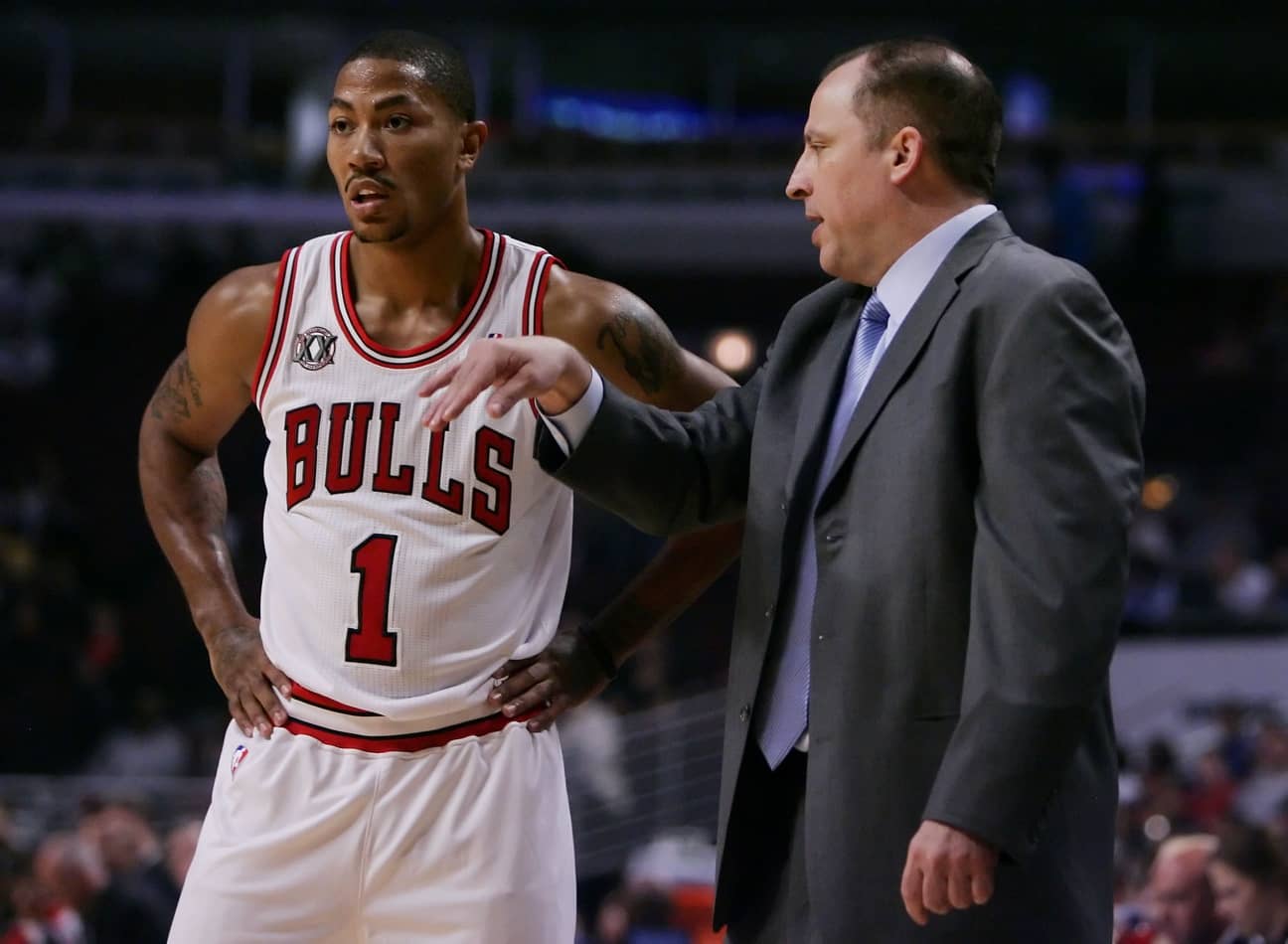
Derrick Rose did not let his jersey retirement night turn into a nostalgia exercise filled with blame, regret, or rewritten narratives. Instead, standing in Chicago with his No. 1 rising into the rafters, Derrick Rose used the moment to set the record straight about one of the most persistent storylines attached to his career: the idea that Tom Thibodeau somehow ran him into the ground.
Rose dismissed that framing outright.
“I know a lot of people don’t like Thibs because of that. But let me tell you, let me tell you, there’s a reason why I say that. People look at Thibs and only see the injury part. But I’m here to say f**k that.”
“There’s a reason why everything is meant to be, bro. Thibs was the first coach I ever had who truly made me feel special when we watched film. I used to do s**t in games just to make sure he saw it on tape, so he knew that between me and him, I picked that play. I know you saw that. I know you saw me read that play.”
“It felt like he loved the game more than me, which he didn’t. Thibs, you may have gone to Harvard, you may have done physics, but I showed you physics.”
For years, Thibodeau has been painted as the villain in Rose’s injury story. Heavy minutes, relentless intensity, and a coach who never eased off the gas. Rose’s response was blunt and emotional. He acknowledged that many people dislike Thibodeau because of the injury narrative, then shut it down completely. To Rose, blaming Thibs misses the entire point of their relationship and what those early Bulls teams were built on.
As a rookie with the Chicago Bulls, Rose played 81 games and averaged 37.0 minutes per game. In his second season, he appeared in 78 games at 36.8 minutes per night. Then came his MVP year in 2010–11, when he again played 81 games, logging 37.4 minutes per game while carrying the entire offense. Those numbers were high, but they were not outliers for a franchise star in that era. Rose was young, explosive, and built around usage and pace.
The playoff minutes are what critics often point to, and Rose never denied that they were heavy. In his rookie postseason run, he averaged 44.7 minutes per game. In his second year, that number was 42.4. During his MVP playoff run, it dipped slightly to 40.6 minutes per game, still enormous but not reckless by early-2010s standards. Rose was the engine of a No. 1 seed. There was no Bulls offense without him on the floor.
That MVP season remains one of the most impressive individual years of the modern era. Rose averaged 25.0 points, 4.1 rebounds, and 7.7 assists, winning MVP at just 22 years old. He did it without another superstar beside him and while leading the Bulls to the best record in the league. Thibodeau’s system leaned on Rose heavily because it had to. Rose did not just accept that role; he embraced it.
Context matters here. Rose’s injuries were devastating and career-altering, but they were not the result of carelessness or neglect. His ACL tear came on a routine play, one he had executed countless times. Rose himself has said before that he played the way he played because that was who he was. He never blamed Thibodeau then, and he refused to do it now, even when public opinion would have welcomed it.
The jersey retirement night was about legacy, and Rose made sure that legacy included honesty. He did not need to protect Thibodeau. He chose to. That distinction matters. It speaks to mutual respect and shared history rather than revisionist narratives.
In a league quick to assign fault, Rose took responsibility for his path and gratitude for the people who walked it with him. By defending Tom Thibodeau on one of the most emotional nights of his life, Derrick Rose reminded everyone that greatness is rarely neat, injuries are not morality tales, and real relationships in basketball are far more complex than minutes played on a box score.