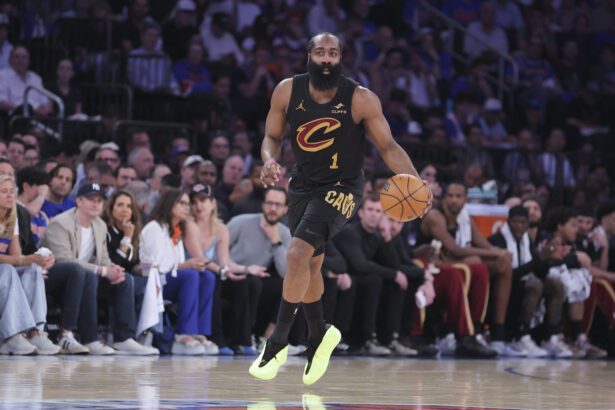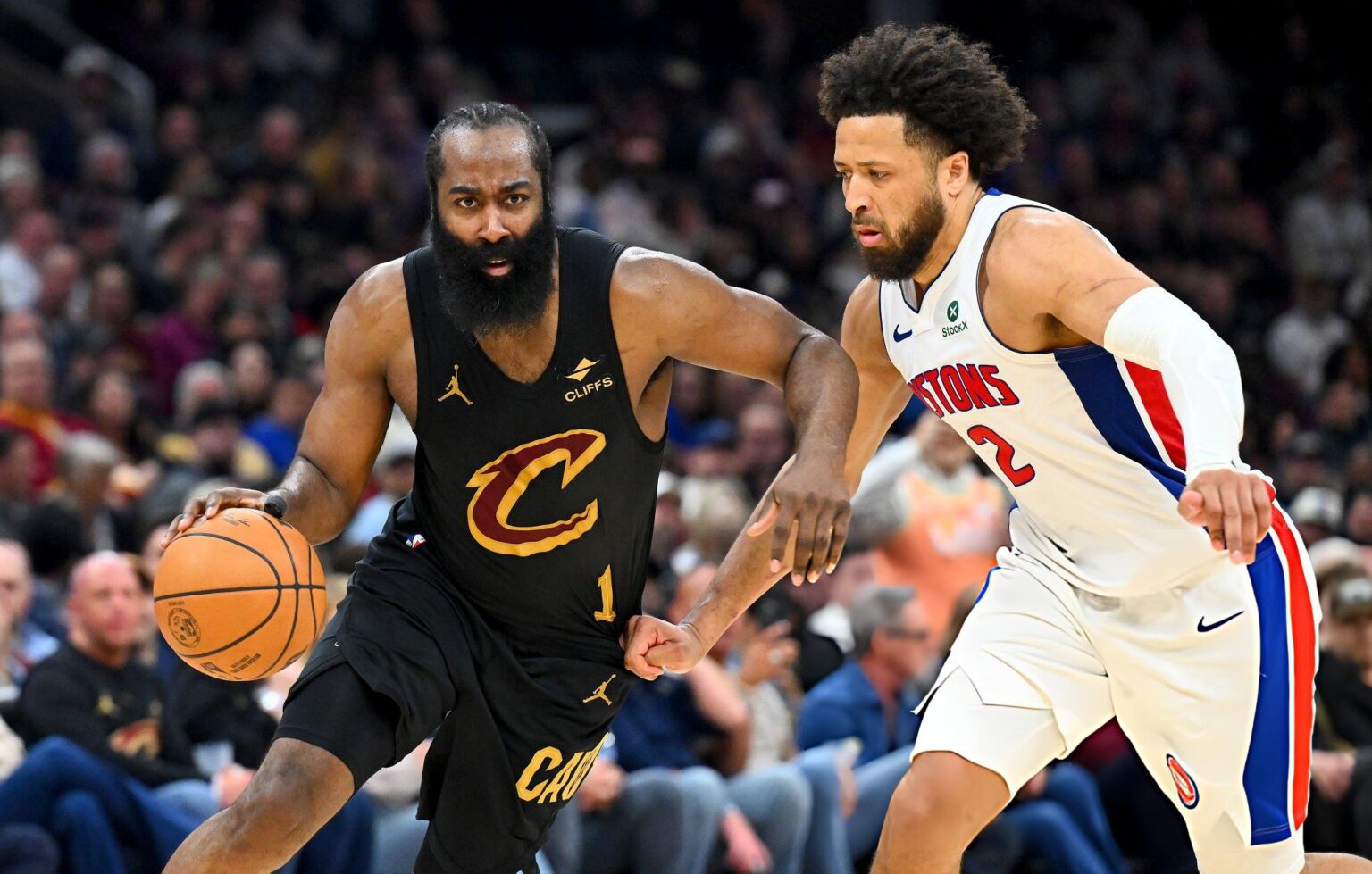
The Cavaliers are down 0-2 against the Pistons in the Eastern Conference Semifinals. Blaming it solely on a potentially injured James Harden would still be too simple. The Cavaliers have also lost the possession battle, failed to defend the 3-point line in Game 2, struggled to get to the rim, gave up too many second chances, and allowed Cade Cunningham to control the pace late in both games.
But Harden is the main individual reason the series feels so bad for the Cavaliers right now. That is the honest answer. His job was not only to score. His job was to organize the offense, calm the game, punish pressure, protect the ball, and give Donovan Mitchell a real second creator. Through two games, he has not done that well enough.
The numbers are harsh. Harden has 32 points, 14 rebounds, 10 assists, and 11 turnovers in the series. He is shooting 9-of-28 from the field and 1-of-11 from 3. That is 32.1% from the field, 9.1% from deep, 47.5% true shooting, and a 33.9% effective field-goal percentage. For a guard playing over 35 minutes per game, those numbers are damaging. The Cavaliers did not trade for a low-efficiency, high-turnover version of Harden. They traded for a veteran who could survive playoff pressure.
Instead, the Pistons have turned him into a pressure point.
Harden’s Offense Has Lost Its Shape
The Cavaliers did not get a disaster from James Harden in Game 1 by normal box-score standards. He finished with 22 points, 8 rebounds, and 7 assists. That looks fine if the game is viewed fast. But the deeper numbers show the problem. Harden shot 6-of-15 from the field, 1-of-7 from 3, and had 7 turnovers. He got to 22 points because he went 9-of-9 from the free-throw line, not because he controlled the game as a scorer. The Pistons forced the Cavaliers into 20 turnovers and turned them into 31 points, and Harden was the worst offender with seven giveaways.
That is the main issue with Harden right now. He is not giving the Cavaliers a good offense. In Game 1, his turnover rate was the whole story. In Game 2, the shooting fell apart, too. He finished with 10 points, 6 rebounds, 3 assists, and 4 turnovers while shooting 3-of-13 from the field and 0-of-4 from 3. He also had a team-worst minus-15. The Cavaliers lost by 10. That does not mean plus-minus explains everything, but it does show how badly his minutes went.
The most concerning part is the ratio between creation and waste. Harden has 10 assists and 11 turnovers in the series. That is a 0.91 assist-to-turnover ratio from the player who is supposed to be the main table-setter. In the regular season with the Cavaliers, he averaged 7.7 assists and 3.2 turnovers while shooting 46.6% from the field and 43.5% from 3. His true shooting was 63.9%. That version made sense. This version is almost the opposite player.
His shot profile also looks wrong. Harden is not beating defenders often enough to create layups, collapse help, and force the Pistons into rotation. He is getting pushed into stepbacks, late-clock passes, and floaters in traffic. When he does get a switch, the Pistons are not panicking. They are sitting on his left hand, loading early, and trusting their size behind the play. Jalen Duren, Ausar Thompson, Tobias Harris, and Cade Cunningham are all big enough to contest without overhelping. That means Harden has to win with separation, and he has not done it.
The 3-point shooting is the most visible problem. Harden is 1-of-11 from deep in the series. That number hurts more because the Cavaliers need him to pull the defense out. When Harden’s stepback is not a real threat, defenders can sit lower, protect the paint, and help earlier on Mitchell. It also changes the timing of the offense. Harden possessions become longer, slower, and easier to load against. The Cavaliers already have spacing problems when Jarrett Allen and Evan Mobley share the floor. Harden missing this badly makes those spacing problems sharper.
His Game 2 second half was even worse than the final line. He scored only 2 points after halftime and went 1-of-3 from the field. Kenny Atkinson said after the game that the Cavaliers cannot have their Hall of Famer take only two shots in the second half, and he took blame for that. But this is not only a usage problem. A player has to demand the ball with force, get to his spots, and create pressure. Harden did not look like a player who was bending the game.
The Cavaliers can survive one bad shooting night. They cannot survive Harden being inefficient, turnover-heavy, passive late, and vulnerable on defense all at once.
The Cavaliers Are Wasting Possessions
Harden is the headline, but the Cavaliers are not down 0-2 only because of one player. The bigger statistical problem is possession math. The Pistons are getting more usable possessions, better 3-point efficiency, and more second-chance pressure.
Through two games, the Pistons have outscored the Cavaliers 218-198. They are shooting 76-of-164 from the field and 24-of-54 from 3. That is 46.3% from the field and 44.4% from deep. The Cavaliers are 70-of-161 from the field and 21-of-70 from 3. That is 43.5% from the field and 30.0% from deep. The gap from 3 is massive. The Cavaliers have taken 16 more 3s, but the Pistons have made three more. That is how a math edge becomes a series edge.
Game 2 made it very clear. The Cavaliers went 7-of-32 from 3, only 21.9%. The Pistons went 14-of-28, exactly 50.0%. That is a 21-point difference from the arc. The final margin was 10. The Cavaliers also went 0-of-11 from 3 in the fourth quarter, which destroyed their comeback chance. Mitchell gave them enough scoring to stay alive with 31 points, but the offense collapsed when the game needed half-court makes.
The advanced team numbers from Game 2 are even more direct. The Cavaliers were at a 107.8 offensive rating, 46.3% effective field-goal percentage, and 12.2% offensive turnover rate. The Pistons were at a 120.2 offensive rating and 57.5% effective field-goal percentage. The Cavaliers did clean up turnovers compared to Game 1, but their shot quality and shot-making were not close to enough.
The rim numbers are also ugly. The Cavaliers attempted only six shots in the restricted area in Game 2, which was in the 2nd percentile. Mitchell took none of his 24 shots at the rim. That is not a normal Cavaliers offense. That is a team being pushed into floaters, pull-ups, and jumpers. The Pistons are keeping the ball in front, staying vertical behind the play, and making the Cavaliers score over bodies.
That connects back to Harden. If he is not getting downhill, the Cavaliers lose one of their best ways to create rim pressure without Mitchell taking every hard possession. Harden was supposed to create slower, smarter offense, but not dead offense. There is a difference. Good slow offense still creates layups, corner 3s, free throws, and weak-side movement. Bad slow offense lets the defense rest.
The rebounding numbers also favor the Pistons. In Game 1, they had 16 offensive rebounds. In Game 2, they had 12. That is 28 offensive boards in two games. The Cavaliers have 20. Duren has been a major part of that. In Game 1, he had 11 points, 12 rebounds, 4 assists, and 7 offensive rebounds. In Game 2, he had 8 points and 10 rebounds. Even when he is not scoring a lot, he is forcing the Cavaliers to finish defensive possessions physically.
The Cavaliers are not losing because they are being destroyed in every category. That is what makes the series more frustrating. Game 1 was tied midway through the fourth. Game 2 was also there to be stolen. But the Pistons have been better in the parts that decide playoff games: fewer wasted possessions, better late-clock creation, more second chances, and more reliable 3-point shooting.
Harden is supposed to help in exactly those parts. That is why he gets the focus.
The Pistons Are Hunting The Right Weaknesses
The Pistons are not defending Harden like a normal star guard. They are defending him like a player they believe they can wear down. That is a very different idea.
J.B. Bickerstaff’s team has size at the point of attack and a lot of long bodies behind it. Cunningham is 6-foot-6 and can see over the floor. Thompson is a strong on-ball defender. Harris is big enough to switch. Duren gives them vertical size. Duncan Robinson is the defender the Cavaliers should attack more, but the Pistons have protected him well enough because the Cavaliers’ offense has not forced enough switches.
The Pistons are also making Harden defend. That is not small. In Game 2, the Pistons sought out mismatches and attacked Harden on defense. That matches the eye test. They put him in actions, made him move, and forced him to guard with effort before asking him to create on the other end. Harden is still strong in the post and can hold up against some wings, but he is not a defender who wants to chase, navigate, stunt, recover, and then run offense for 36 minutes.
The Pistons’ spacing is also making the Cavaliers uncomfortable. Robinson had 19 points in Game 1 and shot 5-of-8 from 3. He followed that with 17 points in Game 2 and shot 5-of-9 from deep. That is 10 made 3s in two games from a role player. He does not need to dominate the ball. He only needs the defense to lose him for one second. The Cavaliers have done that too often with Harden matched up with him.
Tobias Harris has been just as important because he punishes smaller defenders and gives the Pistons another stable scorer. He had 20 points and 8 rebounds in Game 1, then 21 points and 7 rebounds in Game 2. He is not playing like a fourth option. He is playing like a calm playoff forward who knows exactly where his shots are coming from. The Cavaliers do not have a matchup answer when Cunningham is controlling the ball, Robinson is stretching the defense, Duren is on the glass, and Harris is attacking the middle.
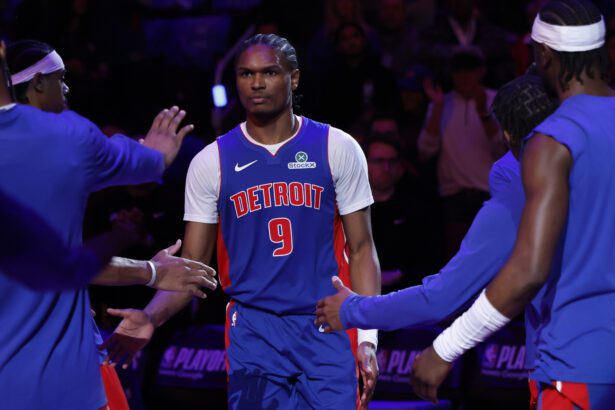
Cunningham is the main reason the Pistons look more organized. He had 23 points and 7 assists in Game 1, then 25 points and 10 assists in Game 2. His efficiency was not perfect in Game 1, but his control was better than Harden’s control. In Game 2, he made the biggest plays late, including 12 points in the fourth quarter. That is the star comparison right now. Cunningham is giving the Pistons late-game direction. Harden is giving the Cavaliers late-game doubt.
This is where the series has become uncomfortable for the Cavaliers. The Pistons are not winning with one trick. They are winning with a complete playoff formula. Cunningham creates advantages. Robinson stretches the floor. Harris scores without needing the whole offense. Duren controls the glass. Thompson brings defensive pressure. Daniss Jenkins has given real bench minutes, including 12 points, 7 rebounds, and 3 assists in Game 1, then 14 points, 6 rebounds, and 4 assists in Game 2.
The Cavaliers have star names, but the Pistons have had clearer roles. That is usually what wins a series when the talent gap is not large.
What The Cavaliers Must Change In Game 3
The Cavaliers do not need to bench Harden or panic. They do need to change how he is used. Harden cannot keep playing as a high-usage, slow-tempo initiator if he is not punishing the defense. That is feeding the Pistons’ plan.
The first adjustment should be more Mitchell-Harden screening actions. Not just one standing in the corner while the other dribbles. They need to force the Pistons to decide who handles the ball, who switches, and who gets targeted. If Cunningham is guarding one and Thompson is guarding the other, the Cavaliers have to make those defenders work through second and third actions. Right now, too many possessions are one-action trips.
The second adjustment is more Harden as a screener. This is uncomfortable for some star guards, but it can work. If Harden screens for Mitchell, the Pistons either switch and let Mitchell attack Harden’s defender, or they show help and open short-roll passing. Harden is strong, smart, and still a good passer. Using him only as the ball-handler makes the Cavaliers easier to read. Using him as a screener can create confusion.
The third adjustment is faster spacing decisions. The Cavaliers cannot take the whole clock to enter offense. Harden is at his best when he controls pace, but that does not mean walking into a loaded defense every trip. The Cavaliers need early drag screens, hit-ahead passes, and quick reversals. If they wait until 12 seconds are left, the Pistons can switch, load up, and live with tough shots.
The fourth adjustment is Allen and Mobley usage. Jarrett Allen was almost invisible in Game 1 because of foul trouble, finishing with 2 points and 3 rebounds in 18 minutes. He was much better in Game 2 with 22 points and 7 rebounds on 7-of-9 shooting. That should tell the Cavaliers something. They need more direct rim pressure through Allen, especially when Harden is struggling to collapse the defense himself.
Evan Mobley is the harder case. He had 14 points, 9 rebounds, and 5 assists in Game 1, then only 9 points and 1 rebound in Game 2. One rebound from Mobley in a playoff game is not acceptable for the Cavaliers. He does not need to become a 25-point scorer every night, but he must impact the glass battle. If the Pistons are winning the glass and the Cavaliers are not getting rim attempts, Mobley has to change one of those things.
The Cavaliers also need Max Strus to be playable as a shooter again. Strus had 19 points in Game 1, then only 3 points in Game 2. He missed four 3s in the fourth quarter of Game 2, and the Cavaliers went 0-of-11 from deep in the period. That cannot happen if the offense already has Harden struggling from outside. The whole structure depends on enough shooting around Mitchell and the bigs.
The defense needs a better plan, too. If Harden is being attacked, the Cavaliers have to decide whether they will switch less, pre-rotate earlier, or protect him with different matchups. They cannot just let the Pistons choose the matchup every trip. That is how a weakness becomes a game plan.
Still, the fix begins with Harden. He does not need to score 35. He needs to give the Cavaliers 18 to 22 points with efficient shot selection, eight or nine assists, and three turnovers or fewer. He needs to make two or three 3s. He needs to make the Pistons guard him above the arc. He needs to avoid the live-ball mistakes that create transition chances. That is the baseline. Anything below that puts too much pressure on Mitchell.
Final Thoughts
James Harden is not the only reason the Cavaliers are down 0-2, but he is the easiest reason to identify because his role is so important. The Cavaliers traded for him to solve playoff offense. Through two games, he has added a new playoff problem.
The Pistons deserve credit. They are the No. 1 seed for a reason. They went 60-22 in the regular season, finished with a +7.53 adjusted point differential, and have defended this series with real size and force. This is not a fluke. The Cavaliers are playing a better team, at least through two games.
But this series is not over because the Cavaliers have been close enough. They were tied in the fourth quarter of Game 1. They took a brief fourth-quarter lead in Game 2. The gap is not impossible. The problem is that the Pistons have been more stable, and Harden has been one of the least stable parts of the Cavaliers’ rotation.
So the answer is yes, but with context. Harden is not alone. The Cavaliers’ spacing, rebounding, rim pressure, fourth-quarter shooting, and defensive matchups all need to improve. But when a star guard has more turnovers than assists and more turnovers than made 3s, while shooting 32.1% from the field and 9.1% from deep, he becomes a central reason. The Cavaliers can still make this a series, but only if Harden stops playing like a pressure point and starts playing like the player they thought they traded for.