The Mavericks didn’t just beat the Knicks on Monday afternoon, they controlled the game from the opening tip and never let go. Playing with poise, pace, and an edge that never wavered, Dallas cruised to a 114-97 win on MLK Day, leading basically the entire afternoon and building the margin as large as 30 points. What was expected to be a grind instead turned into one of Dallas’ most complete performances of the season.
Dallas shot 48.8% from the field and an eye-popping 46.9% from three, turning Madison Square Garden quiet early. New York struggled to find rhythm, finishing at just 40.0% overall and 29.0% from deep. While the Knicks won the rebounding battle, the Mavericks dictated everything else, especially tempo, ball movement, and transition play.
1. Max Christie Delivered A Career-Defining Shooting Night
Max Christie was unconscious from the perimeter and set the tone for Dallas’ offensive explosion. He finished with a game-high 26 points on 9-of-13 shooting and knocked down eight of his 10 attempts from three-point range. Every time New York made a small push, Christie answered with another jumper, often without hesitation and frequently off movement.
Christie’s efficiency stretched the Knicks’ defense beyond its breaking point. His +20 plus-minus reflected how dominant Dallas looked when he was on the floor, and his six rebounds added value beyond scoring. The Mavericks’ spacing opened up completely whenever Christie was stationed on the wing, forcing New York into late rotations and broken coverages.
2. Cooper Flagg Looked Comfortable Carrying Responsibility
In just under 29 minutes of playing time, Cooper Flagg showed great determination once again, finishing with 18 points, seven rebounds, and three assists. Flagg attacked mismatches and was tactically aggressive, going 7-of-14 from the floor. He put the ball on the deck and slipped into space, playing off the ball.
Flagg was visibly calm and composed, which was mixed with confidence. Posting a +21, the best of the game, and playing with four turnovers, he was never rattled. He contributed, and Dallas was able to maintain control when the Knicks tried to gain tempo, and he was able to do it without putting too much pressure on the offense.
3. Naji Marshall Quietly Filled Every Column
At first glance, it was hard to see the overall impact Naji Marshall had on the game, and his stats didn’t pop off the chart. He scored 19 points and had 8 boards and 4 assists in 33 physical minutes, which is a lot on the wing. When he drove the lane, he finished through contact, and he was just finishing over the top when he made a timely read to help New York on the paint.
Marshall was able to help New York’s guards a little slower, and his presence helped to disrupt the passing lanes. He helped to slow down the perimeter creators. His -15 plus/minus showed the influence on both ends of the floor, and that steady presence help the Dallas rotations to stay active without overextending anyone’s workload.
4. The Mavericks Won The Game With Speed And Space
Dallas’ transition offense was a decisive factor, outscoring New York 32-4 on the fast break. The Mavericks pushed the ball relentlessly, turning rebounds and steals into immediate scoring opportunities. That pace forced the Knicks into rushed decisions and contributed to their 17 turnovers.
The ball movement followed suit. Dallas recorded 25 assists on 40 made baskets, swinging the ball side-to-side until quality looks emerged. Their 15 made threes weren’t the product of isolation, but rather the result of consistent drive-and-kick action and unselfish reads.
5. New York Never Found Its Offensive Identity
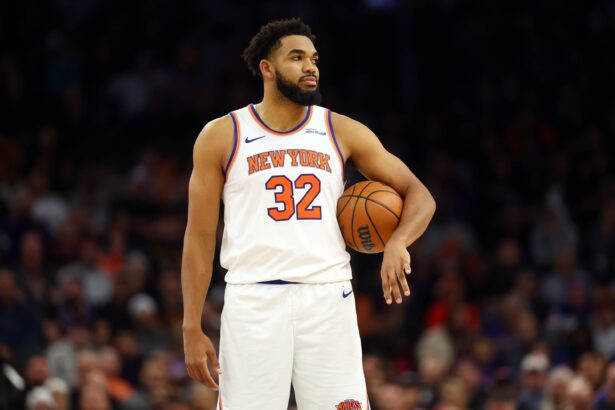
While Karl-Anthony Towns battled with 22 points and 18 rebounds, the Knicks struggled everywhere else. Jalen Brunson finished with 22 points but needed 24 shots to get there, and Mikal Bridges managed just seven points on 3-of-10 shooting. As a team, New York shot 9-of-31 from three and rarely generated clean looks late in the shot clock.
The lack of spacing and rhythm was evident. Despite winning the offensive rebounding battle 17-7, the Knicks failed to convert second-chance opportunities efficiently. Dallas’ defensive discipline kept New York chasing all afternoon, and by the time the fourth quarter arrived, the outcome had long been decided.