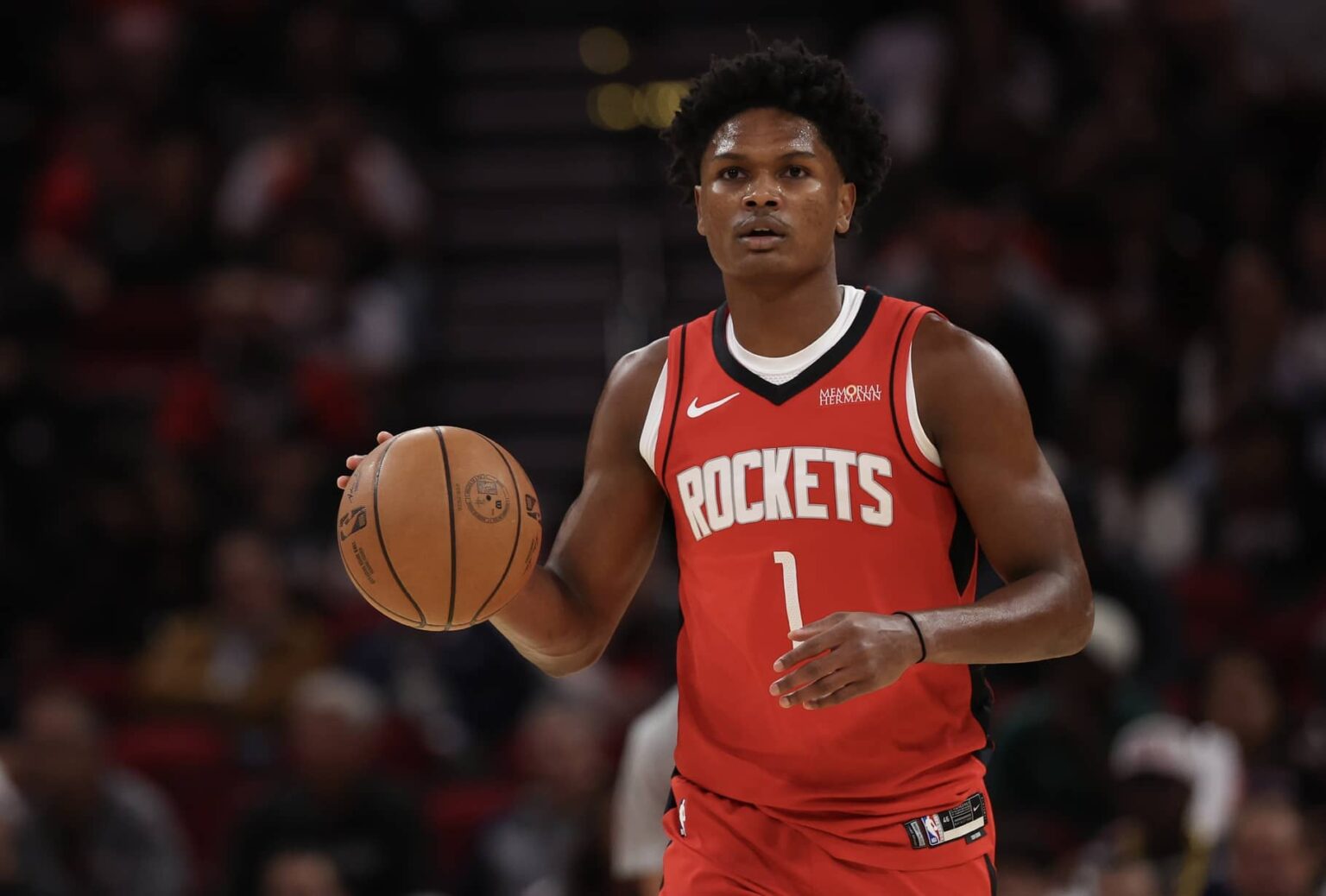
The Rockets’ season ended with a 98-78 loss to the Lakers in Game 6, and that result changed the tone around every major offseason decision. The team went from a strong regular season to another first-round exit, with Kevin Durant missing five of six playoff games because of an ankle injury and the offense falling apart in the closeout loss. The Rockets shot only 35.0% from the field, made just five threes, and never found enough half-court scoring once the Lakers took control. Amen Thompson still led the team with 18 points, eight rebounds, and three blocks, but the loss made the roster questions louder.
One of those questions is now about Thompson himself. Fans are split because the number is massive. The Athletic’s Sam Amick and Will Guillory reported that Thompson is expected to sign a lucrative extension that could reach five years and more than $250.0 million. Fadeaway World already covered this topic in February, when the debate was more theoretical. Now it is real because the Rockets are coming off elimination, Thompson is extension-eligible, and the franchise has to decide if he is already worth star money before the jumper fully arrives.
This is not an easy yes or no. Thompson is not just a young player. He averaged 18.3 points, 7.8 rebounds, 5.3 assists, and 1.5 steals while shooting 53.4% from the field. He also shot only 21.6% from three. That is the whole debate in one line: elite body, elite defense, elite open-floor force, but still a limited shooter.
Amen Thompson’s Archetype Is Extremely Valuable
The strongest case for paying Thompson is not based on scoring average. It is based on player type.
He is already a rare NBA archetype: elite perimeter defender, high-level transition engine, big guard rebounder, and secondary playmaker. That combination is hard to find. It is also hard to replace. Teams pay for this kind of player early because if the offense improves even a little, the contract can look cheap in two years.
Thompson is 6-foot-7 with a 7-foot wingspan. He defends guards and wings, rebounds like a forward, runs the floor like a track athlete, and passes well enough to keep the offense moving. He averaged 18.3 points, 7.8 rebounds, and 5.3 assists with a +2.5 BPM, a strong positive-impact player with dominant rebounding and strong defense.
The defense is the first reason. Thompson is already close to an All-Defense level player. He can pressure the ball, switch actions, recover after mistakes, and create turnovers without needing the offense to be built around him. His 1.5 steals per game do not fully explain his impact because he changes the shape of possessions. Ball-handlers feel him early. Wings do not get easy catches. Weak-side passes are harder because of his length.
That matters most in the playoffs. The Rockets want to be a physical, defense-first team under Ime Udoka. Thompson fits that identity better than almost anyone else on the roster. He gives them pressure at the point of attack, rebounding from a guard spot, and the ability to guard high-usage players without needing extra help every possession.
The transition value is also real. Thompson is one of the league’s best grab-and-go players. He does not need an outlet pass. He can rebound, push, force backpedaling defenders into mistakes, and either finish or hit the first open teammate. That helps a Rockets team that can get stuck in the half-court when the spacing is tight.
His playoff series against the Lakers showed both sides of the argument. Thompson averaged 19.2 points, 7.0 rebounds, 5.7 assists, 2.0 steals, and 1.2 blocks in 44.2 minutes per game. Those are star-level activity numbers in a difficult matchup. He played huge minutes, defended, attacked, and kept competing even when the offense had problems.
The issue is the half-court offense. Thompson is not yet a reliable shooter, and defenses know it. He attempted only 1.5 threes per game in the regular season and made 21.6%. That affects spacing around Alperen Sengun, Kevin Durant, Reed Sheppard, Jabari Smith Jr., and Fred VanVleet. When the Rockets play Thompson with non-shooting bigs, the paint becomes crowded. When the Rockets play him with enough shooting, his driving and passing look much better.
That is why the extension is so divisive. If Thompson becomes even a 33.0% or 34.0% three-point shooter on honest volume, he is a max-level player. If he stays near 21.0% on low volume, the Rockets are paying $250.0 million for a player opponents may still ignore beyond the arc in playoff games.
But teams do not only pay for what a player is today. They pay for what they believe is coming. Thompson’s free-throw percentage, 77.9%, gives some hope that the touch is not broken. His finishing is already efficient. His passing is advanced enough. His defense is already elite. The jumper is the missing piece, not the whole game.
That is why the Rockets have to take the risk seriously. There are not many young players who can impact games without shooting. Thompson does. That gives him a very high floor. If he adds a real jumper, the ceiling is much higher than a normal defensive wing.
The Rockets’ Timeline Forces Early Commitments
The Rockets cannot treat Thompson like they are still a slow rebuild. That phase is gone.
They went 52-30, finished fifth in the West, ranked first in rebounds at 48.1 per game, fourth in opponent points allowed at 110.0, and fifth in defensive rating at 107.4. This is already a winning team. It is not a group waiting five years to become serious.
That changes the contract talk. When a young team starts winning, the front office has to make decisions before every player becomes expensive at once. The Rockets already extended Smith on a five-year, $122.0 million deal. Sengun is on a major $185.0 million extension. Eason is heading into restricted free agency. Sheppard is still on his rookie deal, but his number rises later. Durant is owed $43.9 million in 2026-27. VanVleet has a $25.0 million player option. Steven Adams and Dorian Finney-Smith are also on the books.
That is the cap cliff problem. If the Rockets wait too long, every negotiation becomes harder because agents know the team is already boxed in. If Thompson reaches restricted free agency after another jump, cap-space teams can create pressure with an offer sheet. The Rockets would still have matching rights, but they would lose control of the number, structure, bonuses, and timing.
Restricted free agency is not fake leverage anymore. Teams with room can make contracts uncomfortable. They can include player-friendly structures, front-loaded money, or shorter-term pressure. The Rockets would probably match anyway, but they may end up paying the same max without the benefit of early control.
That is why an extension this summer makes sense. The Rockets would buy certainty. Thompson would get security. The front office would know the real long-term cost of its core before making the next big trade decision.
There is also a basketball reason to do it early. Thompson has already become part of the team’s identity. He started 79 games, played 37.4 minutes per game, and finished the season with a plus-368 on-court plus-minus. Those are not small-use numbers. Udoka already trusts him like a core player.
The Rockets also need to decide what Thompson’s role is. Is he the long-term point forward? Is he a defensive wing who plays off Sengun and Durant? Is he the future lead ball-handler if VanVleet declines or leaves? That answer affects everything.
The best version is probably not Thompson as a classic point guard. He is more dangerous as a pressure player: defend, rebound, push pace, screen, cut, pass, and attack gaps. Let VanVleet and Sheppard handle more of the shooting. Let Sengun create from the elbows. Let Durant or another star handle late-game isolations. Thompson can still create without being forced into a traditional point guard role every possession.
That is why paying him can still be correct even if the offense is incomplete. He does not need to become Luka Doncic to justify a huge deal. He needs to become a two-way playoff force who can stay on the floor in any lineup. That means average shooting, stronger half-court reads, better free-throw pressure, and fewer empty drives.
The Rockets’ mistake would be paying Thompson and then building the roster as if his shooting problem is solved. It is not. A max extension should come with a roster plan. Thompson needs spacing around him. Sengun needs spacing around him. If the Rockets pay both and then keep stacking non-shooters, the playoff offense will stay tight.
That is the real risk. Not Thompson alone. The ecosystem around Thompson.
A Thompson max works if the Rockets treat him like a special player who needs the right offensive environment. It becomes dangerous if they pay him as a finished superstar and ignore the flaws.
What A Fair Amen Thompson Contract Should Look Like
The full max is easy to understand emotionally. Thompson is young, productive, elite defensively, and still improving. If the Rockets believe he will become an All-NBA-level player, they should not play games. Pay him now and live with the number.
But a fair contract should still reflect the shooting risk.
A five-year deal around $250.0 million would put Thompson near $50.0 million per year. That is star money. It is not “high-end starter” money. Once a player gets paid like that, the standard changes. He cannot just defend and run. He has to bend playoff series.
That is where the Rockets have to be careful. Thompson has never made an All-Star team. He has never shown reliable three-point shooting. He has not yet proven he can be a primary playoff creator. Those are not small details. They are the difference between a max player and a very good young player.
The best argument for the max is the future cap. A $250.0 million deal sounds huge, but the cap keeps rising. If Thompson becomes a 22-point, eight-rebound, six-assist player with All-Defense impact and playable shooting, that contract will age fine.
The argument against the max is playoff history. A $250.0 million player cannot let defenses ignore him. In the regular season, Thompson can beat teams with speed, rebounding, cuts, and transition. In the playoffs, the court gets smaller. Defenses help earlier. Non-shooters get exposed faster. The Lakers series did not destroy Thompson’s case, but it showed why the jumper is still the central issue.
So what is fair?
The Rockets should aim for a five-year deal, but not a fully guaranteed straight max if they can avoid it. Something in the five-year, $215.0 million range would be ideal for the team. He’d start at $36.6 million in the first year, ending at $49.9 million in the last season. That would still pay Thompson like a cornerstone, but it would leave some space between him and the full 25.0% max. The problem is that Thompson’s side may have little reason to accept that if the team already expects a $250.0 million-plus number.
A more realistic compromise is a five-year max framework with performance protections. The Rockets could include incentives tied to All-NBA, All-Defense, games played, three-point volume, or team success. They could also push for no player option, or at least keep the fifth year under team control. The structure may be more important than the headline number.
The team should not offer a shorter deal. That would be a mistake. If the Rockets believe in Thompson, they need five years. A four-year deal gives him another negotiation too soon and reduces the value of paying early. The full point of extending now is long-term control.
Comparisons help. Smith’s five-year, $122.0 million extension was a team-friendly bet on a young forward. Sengun’s deal is much larger because he is already a more polished offensive hub. Thompson sits in a different category. He is not as skilled offensively as Sengun, but his two-way ceiling may be higher because he can defend premium matchups and create offense without needing plays called for him.
That is why $180.0 million would be too low, $250.0 million is aggressive, and $215.0 million feels like the friendliest team number. But the market may not care about clean logic. If Amick and Guillory are right that a five-year, $250.0 million-plus deal is expected, then the Rockets may already be prepared to bet on the upside.
I would pay Thompson, but I would try hard not to give him the full max without protections. If the only way to keep him happy and locked in is the max, I would still do it before letting the situation reach restricted free agency. The Rockets cannot risk losing leverage on one of the few young players in the league with this defensive ceiling.
But the deal has to come with pressure. Thompson needs to shoot more threes, not just make more. He needs to become a better late-clock decision-maker. He needs to turn his athletic gifts into half-court value when defenses build a wall. If he does that, the money works. If he does not, the Rockets will be paying a rare player who is still hard to use in the most important offensive possessions.
Final Thoughts
The Rockets should pay Amen Thompson, but they should understand exactly what they are buying.
They are not paying for a finished offensive star. They are paying for a rare two-way player who already defends at an elite level, rebounds like a forward, passes well, runs the floor, and still has a clear path to become much better.
That is worth a major extension. The only question is structure.
A five-year deal around $215.0 million would be best for the team. A five-year max near $250.0 million is risky, but still defendable if the Rockets believe the jumper will improve. The worst option is waiting too long and letting another team help set the price.
Thompson is not perfect. But players with his body, defense, motor, and playmaking rarely become available. The Rockets should bet on him, then build the roster with enough shooting to make that bet work.