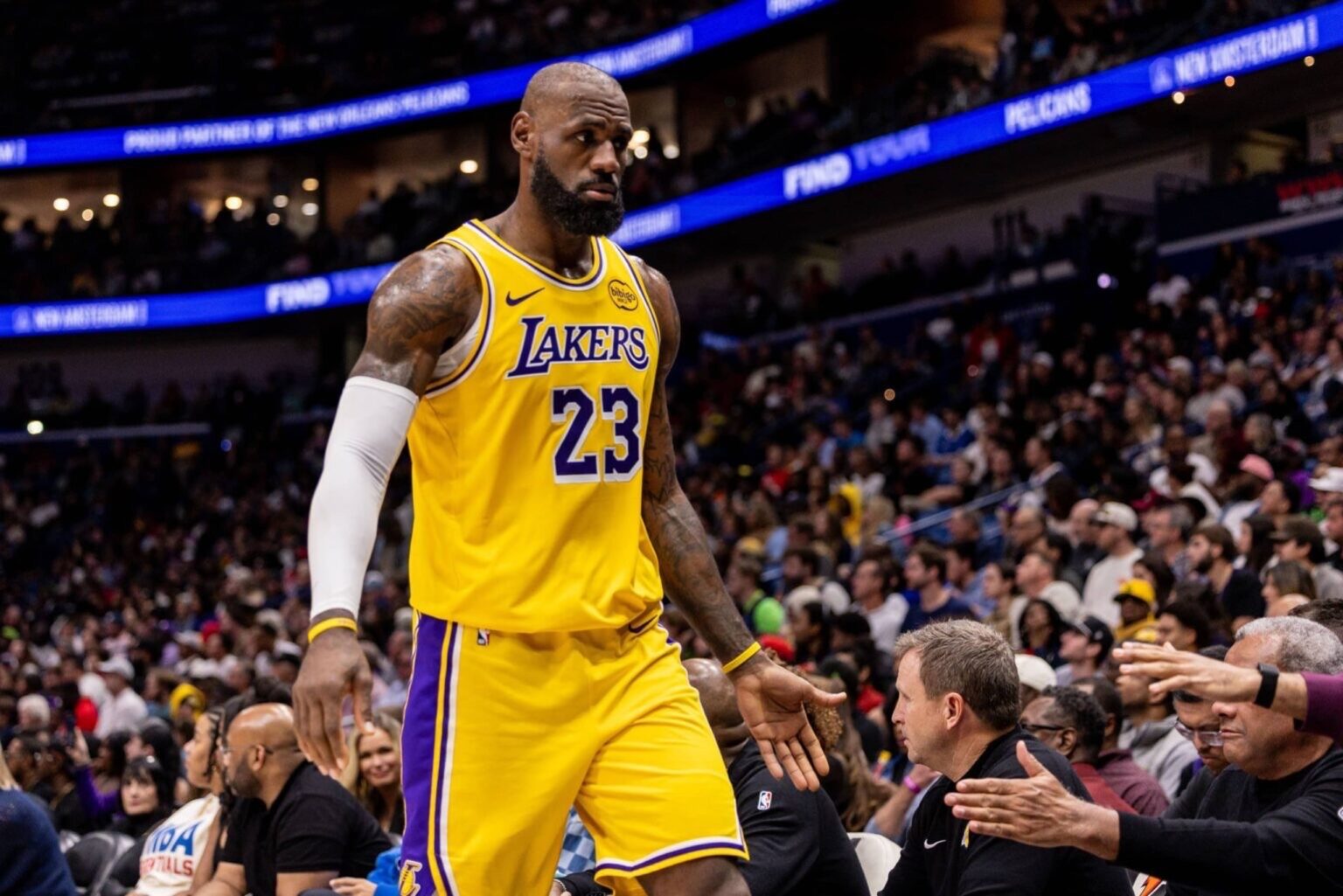
LeBron James is approaching another offseason where the biggest question is not only whether he keeps playing, but what price he is willing to attach to it. James is making $52.6 million this season, and he will control the next step. He can keep his earnings near the top of the market, or he can take less to give a team more room to build a deeper roster around him.
The pay-cut discussion started with reporting tied directly to the Lakers. ESPN’s Brian Windhorst said on ESPN programming that the Lakers are “almost certainly” going to ask James for a potentially significant reduction if he wants to return for another season, framing it as a cap-and-roster necessity rather than a statement about his value.
The same idea has followed James on the Cavaliers side, but with a different constraint. Windhorst has also said publicly that a Cavaliers reunion only becomes realistic if James is willing to come “at a discount” close to $48.7 million, because the team might be able to just sign him on a minimum deal, or a mid-level exception at best.
That is the context for this list. In the current cap system, aggressive discounts are becoming a legitimate roster-building tool, not just a rare gesture. If James decides fit matters more than the number, he could produce the most significant pay cut of this era.
Here are the most aggressive pay cuts in recent NBA history, the ones that materially changed a team’s options and, in some cases, its championship odds.
Honorable Mention
Bradley Beal – $44.7 million
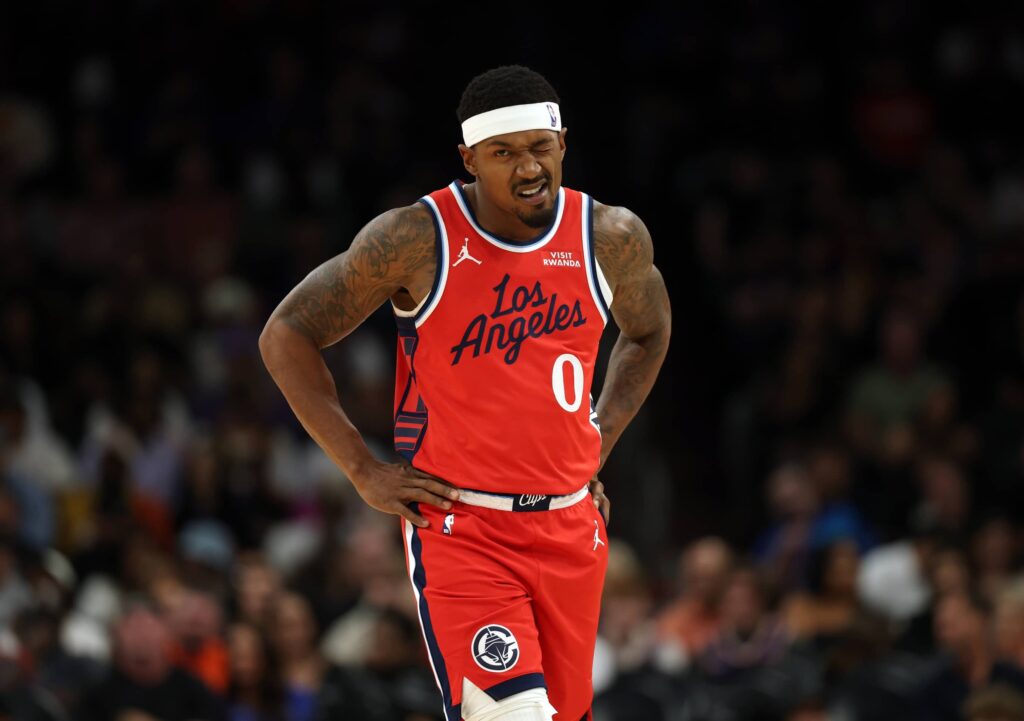
Bradley Beal’s “pay cut” is not the classic version where a star voluntarily leaves money on the table to open cap space. Beal arrived on the Suns still attached to the five-year, $251 million contract he originally signed with the Wizards in July 2022, including the rare no-trade clause that limited trade pathways once the fit deteriorated.
By the summer of 2025, Beal had two seasons left and roughly $110 million remaining. Beal was on the books for $50.2 million in 2024-25, after making $46.7 million in 2023-24. That is a max-slot number for a player who, by that point, had played 53 games in each of his two seasons with the Suns.
Beal eventually agreed to a buyout this past summer, after the Suns moved Kevin Durant to the Rockets. ESPN reported he gave back nearly $14 million to finalize the buyout process. The Suns then used the stretch provision to distribute what remained as dead money across five years, effectively turning a short-term salary hit into an annual charge of around $19 million instead of keeping it concentrated over two seasons.
For Beal, the financial reset was immediate and stark. He would sign with the Clippers on a two-year, $11 million deal with a player option for 2026-27, so he turned a $50.2 million salary into barely $5.6 million just a summer after.
Then the 2025-26 season turned into the downside case. On November 12, ESPN reported Beal suffered a left hip fracture and would undergo season-ending surgery, with an estimated recovery window of six to nine months, while he was also working back from offseason knee surgery and had opened the season at career-low production over a small sample.
That is why this is an honorable mention. The “pay cut” was real, but it was driven by buyout mechanics, availability risk, and the Suns’ need to escape a restrictive roster spot as much as any pure sacrifice narrative.
5. Klay Thompson – $27.3 million
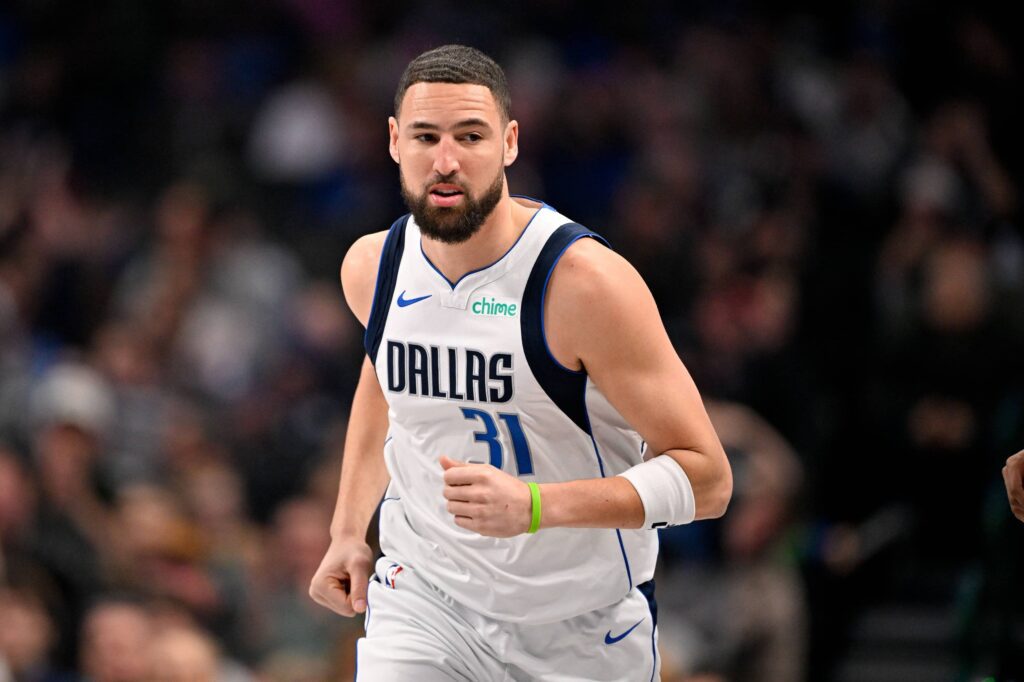
Klay Thompson’s move from the Warriors to the Mavericks is one of the cleanest examples of a true pay cut in the modern NBA, both in raw dollars and in what it signaled about where he was in his career. Thompson made $43.2 million in 2023-24 on the final season of the five-year deal he signed in 2019.
A year later, he was no longer operating in that financial tier. Thompson joined the Mavericks on a three-year, $50 million contract that was executed via sign-and-trade, ending his long run with the Warriors and landing him on a deal built around mid-level starter money rather than max-level salary slots. That is where the “pay cut” framing becomes real.
Even if you look at the contract as an average annual value of $16.7 million, the immediate drop from $43.2 million is massive. In practical terms, this is the type of discount a player only takes when he is prioritizing fit, role, and contention over extracting the last dollar from the market.
The on-court context supports why the market moved that way. In 2023-24, Thompson averaged 17.9 points, 3.3 rebounds, and 2.3 assists in 77 games, while shooting 43.2% from the field and 38.7% from three. Those are still useful numbers, especially for a high-volume spacer, but they were attached to a season in which his nightly impact fluctuated more than it did at his peak. The Warriors’ version of Thompson had become more dependent on rhythm and matchup, and less capable of consistently solving possessions when the shot was not falling.
The Mavericks were a logical landing spot because they could reduce the burden. Thompson did not need to be a primary creator there. He needed to be a movement shooter who punished help and gave the offense a second elite gravity threat next to the team’s top engines. The first season reflected that narrower job description. In 2024-25, Thompson averaged 14.0 points, 3.4 rebounds, and 2.0 assists, with 41.2% shooting from the field and 39.1% from three in 72 games.
This is why Thompson belongs on any list like this. The pay cut was not cosmetic. It was a structural shift from max-level compensation to a salary slot that better matched his current usage and consistency, while also giving the Mavericks a cleaner pathway to stack complementary pieces around its star.
4. Kyle Lowry – $26.4 million
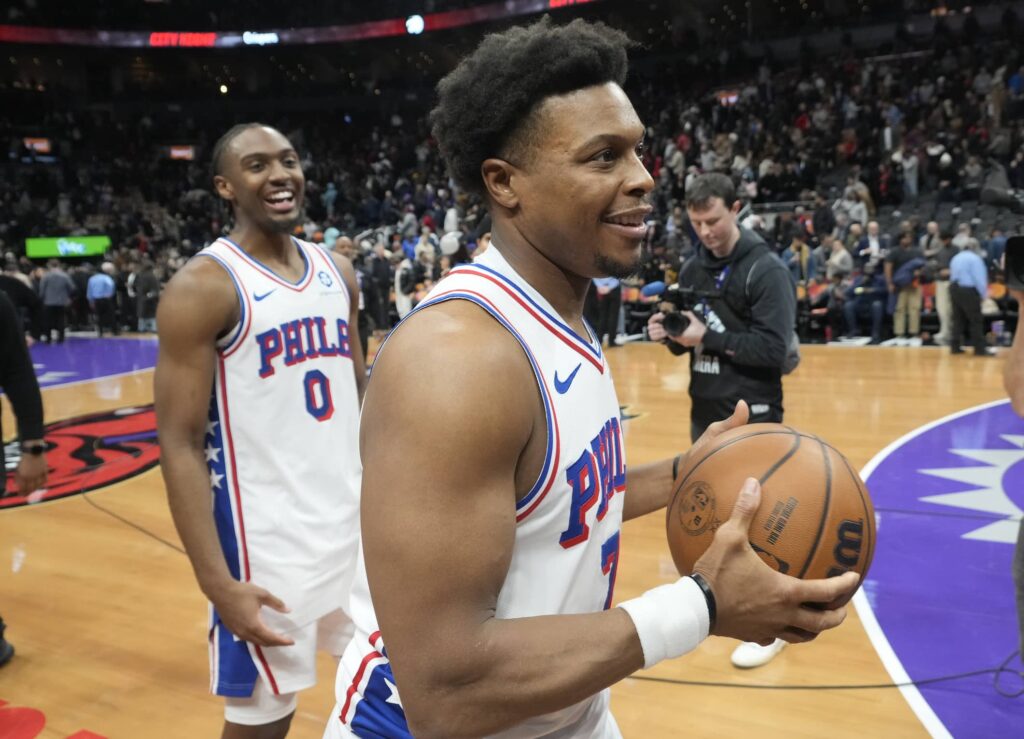
In 2023-24, Kyle Lowry was on the final season of the contract he signed with the Heat, carrying a $29.7 million salary. That number mattered more than his box score at that stage, because it functioned as a trade vehicle. The Heat ultimately moved Lowry to the Hornets in the Terry Rozier deal, and the next phase was almost immediate: Lowry reached a buyout agreement and joined the 76ers after the deadline.
The financial drop was steep. ESPN’s reporting at the time noted Lowry had $10.6 million left on that $29.7 million salary before the buyout. Then he signed with the 76ers on a one-year deal worth $2.8 million for the stretch run. Even accounting for the fact that minimum contracts are prorated when signed midseason, the theme is clear: Lowry moved from max-contract salary territory to minimum-contract in one step.
His next contract locked the “pay cut” in place. In July 2024, Lowry re-signed with the 76ers on a one-year, $3.3 million minimum deal. That is the clean 2023-24 to 2024-25 comparison: $29.7 million to roughly $3.3 million, a shift of about $26 million in listed annual salary.
On the court, Lowry still provided functional minutes in 2023-24, averaging 8.1 points, 3.2 rebounds, and 4.2 assists in 60 games across his stops. But the market was already treating him more as a veteran than a lead guard. By 2024-25, his role narrowed further, and his production reflected it, with averages of 3.9 points, 1.9 rebounds, and 2.7 assists.
This is why Lowry belongs on a pay-cut list. The league did not view the drop as symbolic. It viewed it as a correction, from an expiring max-slot salary used for transactions to a minimum-slot salary used for bench competence, leadership, and situational playoff utility.
3. Kevin Love – $25.8 million
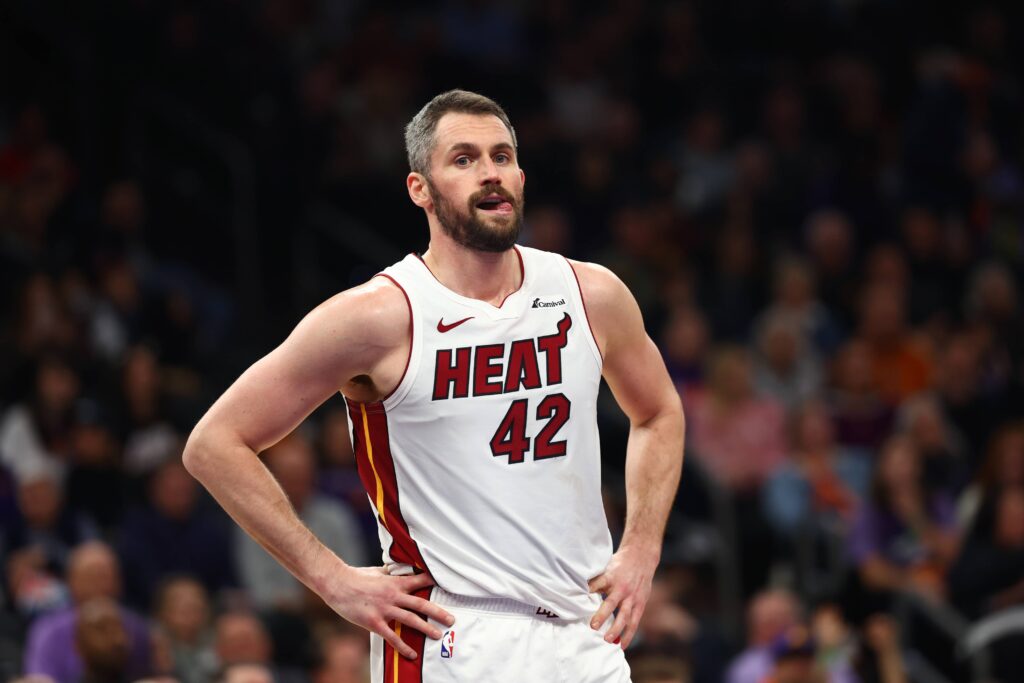
Kevin Love was making roughly $28.9 million in 2022-23 on the last season of the four-year, $120 million extension he signed back in 2018 with the Cavaliers. That salary made sense when he was still a central piece. By 2022-23, it did not. His role had shrunk, he was out of the regular rotation for long stretches, and the Cavaliers and Love’s camp moved toward a buyout around the All-Star break.
Once the buyout happened, the market reset immediately. Love signed with the Heat for the rest of the 2022-23 season on a deal worth $3.1 million. That is the pay cut in plain terms: from about $28.9 million with the Cavaliers to $3.1 million with the Heat, a drop of roughly $25.8 million in listed salary. It was not a small discount to help a team sign another player. It was a complete change in how the league valued him.
The reason is simple. At that stage, teams were not paying Love for star production. They were paying for a specific role. The Heat wanted him as a floor-spacing big who could rebound, make quick reads, and survive playoff minutes next to high-usage creators. That profile is useful, but it is not a max-salary profile. So his contracts started to look like “keep him around” deals rather than “build around him” deals.
Love then stayed with the Heat beyond that first post-buyout run. In June 2024, reporting indicated he declined a $4.0 million player option to sign a new two-year deal worth a little over $8.0 million. Again, those numbers underline the point. Once he left the Cavaliers, he never returned to anything close to the $20-plus million tier.
That is why Love ranks so high on a list like this. The pay cut was extreme, and it came with a clear message: he went from max-contract salary to specialist salary, almost overnight.
2. Blake Griffin – $29.8 million
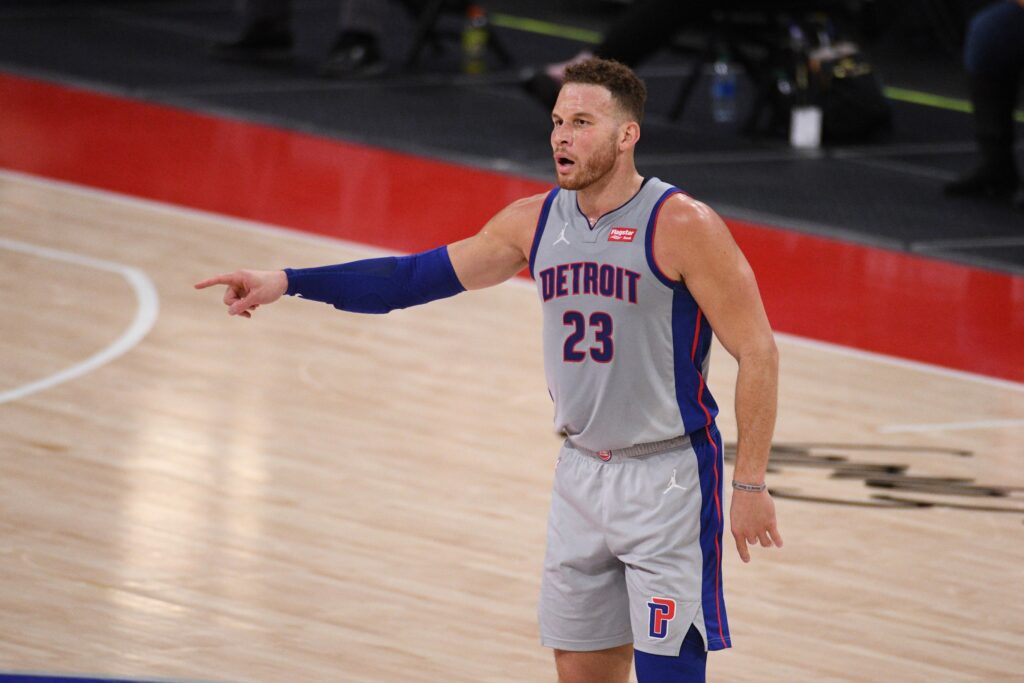
The setup starts in March 2021, when the Pistons and Blake Griffin agreed to a contract buyout. The reporting at the time made the motivation obvious: trading him was basically impossible because of the money left on the deal. Griffin was owed $36.6 million for the rest of the 2020-21 season and $39.0 million for 2021-22. The buyout was the only path that let the Pistons clear the roster situation and let Griffin pick a new team.
In 2021-22, Griffin was technically a minimum player after signing for the Nets as a free agent, but he was still receiving most of his cash from the Pistons because of the buyout structure.
His salary breakdown for that period would be $32.4 million, as he earned over $29 million from the Pistons, plus $2.6 million from the Nets’ salary. The league was not paying him like a $30-plus million player anymore, but the old contract money was still making him earn almos max-money.
His 2021-22 production matched the “minimum veteran” reality. Griffin averaged 6.4 points, 4.1 rebounds, and 1.9 assists in 56 games, playing 17.1 minutes per night. That is a functional bench line. It is not star output, and it is not even guaranteed rotation output on a contender.
Then came 2022-23, when the financial picture finally became straightforward. Griffin signed a one-year minimum deal with the Celtics worth $2.9 million, which is the clean number you can put next to the 2021-22 pay year. His role narrowed again, and the stats reflected it: 4.1 points, 3.8 rebounds, and 1.5 assists in 41 games, down to 13.9 minutes per game.
That is why Griffin ranks this high. He went from a $32.4 million total average in one season to a $2.9 million deal with the Celtics as his last NBA stop. Once his buyout deal was over, Griffin faced the raw reality of his role in the league.
1. Russell Westbrook – $43.3 million
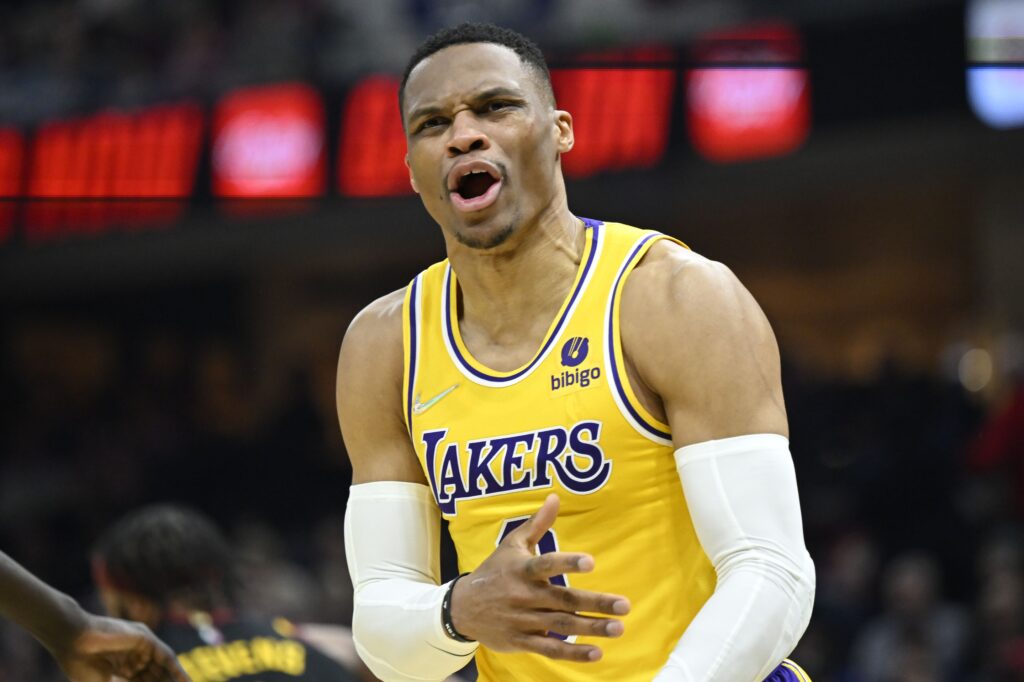
Russell Westbrook entered 2022-23 on a massive expiring number with the Lakers after exercising his player option for $47.1 million. That salary was never going to match his role long-term, and once the season slid toward the trade deadline, the money became the story as much as the player.
At the deadline, Westbrook was moved to the Jazz, and the next step was the key: he negotiated a buyout so he could become a free agent and pick a team. Reporting around the signing noted he had roughly $13.2 million left on the deal at the time the buyout was being finalized. After that, he joined the Clippers on a rest-of-season contract, essentially the minimum tier once you prorate it for late February.
The on-court production in 2022-23 still looked like a high-usage guard, which is part of why the pay cut stands out so sharply. Across 73 games between the Lakers and Clippers, Westbrook averaged 15.9 points, 5.8 rebounds, and 7.5 assists, while shooting 43.6% from the field and 31.1% from three. That is not peak Westbrook, but it is real creation volume, and it is why teams kept believing he could still swing possessions even if the efficiency came and went.
Then the pay cut becomes “clean” in 2023-24. Westbrook re-signed with the Clippers on a two-year, $7.8 million deal that included a player option, and the first-year salary was $3.8 million. That change explains how quickly his market shifted: from $47.1 million in 2022-23 to $3.8 million in 2023-24, a drop of $43.3 million in one year.
His 2023-24 stat line matched the new contract slot. Westbrook averaged 11.1 points, 5.0 rebounds, and 4.5 assists in 68 games, with 45.4% shooting from the field and 27.3% from three. The minutes and usage fell, the scoring fell, and the shooting profile stayed volatile. The Clippers were no longer paying for star output. They were paying for a bench engine who could change pace, pressure the rim, and survive in a reduced role.