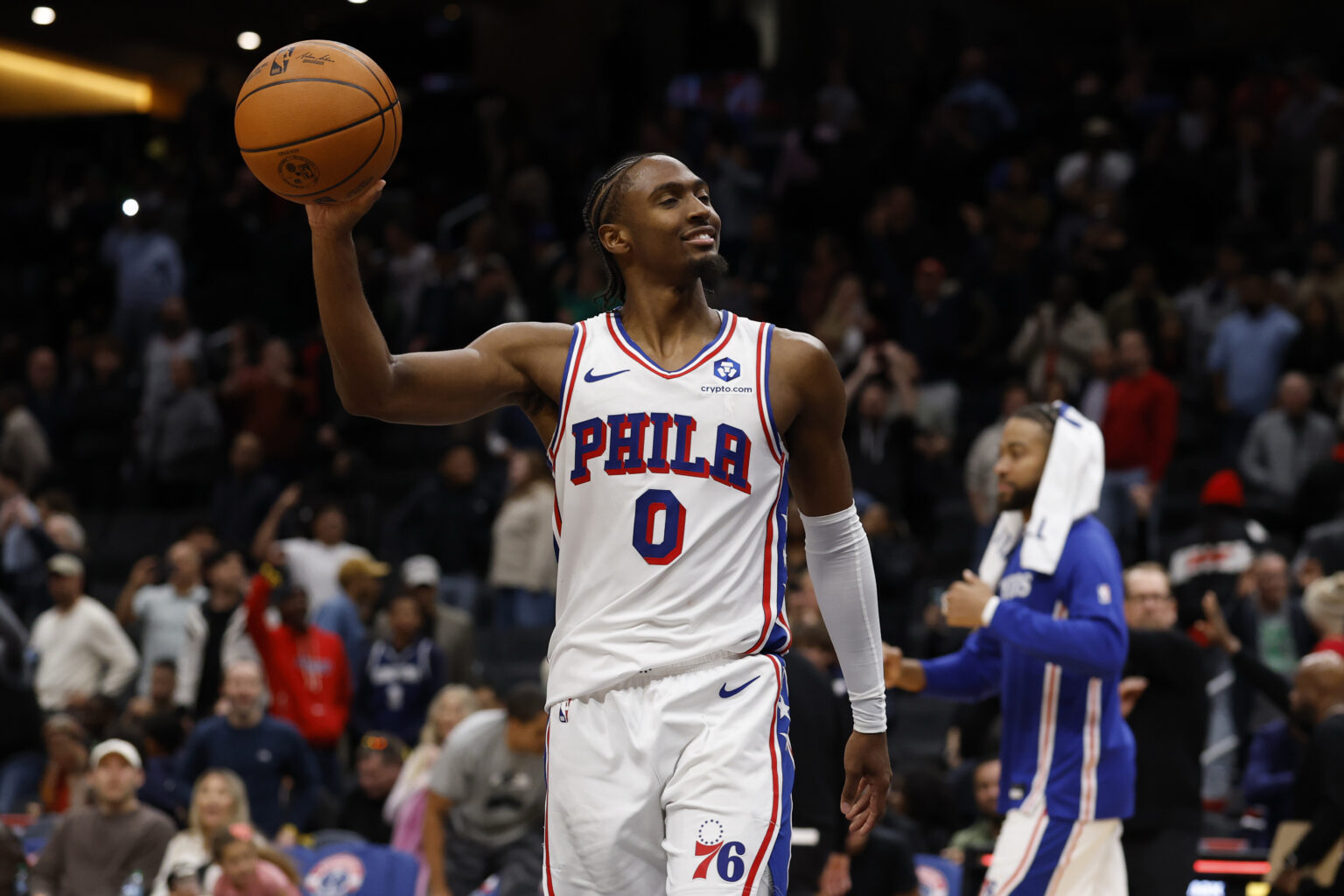
The Philadelphia 76ers have been one of the strangest good stories in the East this season, mostly because it is not loud. There is no nightly “statement game” campaign. No constant chaos. They are just stacking real wins, sitting at 24-19 and fifth in the East, and doing it with a team profile that looks a lot more sustainable than people want to admit.
This is not some fluky heater either. Their advanced profile is basically a playoff team’s baseline. A 115.6 offensive rating, a 114.3 defensive rating, and a +1.3 net rating does not scream “best team in the league,” but it absolutely screams “legit.”
And when you start digging into the nerd stuff, you can see exactly why it is working. It is not one trick. It is geometry. It is possession economy. It is a guard-star engine that creates advantages, a center-star gravity well that bends entire defensive schemes, and a roster that is finally doing the small things that decide two-point games in January and decide series in April.
This Is A Legit Postseason Team
Start with the boring team-wide stat line, because it tells you what kind of basketball they are playing.
The 76ers are scoring 116.8 points per game and allowing 115.5. They are shooting 45.6% from the field and 35.5% from three. They get to the line 25.6 times per game and hit 81.6% there. They average 44.2 rebounds, 24.7 assists, and 14.1 turnovers per game, and they create 9.1 steals per night.
That mix matters. Their offense is not elite, but it is modern and efficient enough to travel. Their defense is not suffocating, but it forces mistakes and creates extra possessions. Their turnover count is not low-low, but it is manageable for a team built around high-usage stars. The biggest “quietly thriving” signal is that they are winning the possession war more often than not, and that is how solid teams survive when the three-point variance swings.
The advanced numbers back the same story. They sit with a 115.6 ORtg and 114.3 DRtg. They are not winning purely on offense, and they are not winning purely on defense. They are winning because they have enough of both, plus the extra-possession levers.
The pace tells you they are not faking it with speed. They are at a 99.1 pace, so they are not just racing into easy points. They are building offense that holds up in half-court stretches.
And when you compare it to last season’s mess, the contrast is brutal. The 76ers averaged 109.6 points per game in 2024-25. Now they are at 116.8. That is a massive jump in offensive output without an extreme pace spike.
That is your first clue that this is not vibes. It is structured.
Tyrese Maxey’s Leap Into A Complete Engine
If you want the simplest reason the 76ers’ offense looks more stable, it is Tyrese Maxey playing like a full-blown franchise centerpiece.
Maxey is averaging 30.1 points, 4.3 rebounds, and 6.8 assists in 41 games, and he is doing it on 47.1% from the field, 39.1% from three, and 88.0% from the line. The minutes are just as telling as the box score. He is at 39.5 minutes per game, which is basically “you are the offense” usage from a workload standpoint.
This matters tactically because Maxey’s shot diet forces defenses to guard multiple layers at once. If you play him for the pull-up three, he turns the corner and gets into paint touches. If you sit on the drive, he punishes you with the stop-on-a-dime jumper and the kickout reads. His efficiency profile is what keeps the whole system from wobbling, because the defense cannot take away one thing and live with the other.
He is also creating possessions. Maxey’s 2.1 steals per game is not just a stat, it is a tactical lever. When your primary creator is also generating live-ball turnovers, you get more transition chances, and transition chances are basically offensive rating steroids for any team.
The recent game logs underline the “real” part of the leap. Against the Rockets in that 128-122 overtime win, Maxey went for 36 points and 10 assists, and he scored 11 points in the final four minutes of regulation to force the extra period.
A few days earlier against the Pacers, he had 29 points and eight assists, and that game included a career-high eight steals, with the Pacers coughing up 24 turnovers overall.
That is not a team surviving on one hot shooting night. That is a team whose guard-star can tilt the fourth quarter, and whose scheme can turn pressure into extra possessions.
Embiid’s Gravity Is Finally A Problem Again
Joel Embiid has not played a full season’s workload, and that is the obvious red flag, but the on-court effect is still enormous. After starting the season very slowly (20.3 points, 5.9 rebounds, and 3.0 assists in his first 10 games this season), he’s been on a tear lately, posting 27.2 points, 8.1 rebounds, and 4.2 assists in his last 10.
Embiid is at 24.2 points, 7.0 rebounds, and 3.3 assists across 23 games overall, and his individual defensive rating sits in the mid-114 range in that sample.
The real story is what happens to the team when he plays, because Embiid is not just a scorer, he is a spacing event. He is the reason weakside defenders cheat. He is the reason the nail help comes early. He is the reason corner defenders have to decide whether they want to give up a dunk, a wide-open three, or a foul.
With Embiid on the floor, the 76ers have been at a 116.3 offensive rating and a 114.0 defensive rating, good for a +2.3 net rating in that split. Without Embiid, their net rating drops into basically break-even territory, at -0.2. An obvious one, but after early-season reports claimed the 76ers were better without him, Embiid proved he’s been back to his usual domination after those setbacks.
This is why their offense looks calmer when he is available. It is not only the points he scores. It is the shots he creates without touching the ball, because defensive rules change when he is on the floor. The 76ers do not need to play perfect basketball to get good shots. They just need to make the defense choose, and Embiid forces a choice every possession.
You saw it against the Rockets. Embiid posted 32 points, 15 rebounds, and 10 assists in that overtime win. A triple-double from a center is not just “cool,” it is a schematic flex. It means the defense never found a coverage that solved him, and it means the 76ers kept getting advantages out of their primary hub.
That is the big Xs and Os point. The 76ers’ offense is not just “run pick-and-roll and pray.” It is about forcing help, identifying where the help came from, and punishing the rotation. Embiid makes the help mandatory.
The 76ers Win The Scrappy Ones Like A Veteran Team
If you want the cleanest “why this is real” explanation, it is the four factors, and the 76ers have a profile that makes sense.
Their shot-making is not elite, but it is good enough. The team TS% is listed at 57.2%. Their raw shooting line is 41.5 makes on 90.8 attempts, with 13.0 threes per game. Based on those numbers, their effective field goal lands at 52.9%, which is a solid mark for a team that is not playing at a breakneck pace.
They get to the line at a healthy rate. They take 25.6 free throws per game. When your primary creators are Maxey and Embiid, this is exactly what you want. Even when the jumpers go cold, the offense can still score because the possession ends with free points. That is how you avoid those ugly seven-minute droughts that bury you in the standings.
Then there is the “steals are points” element. They average 9.1 steals per game, which is sixth in team rank overall. That is the defense feeding the offense. And they block 6.1 times per game, second in the league. It is a possession multiplier, because a stop is not just one less shot for the opponent, it is often a runway layup or a Maxey transition three before the defense is set.
Turnovers are the one area that can bite them, because 14.1 per game is not pristine. But it is not reckless either, especially when you consider they are also forcing opponent turnovers and creating extra possessions the other way.
This is the core of the case for them as a real playoff team. They are not depending on perfect shooting. They are depending on repeatable stuff. Free throws, stops, enough rebounding, and stars who can create advantages against set defenses.
Nick Nurse’s Defensive Identity Is Noticing
The 76ers are not an elite defense by the raw rating, but the way they play defense is the kind of thing that can absolutely mess with teams in a series.
Their team steal rate is the loudest signal. The 76ers’ 9.1 steals per game is a “your ball-handlers have to be sharp” number. They are not just sitting back and contesting. They are making you read the floor under pressure.
The overtime win against the Rockets was a good micro-example. Kevin Durant finished with eight turnovers. Their defense showed bodies, shrunk lanes, and made the catches uncomfortable. It is not only about blocks at the rim. It is about where the help comes from, how quickly it recovers, and whether the offense can keep its spacing clean while it is being poked at.
Against the Pacers, the turnover story was even louder. The Pacers had 24 turnovers, and Maxey himself had eight steals. That is not a coincidence. That is the 76ers leaning into pressure and then jumping passing lanes when the ball gets moved to safety outlets.
This is where Nick Nurse’s fingerprints show up. You can feel the “trap-happy” principles even when it is not a literal trap. The 76ers play in a way that dares you to make the second and third reads, not just the first. They want to accelerate your decision-making clock. They want you to throw that casual swing pass that becomes a runout the other way.
And they can do it because they have defenders who actually fit the pressure idea. Maxey has become a disruptive guard. Kelly Oubre Jr. brings length and chaos on the wing. VJ Edgecombe gives them another big guard who can pressure ball-handlers and also hold up physically.
That personnel fit is why the defense is “good enough” even when Embiid misses time. The 76ers are not built as a one-man defensive system. They are built to create discomfort at the point of attack and steal possessions, and that travels when the games slow down.
The Supporting Cast Fits Perfectly With The Stars
This is where the 76ers deserve real credit. Their “other guys” are not just names. They are role fits that support the geometry.
Start with Kelly Oubre Jr., who has been quietly efficient. He is at 14.6 points and 4.5 rebounds, with 48.9% shooting from the field and 38.5% from three. That three-point number is a big deal for his archetype, because it changes how teams can guard the 76ers’ actions. If Oubre is treated like a real spacer, the weakside help becomes more expensive, and Maxey’s driving lanes get cleaner.
Oubre also adds defensive events, sitting at 1.1 steals and 0.8 blocks per game. In a pressure-heavy scheme, those events are the currency. You do not need Oubre to be a lockdown stopper. You need him to turn two or three possessions into chaos, and suddenly the math flips.
Then there is Paul George, who has been more “connector” than “third superstar” so far. He’s at 15.6 points, 5.3 rebounds, and 3.7 assists, with 37.1% from three and 85.9% from the line. That is not peak Paul George, but the important part for the 76ers is that they do not need him to be a 28-point guy every night to be useful. They need him to stabilize lineups, make secondary reads, and punish small defenders when teams overload on Maxey and Embiid.
VJ Edgecombe has been the bigger swing piece than most people expected. He is at 15.6 points, 5.4 rebounds, and 4.2 assists in 39 games, plus 1.5 steals, and he is hitting 36.8% from three on volume. That is not a normal rookie stat line, especially the combination of playmaking, defensive activity, and credible shooting.
When you have Maxey as the primary engine, you want secondary creators who can keep the offense from stalling when the first action gets blown up. Edgecombe’s assist volume and live-dribble competence matters because it keeps possessions alive. He is also playing huge minutes at 35.9 per game, which tells you the 76ers have seen him as a structural piece since the start of the year, not a development.
Andre Drummond has been the simple but important answer to the “what happens when Embiid sits” problem. Drummond is averaging 7.1 points and 9.0 rebounds in 35 games, with 0.9 blocks. He is not there to replicate Embiid’s spacing. He is there to make the non-Embiid minutes survivable by vacuuming rebounds, defending the rim in drop, and creating second chances. That is how you avoid hemorrhaging points for six minutes at the end of the first quarter and losing a winnable game.
This is what “quietly thriving” looks like. The stars do the heavy lifting, and the supporting cast fits the math instead of fighting it.
The Real Ceiling Question Once April Hits
If you are looking at the 76ers and wondering whether they are actually dangerous in the playoffs, the answer is yes, with one giant asterisk.
The “yes” is based on stuff that wins series. They have a primary creator who can win against set defenses, and Maxey is proving that with his season-long 30.1 points per game on strong efficiency. They have a half-court gravity hub in Embiid, and the team’s on-court ratings with him show a clear advantage. They create extra possessions with steals, and those possessions turn into transition points that swing tight games. They have enough shooting around the stars that defenses cannot simply ignore the corners and live.
The asterisk is health and availability. Embiid is still a 23-game sample so far in season play, and you do not get a deep playoff run without a functional Embiid. The 76ers have shown they can survive without him from a regular-season sample, but “survive” is not the same as “beat the top of the East four times in seven games.”
There is also a real secondary question about whether Paul George ramps up into a higher-usage playoff scorer or stays in the connector lane. His current 15.6 points per game is fine, but it puts more pressure on Maxey and Embiid to win every tough possession late.
Still, I am buying the 76ers as a real top-six problem because the process is explainable. This is not a team winning on unsustainable shot-making. The numbers show a modern offense, a pressure-based defense that creates extra possessions, and star power that can close. Their record matches that profile, and the recent wins look like the kind of wins playoff teams steal when things get messy.
If the 76ers keep getting this version of Maxey, and Embiid is available enough for the team to keep its geometry intact, they are not a cute story. They are the matchup nobody wants because nothing about them is comfortable.