The Spurs didn’t play a perfect game Sunday night, but they played a winning one. In a 114-103 victory, San Antonio controlled 70% of the game, built a lead as large as 15 points, and used shot-making and rim protection to offset a rebounding deficit.
Despite being outshot overall from the field (41.6% to Detroit’s 37.7% isn’t a huge gap) and losing the rebounding battle 55-50, the Spurs dominated the areas that matter most in today’s NBA: three-point efficiency, ball movement, and defensive impact. They buried 18 threes at a 45.0% clip, compared to Detroit’s brutal 7-36 (19.4%) performance from deep.
With the race for the No. 1 seed tightening in the Western Conference, San Antonio delivered a composed performance built on spacing, playmaking, and interior dominance. Here are five key reasons they walked away with the 11-point win.
1. Three-Point Shooting Created Immediate Separation
The most glaring statistical difference came from beyond the arc. San Antonio shot 18-40 from three (45.0%), while Detroit managed just 7-36 (19.4%). That’s a 33-point advantage from deep in a game decided by 11.
Devin Vassell was electric, finishing with 28 points on 10-14 shooting, including a blistering 7-11 from three. Julian Champagnie added 5-8 from beyond the arc for 17 points, giving San Antonio two elite perimeter threats who stretched Detroit’s defense thin.
Meanwhile, Detroit’s primary shooters struggled badly. Duncan Robinson shot 3-11 from three, and Cade Cunningham went 2-9. The Pistons’ 19.4% team mark from deep allowed San Antonio to collapse into the paint defensively without fear of consistent punishment.
2. Victor Wembanyama Controlled The Interior On Both Ends
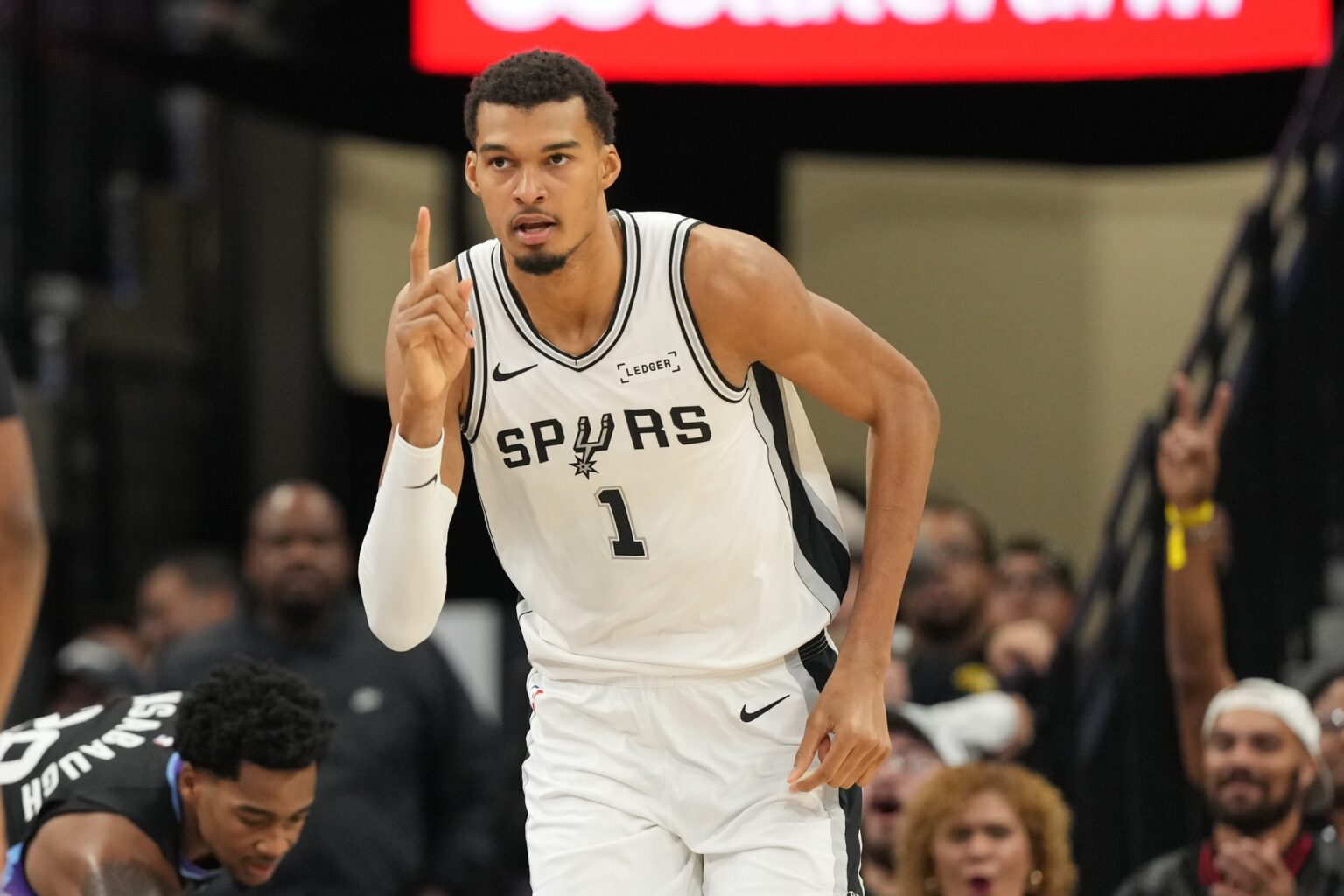
Victor Wembanyama delivered a dominant two-way performance, finishing with 21 points, 17 rebounds, and 6 blocks in 36 minutes. His presence alone altered Detroit’s offensive rhythm.
He grabbed 8 offensive rebounds, helping San Antonio total 16 second-chance opportunities. Those extra possessions neutralized Detroit’s overall rebounding edge and extended multiple key scoring runs.
Defensively, his 6 blocks and countless altered shots limited Detroit’s efficiency inside. While the Pistons scored 62 points in the paint, many of those came through volume rather than efficiency, particularly late when the outcome was largely decided.
3. Ball Movement And Playmaking Set The Tone
San Antonio had 32 assists on 42 made field goals, while Detroit had 21 assists on 40 made field goals. Other teams play in a similar way to Detroit, which shows a clear difference in how each team plays the game.
De’Aaron Fox maintained the game flow to control the tempo of the game. In the 4th quarter, he made sure the ball went to the right people to shoot to keep them on the winning side.
Detroit relied on individual players to make driving actions. Cade Cunningham went 5-for-26, and while on a 26-attempt isolation, the offense went stagnant – and that’s exactly what happened.
4. Defensive Activity Changed The Game
Detroit could not execute its offense well because Wembanyama, the Spurs’ leading scorer, had 11 blocks and 8 steals to disrupt the execution in the offensive half. Other defenders worked hard to rotate on the weak side all night.
Despite San Antonio allowing Detroit 16 fast-break points, they were able to keep the Pistons’ transition scoring low because they turned defensive rebounds into uncontested shots on the perimeter, and their transition defense made them take a lot of contested shots.
The Spurs had the same 16 turnovers, but San Antonio’s good defensive pressure turned the Pistons’ turnovers into 21 points, while the Spurs’ pressure only allowed Detroit to score 13 points off turnovers. That is a big difference.
5. Balanced Scoring Overcame Rebounding Deficit
Detroit still won the rebounding battle at 55-50, with 20 offensive rebounds. However, they couldn’t turn those rebounds into runs. There were key moments where the Spurs’ defense stepped up.
The Spurs had 5 players score in double figures. This included Vassell (28), Wembanyama (21), Champagnie (17), Castle (16), and Fox (10). Such a balanced attack made it tough for Detroit to focus on any one scorer.
On the other hand, Detroit had a strong reliance on Jalen Duren’s 25 points and 14 rebounds. There was little scoring behind him, and Ronald Holland II had 15 points off the bench. Especially with Cunningham’s inefficiency, the flow of the offense was really impacted.