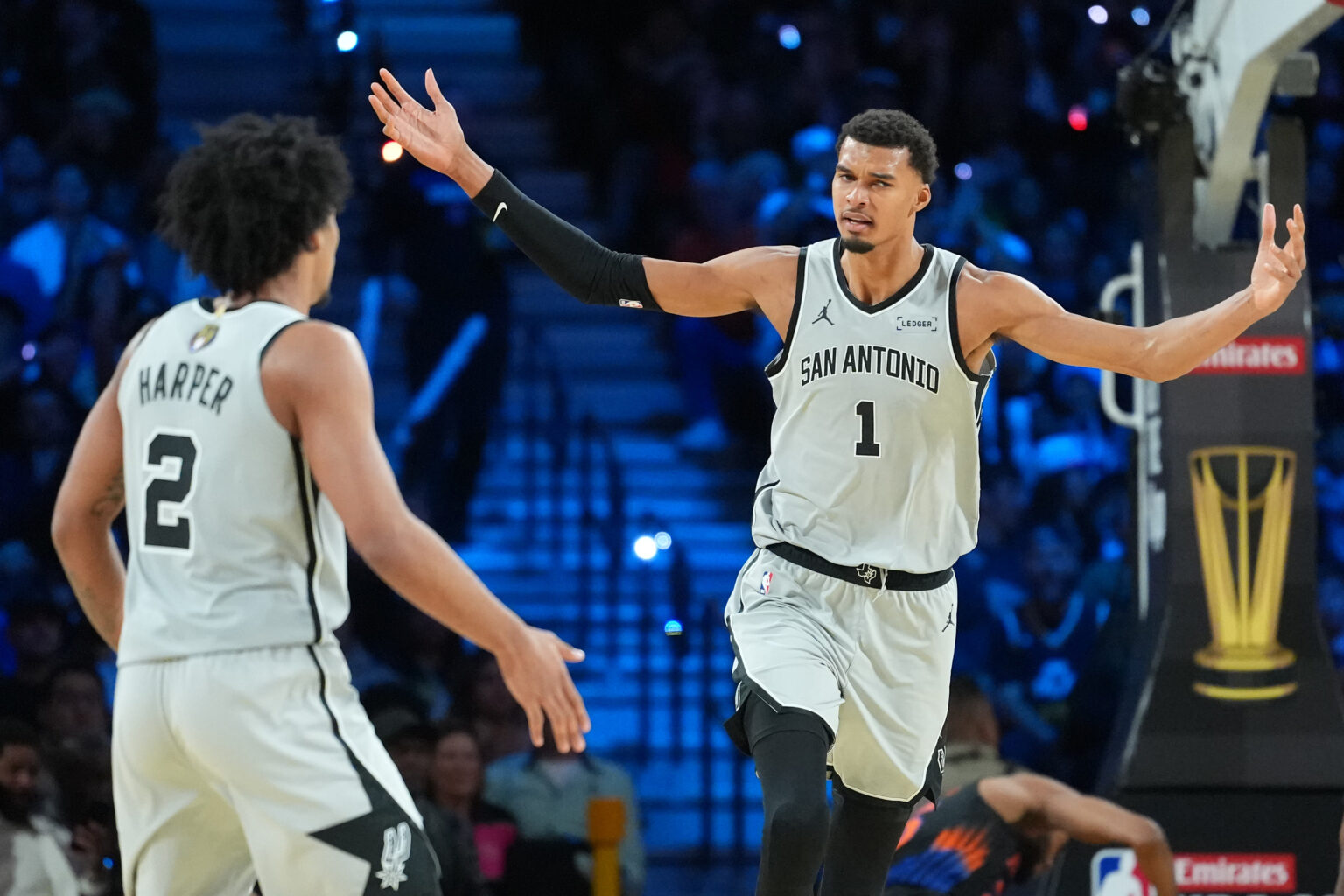
For long stretches Tuesday night, the San Antonio Spurs looked like they belonged on this stage. They controlled the pace early, built leads with ball movement and perimeter shot-making, and put real pressure on a veteran New York Knicks roster. But championship games have a way of exposing weaknesses, and as the minutes tightened, the margins that separate promise from polish became painfully clear.
San Antonio’s 113-124 loss in the NBA Cup Final wasn’t the result of one bad quarter or one cold stretch. It was a cumulative breakdown – on the glass, in late-game execution, and in sustaining physicality – that allowed the Knicks to seize control and never let it go. The Spurs left with valuable experience, but also with clear lessons about what it takes to finish on a stage like this.
The Spurs Were Overwhelmed On The Glass
The most decisive number of the night was the rebounding margin. New York crushed San Antonio 59-42 overall and 23-18 on the offensive boards, repeatedly extending possessions and wearing down the Spurs’ interior. Mitchell Robinson alone grabbed 15 rebounds in just 18 minutes, including 10 offensive boards; more offensive rebounds than several Spurs lineups managed collectively.
Those extra possessions told the story late. The Knicks finished with a 56-44 edge in points in the paint, largely because San Antonio couldn’t end defensive stands with rebounds. Even when the Spurs forced misses, they often failed to secure the ball, allowing New York to reset and attack a defense that was already scrambling. Over the final 18 minutes, second-chance points became a steady bleed rather than a sudden wound.
Late-Game Execution Slipped When The Pressure Rose
San Antonio led for nearly 60 percent of the game, but the moment demanded poise, the Spurs couldn’t find it. During New York’s decisive 13-1 run spanning the late third and early fourth quarters, San Antonio went cold, missing seven of eight shots while committing rushed turnovers and settling for contested jumpers early in the clock.
While the Spurs finished with a respectable 29 assists, their ball movement slowed dramatically when New York tightened defensively. De’Aaron Fox had nine assists but also five turnovers, several of them coming during that momentum-swinging stretch. As a team, San Antonio generated just 10 points off fast breaks and struggled to get downhill once the Knicks switched more aggressively. When the game demanded structure, the Spurs couldn’t consistently manufacture clean looks.
Defensive Matchups Wore Thin Against Elite Shot Creators
The Spurs simply ran out of answers for New York’s primary scorers. OG Anunoby and Jalen Brunson combined for 53 points, with Anunoby hitting 50 percent from three-point range and Brunson absorbing heavy minutes while still creating eight assists. San Antonio’s perimeter defense struggled to contain dribble penetration, and help rotations often came a step late, opening kick-out opportunities.
Even when the Spurs contested shots, New York’s physicality punished them elsewhere. The Knicks shot 47 percent from the field and 38 percent from three, modest numbers on their own, but devastating when paired with New York’s rebounding dominance. San Antonio’s defense spent too many possessions in scramble mode, and by the fourth quarter, fatigue showed – closeouts softened, rotations lagged, and the Knicks made just enough shots to keep control.