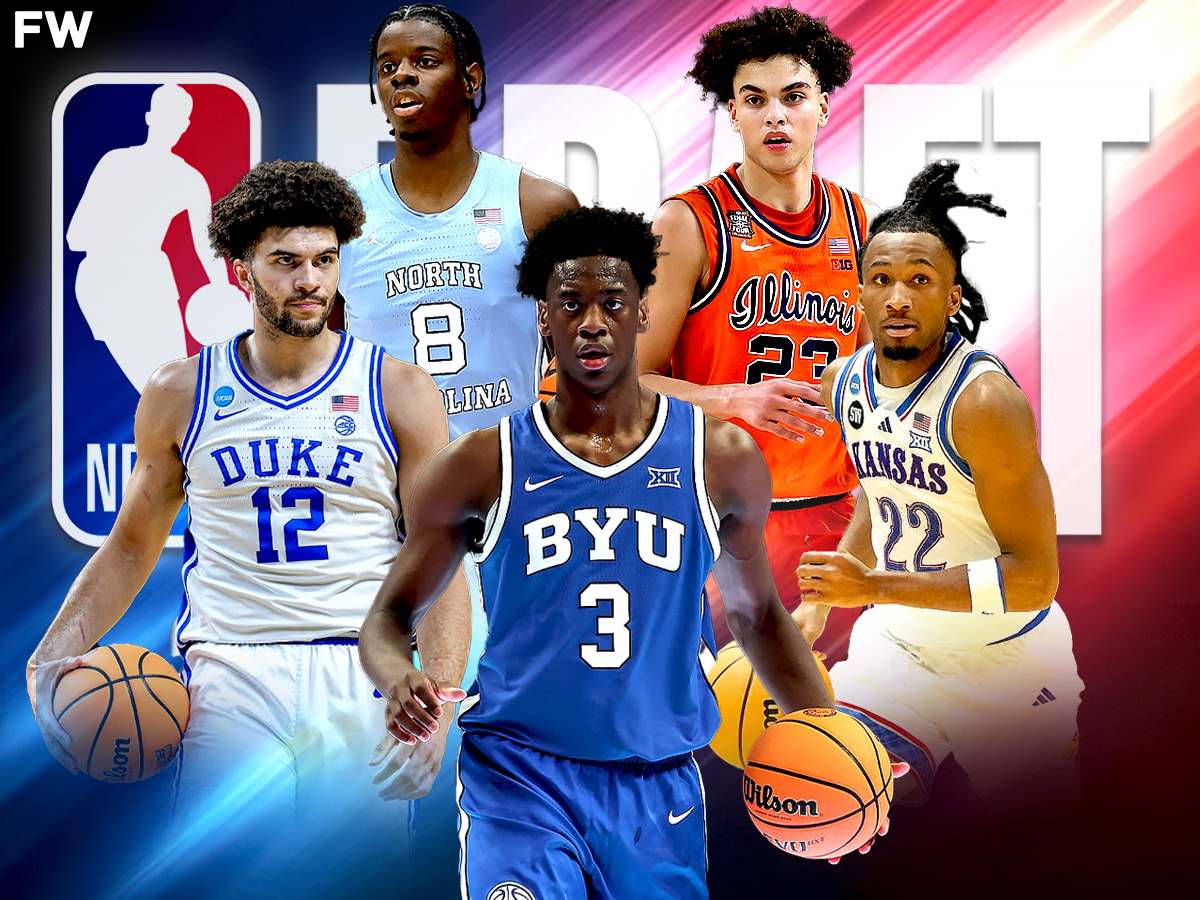
The Wizards own the No. 1 pick in the 2026 NBA Draft, but this is not a draft with one locked name at the top. AJ Dybantsa is the safest favorite across most post-lottery mocks, Darryn Peterson has real No. 1 buzz, and Cameron Boozer has the production profile that can force a longer discussion. The Athletic projected Dybantsa to the Wizards at No. 1, while noting the Peterson-Dybantsa debate depends on the eye of the evaluator. We also posted our post-lottery mock with Dybantsa first and Peterson second.
These percentages are not betting odds. They are a draft-board estimate based on team context, prospect ceiling, production, positional value, and how realistic it is for the Wizards to view each player as the best long-term answer.
1. AJ Dybantsa – 31.0%
AJ Dybantsa is still the favorite because he gives the Wizards the most traditional No. 1 pick profile. He is a 6-foot-9 wing with scoring volume, positional size, and enough creation skill to become a first option if everything develops correctly.
His 2025-26 production gives the case real weight. Dybantsa averaged 25.5 points, 6.8 rebounds, and 3.7 assists while shooting 51.0% from the field and 33.1% from three. The three-point number is not elite, but it is not broken. The stronger part of the profile is the mix of rim pressure, mid-post scoring, transition ability, and self-created looks.
The Wizards can justify Dybantsa because wings with this kind of physical profile are the safest star bets in the modern NBA. He does not need to be a pure point guard. He does not need to be a center. He can play next to different roster builds, which is important for a team still trying to understand its real core.
The concern is whether he is more of a high-level scorer than a complete offensive engine. He has creation flashes, but he is not as natural a passer as Peterson. He also needs to prove the jumper becomes a reliable weapon against NBA length.
Still, Dybantsa has the clearest No. 1 pathway. If the Wizards want the best blend of upside, size, and positional value, he is the pick.
2. Darryn Peterson – 29.0%
Darryn Peterson is close enough to Dybantsa that the gap should not be exaggerated. He could absolutely go No. 1 if the Wizards decide they want the best guard creator in the class instead of the highest-upside wing.
Peterson averaged 20.2 points, 4.2 rebounds, and 1.6 assists while shooting 43.8% from the field and 38.2% from three. The assist number does not fully show his creation ability, because his value is not only in basic passing totals. He can get to spots, score off movement, punish switches, and create advantages with the ball. He is also 6-foot-5, which gives him more size than a normal lead guard.
His case is about advantage creation. The Wizards need someone who can bend the floor. Peterson has the handle, shot-making, and pace control to become that player. He is comfortable off the ball, which matters if the Wizards keep other creators on the roster. He is not a small guard who needs every touch to have value.
The pushback is availability and physical certainty. Peterson had a season that raised some medical and conditioning questions, and teams will examine that closely. At No. 1, front offices usually try to limit risk. Dybantsa has a more obvious physical profile. Boozer has a stronger production floor. Peterson’s argument is skill and shot creation.
That argument is strong enough to give him a real chance. If private workouts go well and the medical file checks out, Peterson could become the top name on the Wizards’ board.
3. Cameron Boozer – 24.0%
Cameron Boozer has the best production-to-risk balance in the class. He may not have the same wing scoring ceiling as Dybantsa or the same guard creation profile as Peterson, but he is the most polished player in the top tier.
Boozer averaged 22.5 points, 10.2 rebounds, and 4.1 assists while shooting 55.6% from the field and 39.1% from three. That is a complete statistical profile. He scores efficiently, rebounds at a high level, passes well for a frontcourt player, and shoots well enough to create real spacing questions for defenses.
The No. 1 case starts with reliability. Boozer is not only a college producer. He has a clear NBA role because of his touch, strength, passing, and decision-making. He can play through the elbows, attack slower bigs, post smaller defenders, and punish defenses that leave him open. His floor is higher than most prospects in this class.
The reason he is third here is ceiling perception. Some teams may question whether Boozer can become the best player on a title-level team. He is not an explosive wing. He is not a dynamic lead guard. His game is built more on strength, skill, and feel than sudden athletic advantage.
That does not remove him from the No. 1 race. If the Wizards want the safest star-level outcome, Boozer has a real argument. He is the player most likely to help early and still grow into a top offensive option. He is not far behind the first two.
4. Caleb Wilson – 5.0%
Caleb Wilson is the first player outside the main tier with a realistic path to No. 1. His chance is small, but it exists because of his physical tools and two-way ceiling.
Wilson averaged 19.8 points, 9.4 rebounds, 2.7 assists, 1.5 steals, and 1.4 blocks while shooting 57.8% from the field. That is a serious profile for a 6-foot-10 forward. He can run, finish, defend different areas, rebound, and create defensive events. His combination of size and movement gives him a different argument than Boozer.
The swing skill is the jumper. Wilson shot 25.9% from three, which is the main reason he is not in the same No. 1 tier. If the Wizards believe the shot is fixable, he becomes more interesting. Big forwards who defend, handle some possessions, and finish efficiently are very valuable. But if the shot does not develop, his offensive ceiling becomes more limited.
Wilson’s best argument is defensive upside. Dybantsa and Peterson may offer more creation, while Boozer offers more polish. Wilson could become the best defensive player among the top group. That gives him a path if the Wizards prioritize two-way range and physical upside.
At 5.0%, this is still a long shot. He likely needs excellent workouts and strong internal belief from one front office. But he belongs in the discussion because his tools are not normal.
5. Darius Acuff Jr. – 3.5%
Darius Acuff Jr. has the scoring profile to force his way into the conversation, even if No. 1 feels unlikely. He is not in the top tier because of size and defensive questions, but his offensive production is too strong to dismiss.
Acuff averaged 23.5 points, 3.1 rebounds, and 6.4 assists while shooting 48.4% from the field and 44.0% from three. That is elite guard production. He scored with volume, shot the ball at a high level, and still created for others. Guards with that blend usually rise during the pre-draft process if the interviews and measurements are strong.
His case is simple. He may be the best pure offensive guard in the class. Peterson is bigger and more complete, but Acuff is more explosive as a scorer. He can shoot off the dribble, get into the lane, create late in the clock, and put pressure on defenses from high pick-and-roll actions.
The issue is whether a team can take him No. 1 without elite size. Acuff is listed around 6-foot-2, so he has less margin for error defensively. The Wizards would need to believe his scoring is special enough to outweigh that limitation.
That is possible, but not likely. Smaller guards have to be extraordinary to go first. Acuff’s numbers are extraordinary, but the class has larger, more projectable star profiles above him. His real range is probably lower. His No. 1 chance exists only if the Wizards fall in love with the shot-making.
6. Mikel Brown Jr. – 2.5%
Mikel Brown Jr. is another guard who can enter the broader discussion because of size, handle, shooting confidence, and passing feel. He is not as statistically dominant as Acuff, and he is not as complete as Peterson, but the outline is strong.
Brown averaged 18.2 points, 3.3 rebounds, and 4.7 assists while shooting 41.0% from the field and 34.4% from three. The efficiency is not perfect. That is the problem. He took difficult shots, had some turnover issues, and did not always control games the way a top pick usually does.
Still, Brown has a real NBA profile. He is a 6-foot-5 lead guard who can shoot from distance, pass over smaller defenders, and play with pace. That size gives him more flexibility than smaller guards. He can play on or off the ball, which helps his fit with different rosters.
His No. 1 case would need to be built on projection more than production. The Wizards would have to believe his handle, shooting mechanics, and passing vision will translate better in NBA spacing than they did in college efficiency numbers.
That is not impossible. Some guards look more efficient when the floor opens and the reads become cleaner. But at No. 1, that is a difficult bet when Dybantsa, Peterson, and Boozer are available.
Brown is a real lottery talent. His chance to go first is thin, but he belongs among the extended group because lead guards with size always get serious attention.
7. Kingston Flemings – 2.0%
Kingston Flemings has a small but real chance because he brings burst, defensive activity, and lead-guard pressure. He is not the most polished player in the class, but he has the kind of speed that changes the shape of a game.
Flemings averaged 16.1 points, 4.1 rebounds, 5.2 assists, and 1.5 steals while shooting 47.6% from the field and 38.7% from three. That is a balanced guard profile. He scored, passed, defended, and shot well enough to keep defenses honest.
The most interesting part is his two-way pressure. Flemings can get downhill quickly and force rotations. He is also more active defensively than many scoring guards. That gives him a path to become more than a one-way offensive player.
His No. 1 case is harder because he is not as big as Peterson and not as productive as Acuff. He needs to win with burst, toughness, and development. That usually does not lead to the first pick unless the guard is clearly special.
For the Wizards, Flemings would be more of a trade-down target than a direct No. 1 pick. If they moved down and still wanted a guard, he could enter the picture. At No. 1, he needs too many things to break correctly.
Still, he is not a fake top-10 name. His speed, defensive edge, and passing give him a real lottery floor. The chance at No. 1 is only 2.0%, but his long-term NBA value could end up higher than that number suggests.
8. Nate Ament – 1.5%
Nate Ament is the high-variance forward in this group. His chance to go No. 1 is small because the production and efficiency were not strong enough, but the tools are the reason he remains in the conversation.
Ament averaged 16.7 points, 6.3 rebounds, and 2.3 assists while shooting 39.9% from the field and 33.3% from three. Those numbers explain the split evaluation. The size and skill are real. The efficiency is not good enough for a top-pick favorite.
At 6-foot-9 or 6-foot-10, Ament can handle, pass, and shoot in theory. Those players always interest teams because they are hard to find. If a front office believes the shot selection can be cleaned up and the frame can improve, the upside becomes serious.
The Wizards would need to view him as a future big wing creator. That is the only way he gets into the No. 1 conversation. He cannot be picked first as a role forward. He would need to sell them on the idea that his current flaws are development problems, not skill limitations.
That is a hard argument in this class. Dybantsa already gives size and wing scoring. Boozer gives production. Peterson gives creation. Ament is more theoretical than all three.
Still, draft rooms sometimes fall in love with rare frames and flashes. Ament has enough of both to hold a small percentage. His workout season is very important. Strong shooting sessions and better measurements could move him higher.
9. Keaton Wagler – 1.0%
Keaton Wagler is not a true No. 1 candidate in the normal sense, but he gets a small chance because of shooting, size, and late-blooming guard value. If the top of the board becomes chaotic, a player like him can rise.
Wagler averaged 17.9 points, 5.1 rebounds, and 4.2 assists while shooting 44.5% from the field and 39.7% from three. That is a strong offensive profile for a 6-foot-6 guard. He can shoot, handle secondary actions, and play without needing every possession built around him.
His biggest strength is fit. He can play next to a lead guard, function as a secondary creator, and space the floor. NBA teams value that. His shooting number is strong enough to believe the jumper will translate, and the size gives him a chance to defend more than one backcourt spot.
The reason he is not higher is ceiling. Wagler is not an elite athlete, and his first-step advantage is not at the level usually required for a No. 1 pick. He projects more as a high-level complementary guard than a franchise engine.
For the Wizards, that makes him almost impossible at No. 1 unless the board changes dramatically through workouts and interviews. He is more likely to be picked in the middle of the lottery.
The 1.0% number is respect for the shooting and size, not a prediction. He is a good prospect. He is just not the type of prospect teams usually take first.
10. Brayden Burries – 0.5%
Brayden Burries closes the list because he has a complete enough wing profile to stay in the broader top-10 discussion. His No. 1 chances are very low, but he is the kind of player teams may value more than public boards expect.
Burries averaged 16.1 points, 4.9 rebounds, and 2.4 assists while shooting 49.1% from the field and 39.1% from three. He also averaged 1.5 steals, which helps his two-way case. He is not only a shooter. He has strength, transition value, and enough defensive activity to become a playoff-style wing if the role develops correctly.
His problem is star upside. Burries does many useful things, but he does not have the same primary-creator case as Dybantsa, Peterson, Acuff, or Brown. He also does not have Boozer’s production profile or Wilson’s defensive ceiling.
That does not mean he is a weak prospect. It means his best NBA pathway may be as a high-level connector instead of a franchise player. Those players are very valuable. They just do not usually go first overall.
The Wizards would only consider Burries at No. 1 if their internal board was completely different from the public consensus. That is possible in theory, but unlikely in practice. He is more realistic as a mid-lottery option.
His 0.5% chance reflects that. Burries belongs on the top-10 list because of his shooting, strength, and two-way projection. But the No. 1 pick should still come from the top three unless the pre-draft process changes the race.