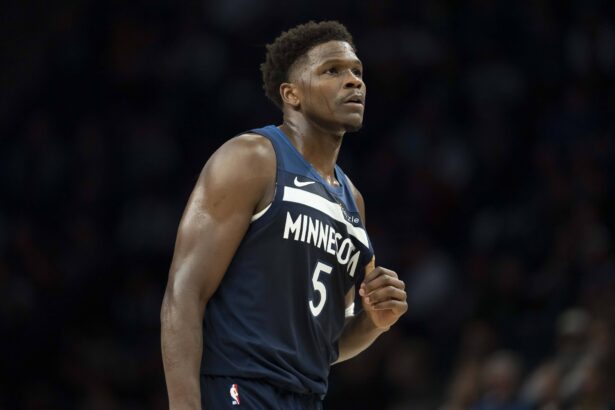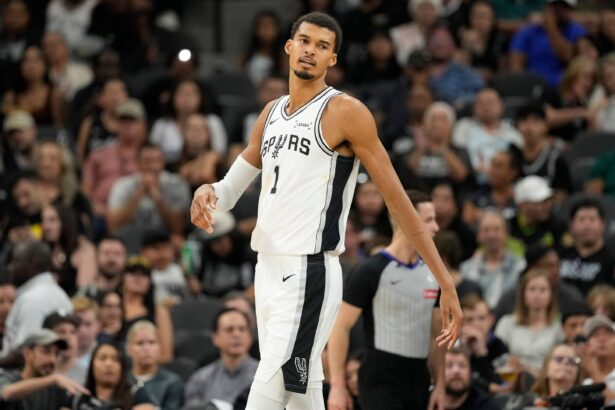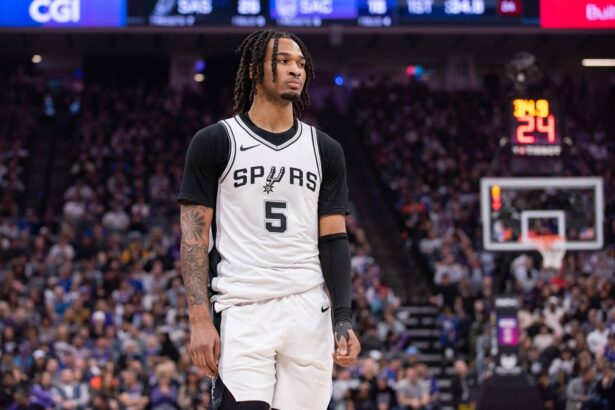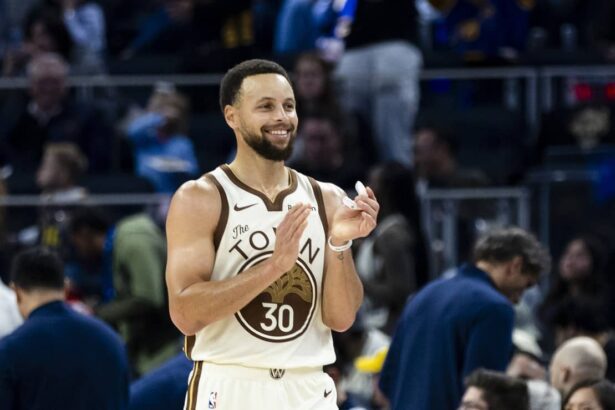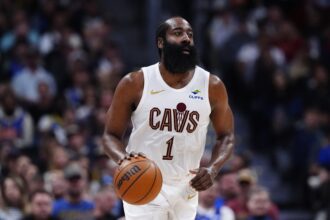
The Los Angeles Lakers (23-14) are sitting 5th in the West, the Golden State Warriors (22-19) are 8th, and the Brooklyn Nets (11-26) are 13th in the East. Three totally different situations, but the same deadline problem: everybody wants to get better without torching the whole roster.
This trade idea fits the current rumor lane because the Warriors have been linked to Michael Porter Jr. as a legit target. The Stein Line specifically reported the Warriors are “targeting” Porter, along with a couple other wings, which tells you they’re shopping for a higher-end scorer, not just a bench tweak.
On the Lakers’ side, the Kuminga noise is real, too. Bleacher Report’s latest roundup by Jake Fischer said the Lakers are monitoring Jonathan Kuminga’s situation while casting a wide net for wing help, which is basically code for “we’re watching if the Warriors blink.”
Then you’ve got the Nets, and they’re the obvious “third-team engine” here. They’re 11-26 and trending toward asset mode, and local coverage has already framed their deadline around evaluating the future, including what to do with Porter before things get too late.
So yeah, this isn’t random trade machine fan-fiction. It’s a clean three-team concept built right on top of what’s been buzzing this week: Warriors hunting a big wing like Porter, Lakers keeping tabs on Kuminga, and the Nets sitting in the spot where picks and flexibility suddenly look way more valuable than a few extra wins.
The Trade
Los Angeles Lakers Receive: Jonathan Kuminga, Buddy Hield, Day’Ron Sharpe, Tyrese Martin
Brooklyn Nets Receive: Deandre Ayton, Moses Moody, Rui Hachimura, Maxi Kleber, 2027 first-round pick (via GSW), 2028 first-round pick swap (via LAL), 2032 second-round pick (via LAL)
Golden State Warriors Receive: Michael Porter Jr., Dalton Knecht
The salary part is the one people usually skip, but it’s literally why a three-team build like this can exist.
Michael Porter Jr. is the big number. He’s on $38.3 million for 2025-26. The Warriors’ side has enough mid-to-large money to stack up: Jonathan Kuminga is at $22.5 million, Buddy Hield is at $9.2 million, and Moses Moody is at $11.6 million.
For the Lakers pieces in this framework, Rui Hachimura sits at $18.3 million and Maxi Kleber is at $11.0 million. Deandre Ayton is the weird one financially because he’s earning major cash this season due to the buyout situation, but for trade-matching purposes, his Lakers salary is $8.1 million.
Then the Nets add-ons stay clean: Day’Ron Sharpe is at $6.3 million and Tyrese Martin is at $2.2 million.
Bottom line: Porter’s $38.3 million doesn’t get matched by one clean star contract here, it gets matched by layers of rotation-level money, and that’s exactly how real deadline trades get built, especially once you bring a third team in to reroute salaries and attach picks to balance out the talent gap.
Why It Makes Sense For The Lakers
The Lakers are a good team right now, but they’re also the definition of “one twist away from chaos.” They’ve been winning, but they’ve also had games where the offense gets too Luka Doncic-and LeBron James-heavy, and the supporting cast turns into spectators. Luka went for 42, and it still wasn’t enough against the Kings, which tells you how thin the margin can get when the three-ball goes cold.
This trade basically says: fine, keep your stars, but give them more playable bodies that actually fit modern playoff basketball. And with the Lakers failing to add a 3-and-D wing in the market so far, a new twist enters the picture.
Start with Jonathan Kuminga. He’s averaging 11.8 points, 6.2 rebounds, and 2.6 assists in 24.8 minutes. That’s not “future superstar” production, but it is real two-way athleticism you can weaponize.
The Lakers’ team profile says they score 116.5 points per game on 49.8% from the field, with 25.1 assists, and they turn it over 15.3 times a night. Kuminga helps in the exact spots where the Lakers get a little too careless: rim pressure, transition finishing, and easy paint touches when everything turns into a half-court grind.
Then there’s Buddy Hield. His season line is ugly by his standards (7.3 points per game and 32.7% from three), but the shot is still a threat, and that matters more than fans admit. Even when he’s “off,” defenses still treat him like a shooter. If you put him on the floor with Luka, you’re forcing a decision every possession: help on the drive, or stay hugged to a guy who can get hot in 90 seconds. That gravity is the whole point.
Day’Ron Sharpe is the sneaky one. He’s at 7.7 points, 6.3 rebounds, and 2.4 assists in 17.8 minutes. That’s backup big production that actually changes games, especially when you’re trying to win the non-LeBron minutes or survive foul trouble. And Tyrese Martin (7.7 points, 3.0 rebounds, 2.1 assists) is another plug-and-play wing who can soak up minutes without killing you.
The biggest Lakers angle though is roster balance. This move turns two bigger contracts (Rui at $18.3 million and Kleber at $11 million) into four rotation options, and Kuminga’s $22.5 million salary is the type of “trade chip contract” front offices love because it’s big enough to matter but still movable.
Would the Lakers miss Rui’s production? Sure. He’s at 12.7 points on 52.1% from the field and a wild 44.5% from three. But this is the cold truth: in the playoffs, you don’t win with your fifth-best scorer, you win with the number of playable guys you trust when the matchup turns nasty. This trade gives the Lakers more levers to pull.
Why It Makes Sense For The Nets
The Nets are 11-26, 13th in the East, with an offense that’s 26th by offensive rating in the league. That’s not a “one tweak away” situation. That’s a “stop pretending and pick a direction” situation.
Michael Porter Jr. is having a monster year statistically, and that’s exactly why a rebuild would consider selling high. He’s averaging 25.9 points, 7.5 rebounds, and 3.4 assists. But he’s also on a gigantic number: $38.3 million this season. If you’re the Nets, that contract is either (1) your centerpiece for the next three years, or (2) the thing you flip into picks and flexibility before it becomes an anchor.
This deal leans hard into option two, and I honestly get it.
First, the Nets get Moses Moody, a younger wing who’s giving you 10.2 points, 3.1 rebounds, 1.5 assists, and 0.9 steals per game. He’s not a star, but he’s a real NBA rotation piece, and he’s on $11.6 million, which is very tradable later if you want to keep cycling assets.
Then you get Rui Hachimura, who is quietly having one of those “I’m better than my reputation” seasons: 12.7 points, 52.1% from the field, and 44.5% from three. On $18.3 million, he’s either a starter you rehab into a contender’s target, or a midseason flip when somebody gets desperate for size and shooting.
The Deandre Ayton part is the swing. His Lakers stint has been efficient: 14.0 points, 8.8 rebounds, 1.0 block, and a ridiculous 68.2% from the field. And because his current salary is only $8.1 million, the risk is way lower than the old “max Ayton” version people still picture in their head. With the Lakers reportedly not considering him in their long-term plans, the Nets could actually flip him again later for more future assets.
Kleber is basically salary structure at this point, and his season production is minimal (1.6 points, 1.7 rebounds, and a rough 20.0% from three). But $11 million expiring-ish types are exactly the contracts rebuild teams use to grease trades.
Now the real reason the Nets even answer the phone: picks. They get a Warriors first, a Lakers first-round swap, and a Lakers second. That’s the rebuild language. It also aligns with how teams like this usually operate: take on multiple deals, collect draft assets, and give yourself more bites at the apple.
Does it hurt to lose Porter? Obviously. He’s their engine. But the Nets also aren’t winning enough games for “engine” to matter. If you’re not building toward a top-6 seed timeline, you’re just burning seasons.
Why It Makes Sense For The Warriors
This is the part where I get loud: if the Warriors can land Michael Porter Jr. without giving up their best young piece or their core identity, they should sprint to do it.
They’ve been scoring 115.4 points per game with 28.4 assists, hitting 35.9% from three, and they’re turning it over 15.7 times a night. They’ve also been hovering around the middle of the West, and the first half feels “good, but not good enough.”
Porter Jr. is the type of piece that changes how defenses guard you.
His 25.9 points a night isn’t just “nice scoring.” It’s the specific kind of scoring the Warriors sometimes lack: size-based shotmaking. When games slow down, you can toss it to a 6’10” guy who can hit contested jumpers, and you don’t have to spam Steph pick-and-roll until everyone is exhausted. That’s a playoff cheat code.
And it’s not just points. Porter is at 7.5 rebounds, so you’re not sacrificing the glass the way you might with a smaller scoring guard.
The outgoing package makes sense, too. Kuminga’s contract is big ($22.5 million), he’s currently out of the rotation entirely since December, and the reporting around his situation has been messy, including the note that he is a “lock” to be traded after January 15. Since the Warriors aren’t fully committing to him, using him as the salary engine for a star-ish wing is exactly how you maximize value.
Buddy Hield is the easy “matching money + shooting reputation” piece at $9.2 million, and Moody is the real cost because he’s productive and on a solid number. But if you’re the Warriors, you’re making a bet that Porter’s top-end impact is worth more than Moody’s steady two-way floor.
Then you throw in Dalton Knecht as the sweetener coming back. He’s only at 5.1 points and 1.7 rebounds, but he’s a cheap rookie-scale shooter type you can keep developing behind the vets.
And here’s the big basketball point: Porter Jr. fits the Warriors’ shot diet. They already take a ton of threes, they already move the ball, and they already create “one pass away” looks. Adding a wing who can bomb threes and punish switches is how you get a cleaner offense without reinventing anything.
The Risk
Every team here is taking a different kind of risk.
The Lakers risk losing their cleanest forward shooter (Rui at 44.5% from three) for a package that includes Hield shooting 32.7% from deep this season. That’s a real gamble on “process” over “current results.”
The Nets risk the obvious one: they trade away a guy averaging 25.9 a night, and sometimes “sell high” just turns into “we gave away the only reason people watch us,” but overall, this seems like a great offer to keep losing and tank for draft position.
The Warriors risk fit and health. Porter’s contract is massive, and if he isn’t a playoff-credible defender in their scheme, you’re basically paying $38 million for scoring that might get hunted more than saving you on offense. But I’ll still say it: the Warriors are built to cover for scoring wings better than most teams because they can play smart help defense and keep the ball moving enough to outscore mistakes.
Final Thoughts
If I’m ranking who “wins” this idea on paper, I’ve got the Warriors first, the Nets second, and the Lakers third.
The Warriors get the best player in the deal, the Nets get picks and flexibility while still grabbing real rotation guys, and the Lakers get deeper but take the biggest on-court uncertainty because they’re swapping reliable shooting for a mix of volatility.
But as a concept? This is one of those three-team frameworks that actually feels like it speaks each team’s language, instead of being fantasy trade machine nonsense.