Scoring records no longer feel as untouchable as they once did. The league plays faster, offenses are built around space, and high-usage stars now take more threes and more free throws than previous generations. That combination has already pushed individual scoring to extreme levels.
Still, one vulnerable record does not make the modern record book easy to crack. Some marks are protected by rule changes, some by role evolution, and some by circumstances the NBA simply does not produce anymore. Even in a higher-scoring era, many of the league’s biggest numbers remain extraordinarily difficult to touch.
Wilt Chamberlain’s Record Will Be Broken Some Day
Wilt Chamberlain’s 100-point game has stood since March 2, 1962, so the record is now 64 years old. For a long time, that number felt more mythical than vulnerable. The modern NBA has changed that. Offenses now create far more space, stars take more threes, and elite scorers can pile up points faster than ever through a mix of volume shooting, free throws, and pace. That does not mean 100 is easy to reach. It still requires a perfect storm. But it does mean the path exists in a way it did not for decades.
Bam Adebayo’s 83-point game was the clearest reminder. He scored 83 on 20-of-43 shooting from the field, 7-of-22 from three, and 36-of-43 from the line in 42 minutes. He also set NBA single-game records for both free throws made and free throws attempted. That showed exactly how a modern player could make a real run at 100: a huge shot diet, bigger three-point volume, and a massive whistle all in the same night. Adebayo did not break Wilt’s record, but he got to the second-highest scoring total in league history, which is enough to make the idea feel real again for the league’s greatest active scorers.
Luka Doncic’s 60-point game against the Heat showed that possibility. And even as that performance broke a long-standing Kobe Bryant record, his 73-point explosion against the Hawks back with the Mavericks showed the true reach of this generation of scorers. The potential is definitely there for Doncic, Shai Gilgeous-Alexander, Anthony Edwards, and more upcoming elite scorers to break Chamberlain’s iconic scoring mark one day.
Chamberlain’s record is still gigantic, but the modern league at least gives someone a believable route to it. One day, with enough usage, enough threes, enough free throws, and the right game script, somebody may finally get there.
Meanwhile, here are seven unbreakable records that the modern NBA will most likely fail to reach ever again.
1. LeBron James’ 51,530 Total Points
LeBron James’ 50,000 combined points record is one of the strongest examples of a mark that sounds breakable in theory but becomes almost impossible once the full math is laid out. Yes, the modern NBA scores more than ever. Yes, stars are entering the league younger, playing in more offense-friendly systems, and benefiting from more spacing than previous generations. But even in that environment, getting to 50,000 total points across the regular season and playoffs requires a career path that almost no player can realistically replicate.
James became the first player in league history to reach the milestone in March 2025, and he has only kept adding to it since then. The NBA record books now list him at 51,530 combined points as we speak, made up of 43,241 in the regular season and 8,289 in the playoffs. That alone shows the real challenge. This is not just a record built on elite scoring. It is built on elite scoring sustained across more than two decades, plus constant deep playoff runs.
That playoff piece is what makes the record especially brutal to chase. Plenty of great scorers can pile up regular-season points. Far fewer also play enough postseason games to add another massive layer on top of that total. James broke Kareem Abdul-Jabbar’s regular-season scoring record in 2023, but the combined total is even more demanding because it requires both individual dominance and team success for years. He also broke Michael Jordan’s all-time playoff scoring mark back in 2017, which means this record is really the product of two historic records stacked together.
There is also the durability factor, which may be the biggest barrier of all. James is in his 23rd season and just passed Robert Parish for the most regular-season games played in NBA history with 1,612 appearances. A player chasing 50,000 combined points would likely need to stay healthy, productive, and relevant well into his late 30s, while also avoiding the kind of major injury that usually interrupts even all-time careers. That is asking for too much from almost anyone.
So while a 100-point game might eventually fall in the right pace-and-space era, this record feels different. It demands greatness, longevity, health, and playoff volume all at once. That is why LeBron James’ 50,000 total points record looks close to untouchable.
2. Most Consecutive Games Played
A.C. Green’s consecutive games played record is 1,192, and it is one of those marks that looks even more impossible the more modern basketball changes. Green’s streak ran from November 19, 1986, through April 18, 2001, which means he effectively went nearly 15 full years without missing a regular-season game. In a league now defined by load management, tighter injury monitoring, and far greater caution around long-term player health, that number feels almost completely out of reach.
The best modern example of why this record is so difficult is Mikal Bridges. Bridges has become the league’s current iron man and has done everything right for years. He built his reputation on availability, defensive consistency, and taking the floor every night, no matter the role or workload. He just made his 629th consecutive game against the Pelicans, which already ranks 11th all-time in NBA history. That is an extraordinary streak in today’s NBA, and yet it still leaves him just a little over halfway to Green’s number. That gap tells the whole story.
That is what makes the record feel so safe. Bridges is not some random role player lucking into appearances. He is one of the most durable players of his era, and even he would need roughly seven more full 82-game seasons without interruption just to catch Green. One ankle turn, one scheduled rest night, one minor hamstring issue, or one team deciding to sit him in April could break the streak immediately. In the modern league, that kind of interruption is not unusual. It is expected.
There is also a structural reason this record is so hard to touch now. The game is far more physical and demanding than it used to be. Sports science departments have more influence, travel stress is tracked more carefully, and even durable stars are often sidelined for stretches with more wear and tear in an 82-game season.
A player no longer needs a major injury to lose a streak. Sometimes one maintenance decision is enough. That is why Green’s record has held for so long, and why it still looks so untouchable. Bridges has shown just how rare elite durability is in the current NBA, but he has also shown how enormous the climb still is. Green’s 1,192 straight games may be one of the safest records on the board.
3. Wilt Chamberlain’s 55 Rebounds In A Single Game
Wilt Chamberlain’s 55-rebound game is one of the clearest examples of a record that belongs to a different version of basketball. He set it on November 24, 1960, against the Celtics, and it still stands as the highest single-game rebound total in NBA history. Bill Russell’s 51-rebound game is the only performance that even got especially close. That alone tells you how far removed this record is from the modern game.
The biggest reason it feels unbreakable is simple: the game no longer creates enough rebound chances for anyone to reach that territory. In Chamberlain’s era, teams played at a much faster pace, shot far worse from the field, and generated a huge volume of missed shots. Modern offenses are more efficient, spacing is better, and the ball is shared across more lineups and more positions. Even dominant rebounders now operate in a game with fewer available misses and far more schematic responsibility. A center is not just camping around the rim waiting for boards. He is switching, rotating, covering space, and often playing fewer minutes than stars from earlier eras. That structural shift matters as much as individual talent.
The modern leaderboard makes the gap look even worse. The NBA’s single-game rebound list shows just how heavily the top of the record book is concentrated in earlier decades. The record is 55. The modern leaders are nowhere near that level, with Charles Oakley at 35 in 1988 at the top, and Jusuf Nurkic and Kevin Love with 31 as the current leaders. A player does not need to get close to 55 to prove elite rebounding in the current NBA. He usually just needs to get into the low 20s, maybe the high 20s on an exceptional night. Once a record demands almost double what modern elite performances usually look like, it stops feeling realistic.
There is also the minutes issue. Chamberlain built his legend in part because he almost never came off the floor. Today, even great rebounders are managed more carefully, and foul trouble, matchup changes, and rest patterns all work against the kind of uninterrupted workload needed for a 55-board chase. So while a scoring record can be attacked in a pace-and-space era, this one is protected by the way basketball itself has evolved. Chamberlain’s 55 rebounds is not just a huge number. It is a number the modern NBA no longer seems built to produce.
4. John Stockton’s All-Time Assists Record
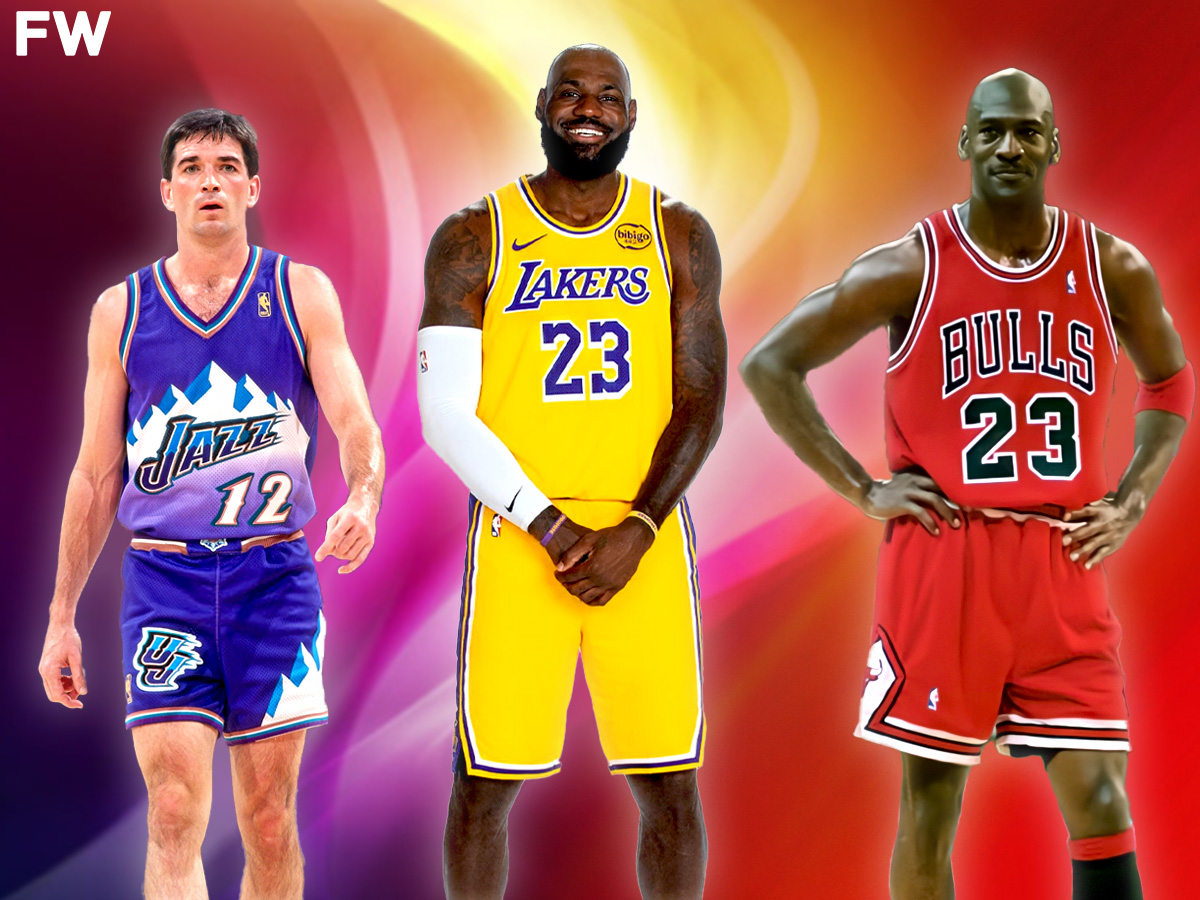
John Stockton’s all-time assists record is 15,806, and this may be the most quietly untouchable record in the modern NBA. People focus on scoring marks because they are easier to visualize, but Stockton’s total is absurd once you look at the distance between him and everyone else. He finished more than 3,000 assists ahead of Jason Kidd, and Chris Paul retired this season as second at 12,552. That means even one of the greatest point guards ever still finished more than 3,200 assists short, and Chris Paul played in the biggest pick-and-roll concentrated era of basketball.
The reason this record is so hard to threaten is that it requires several rare career conditions at once. First, a player has to be an elite passer from the moment he enters the league. Then he has to stay healthy for nearly two decades, keep the ball in his hands every year, and avoid the kind of decline that usually lowers assist totals late in a career. Stockton played 19 seasons and averaged 10.5 assists for his career, which is already ridiculous.
But even that does not fully explain the record. He also stacked monster peak seasons in a way almost nobody else has. He recorded back-to-back 1,000-assist seasons, then kept reaching four digits again and again. He led the league in assists for nine straight years. That kind of sustained control over one statistical category is almost impossible now.
Modern roster design also works against anyone trying to chase him. Teams are less heliocentric at the point guard spot than they used to be, and even elite creators now share initiation duties with wings, secondary ball-handlers, and spread pick-and-roll systems. The ball moves more, but the assists are distributed more widely, too. That is great for offense. It is terrible for someone trying to pile up Stockton-level numbers year after year. Even LeBron James, one of the greatest passers and longevity maestros in league history, sits fourth all-time rather than truly threatening the top spot.
And then there is durability. This is where the record really becomes brutal. One missed month here, one shortened season there, one late-career role adjustment, and the math collapses. A player chasing 15,806 assists would need elite vision, elite health, elite usage, and elite longevity all at once. That combination is just not available anymore. Stockton’s record is not just about passing skill. It is about volume, consistency, and survival over nearly 20 years. That is why it still looks essentially unreachable.
5. Michael Jordan’s 10 Scoring Titles
Michael Jordan’s 10 scoring titles may not look as flashy as a 100-point game or a huge career total, but it is one of the hardest records in the modern NBA to imagine anyone breaking. Jordan is the league’s all-time leader in scoring titles, ahead of Wilt Chamberlain’s seven. That gap shows how far ahead Jordan still is, even among the very best volume scorers the league has ever seen.
The record is so strong because winning one scoring title is not just about talent. It is about domination in a specific season. To win 10, a player has to dominate that category for more than a decade while staying healthy, maintaining top-end usage, and avoiding any significant dip in efficiency or role. Jordan did not just win 10 scoring titles. He won seven straight from 1986-87 through 1992-93, then came back from retirement and won three more from 1995-96 through 1997-98. That kind of control over one statistical category across multiple phases of a career is almost impossible now.
The modern NBA also works against a record like this. Scoring is higher than ever, but it is spread across more stars, more perimeter creators, and more systems built on shared responsibility. A great scorer today has to compete with a deeper pool of high-volume options every year. One season, it is a heliocentric guard. The next is a superstar wing taking 11 threes a game. The season after that, it is a dominant big living inside. That kind of scoring environment creates more volatility, not less.
It also takes only one interruption to derail the chase. A player can be the best scorer in basketball for a decade and still lose multiple titles because of missed games, lower minutes, roster changes, or strategic sacrifice for team balance. Jordan had the talent, but he also had the durability and the sustained offensive burden to keep stacking titles. That combination is rare enough. Doing it 10 times is almost absurd.
So while future stars may eventually push for six or seven scoring titles, getting to double digits feels like a different level entirely. Jordan’s 10 is not just a scoring record. It is a record of yearly offensive supremacy, and that is why it still looks nearly untouchable.
6. Bill Russell’s 11 NBA Championships
Bill Russell’s 11 championships in 13 seasons are one of the most famous records in basketball, and it is also one of the least likely to ever fall. Russell is the standard here, with 11 titles, more than any player in league history. Even on a basic level, that number is absurd. Most great players never win one. Many all-time legends finish with two, three, even four if lucky. Russell won 11.
The obvious argument against the record is the era. The league was smaller then, the playoff field was different, and Russell played on one of the greatest dynasties in sports history. All of that is true. But none of it makes the record easier to chase now. In fact, the modern NBA may make it harder. Free agency creates more movement, new Apron rules mean more parity, stars change teams more often, and sustaining a title core deep into a decade has become extremely difficult. Even dynasties now rarely stay intact long enough to make a serious run at something like this.
That is what separates Russell’s mark from a normal championship count. A player trying to break it would need elite longevity, a nearly perfect organizational environment, repeated health luck across multiple postseasons, and a contender around him almost every single year of his prime. One injury in the wrong May, one front-office misstep, one co-star decline, one contract issue, or one bad matchup can wipe out an entire title path. That is, before you even get to the quality of modern competition, where one championship often requires four brutal playoff rounds against multiple 50-win level teams.
So yes, some records are inflated by context. This one is too. But context does not make it fragile. It makes it historical. Russell’s 11 championships belong to a version of dominance that modern basketball no longer seems able to produce. That is why it remains one of the strongest records on the board.
7. Shai Gilgeous-Alexander’s 132 Straight Games With 20+ Points
This one is different from the others because it is brand new, but it already feels like a record that may last a very long time. Shai Gilgeous-Alexander’s current streak has reached 132 straight games with at least 20 points, the longest such streak in NBA history. Earlier this month, he passed Wilt Chamberlain’s previous mark of 126 by reaching 127 straight. That alone is a ridiculous sentence to write in 2026. Passing Wilt in a scoring consistency category almost never happens.
What makes the record so difficult is that it is not purely about explosion scoring. It is about surviving every kind of game environment without slipping below 20. That means no cold shooting night, no early foul trouble, no load-managed low-minute outing, no game where the score gets out of hand too early, and no random off night in the middle of a long road trip. A 50-point scorer can still lose this kind of streak because the standard is relentless consistency, not just ceiling.
The historical context makes it even stronger. LeBron James owns the NBA’s double-digit scoring streak record at 1,297 games (another unbreakable record), but that is a much lower bar than 20 points every night. Michael Jordan’s previous double-digit mark was 866. By comparison, keeping a 20-point streak alive is exponentially harder because one merely decent game can end it. That is why even LeBron, with all his longevity and scoring volume, never built a 20-point run like this.
There is also a modern roster argument here. Players today rest more often, share offensive responsibility more frequently, and operate in systems that can lower individual scoring on any given night, depending on the matchup and game flow. Gilgeous-Alexander has avoided all of that noise while carrying star-level usage and maintaining elite efficiency. This season, Shai is at 31.5 points per game on 55.5% shooting and 38.8% from three, which helps explain how the streak has stayed alive. But explaining it is not the same as making it repeatable.
That is why this record already feels special. It is one thing to lead the league in scoring. It is another to clear 20 every single night for 132 straight games without blinking. Gilgeous-Alexander did not just set a new record. He pushed a Wilt mark into second place. In a league with more stars and more scoring than ever, that level of consistency may be one of the hardest things to touch again.