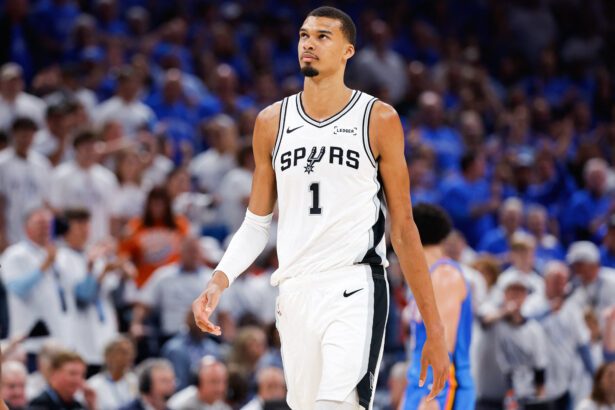
The Blazers’ season ended with a clear lesson. The roster was good enough to reach the playoffs, but not polished enough to survive a real first-round matchup. The Spurs closed the series in five games with a 114-95 Game 5 win, and the Trail Blazers never found enough half-court offense to make the series feel stable.
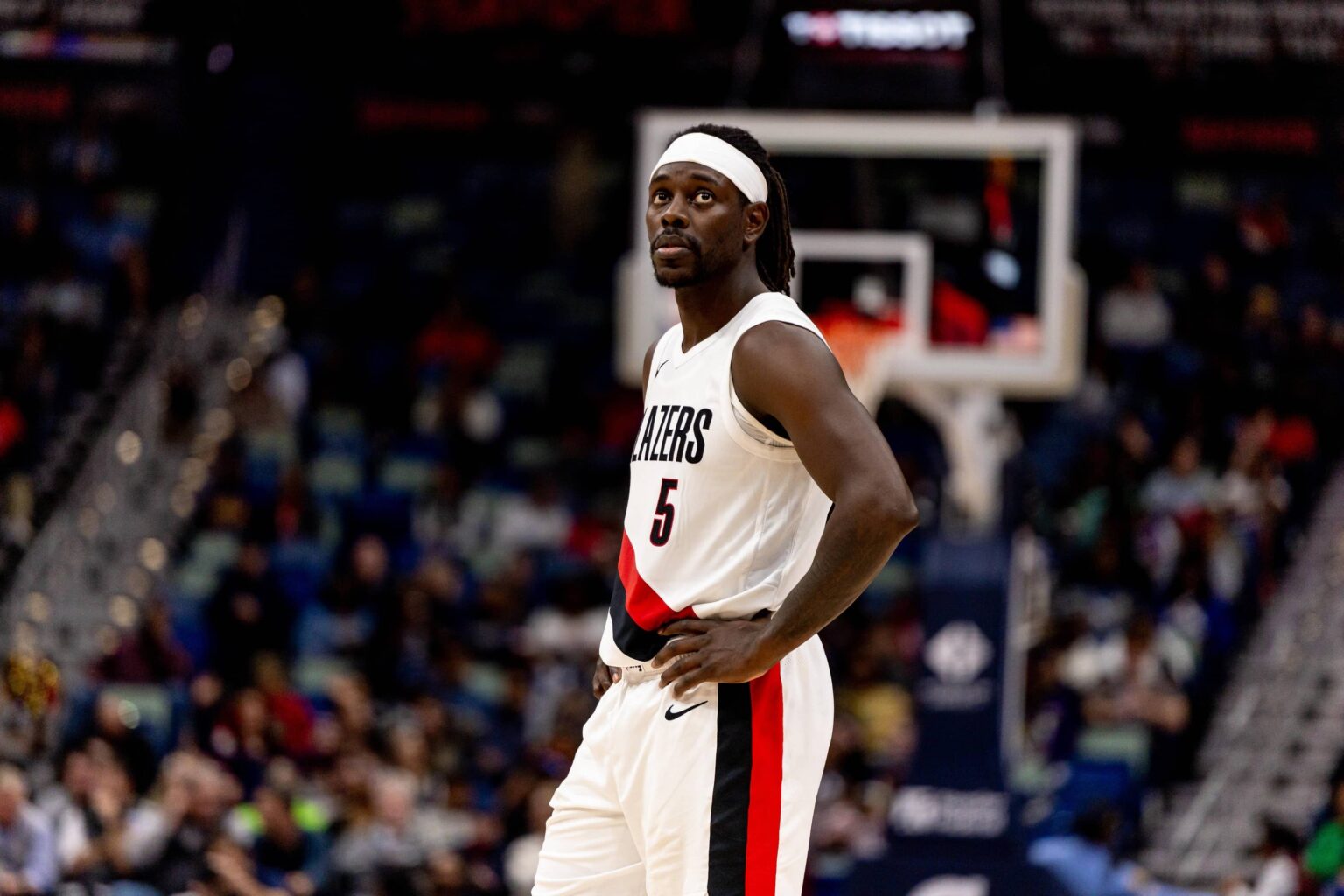
Jrue Holiday was not the reason the Blazers lost. He had an uneven series, including an 8-point closeout game, but he still averaged 16.4 points, 5.4 rebounds, and 7.2 assists across the five games. He also shot 35.3% from 3, which matters because the Trail Blazers badly need reliable spacing around their young guards.
That is why Holiday still has value. He is older, but contenders still pay for playoff guards who defend, organize offense, and do not need 20 shots to help. His regular season was also strong enough: 16.3 points, 4.6 rebounds, and 6.1 assists on 45.1% from the field.
The contract is the issue. Holiday is owed $34.8 million in 2026-27, with a $37.2 million player option for 2027-28. That makes him expensive, but not impossible to move. For the Trail Blazers, the right approach is simple: use Holiday’s value before the contract becomes harder to trade.
7. Los Angeles Clippers
Los Angeles Clippers Receive: Jrue Holiday
Portland Trail Blazers Receive: Bogdan Bogdanovic, Derrick Jones Jr., Isaiah Jackson, Kris Dunn, 2031 second-round pick
This would be the weakest idea on the list, but it still has a basic structure that makes sense. The Clippers would send out around $39.2 million in 2026-27 salary, built around Bogdan Bogdanovic at $16.0 million, Derrick Jones Jr. at $10.5 million, Isaiah Jackson at $7.0 million, and Kris Dunn at $5.7 million. Holiday is at $34.8 million, so the matching is clean from a simple salary standpoint.
The basketball logic is easy for the Clippers. Holiday gives them another veteran guard next to Kawhi Leonard who can defend bigger matchups, handle playoff possessions, and play without dominating the ball. That matters for a team that still has veteran pressure and not enough two-way steadiness at the point of attack. Holiday is not a star scorer anymore, but he is a cleaner late-game player than most available guards in this salary range.
For the Trail Blazers, the value is more complicated. Bogdanovic averaged 7.4 points, 2.6 rebounds, and 2.2 assists while shooting 38.8% from the field this season, so he would be more of a movable veteran shooter than a core piece. Jones is the better on-court fit after averaging 10.3 points, 3.5 rebounds, and 1.4 assists on 50.3% from the field, because the Blazers can always use long athletes who defend and finish.
Jackson would give the Trail Blazers another frontcourt body, and Dunn could cover backup guard minutes or be redirected later. Still, this is not a great return. There is no first-round pick, no premium young player, and no clear long-term starter. The only way the Blazers should consider this is if the market is dry and they mainly want to turn Holiday into smaller contracts before his player option becomes a bigger offseason problem.
6. Phoenix Suns
Phoenix Suns Receive: Jrue Holiday
Portland Trail Blazers Receive: Grayson Allen, Royce O’Neale, Khaman Maluach, Ryan Dunn, 2031 second-round pick
This is the kind of deal the Suns should consider only if they can do it without Dillon Brooks. Brooks is extension-eligible this offseason, and Jake Fischer reported that the Suns want to secure him long term after his role in changing their identity. Mat Ishbia also said he expects Brooks to stay and called him part of the team’s future. That makes him the wrong salary piece for this kind of trade.
The cleaner version is built around Grayson Allen, Royce O’Neale, Khaman Maluach, and Ryan Dunn. Allen is owed $18.1 million in 2026-27, O’Neale is owed $10.9 million, Maluach is owed $6.3 million, and Dunn is owed $2.8 million. That gets the Suns to roughly $38.1 million outgoing for Jrue Holiday’s $34.8 million salary, so the basic matching works.
The basketball case is easy. The Suns need a real point guard. Devin Booker averaged 26.1 points and 6.0 assists this season, but his best version is still as a scorer, not as a full-time organizer. The Thunder series showed the problem. Booker averaged 21.3 points with 4.8 assists and 4.0 turnovers, and he was often forced to solve pressure instead of attacking as a pure shot-maker.
Holiday would help fix that. He is not just a veteran name. He can run offense, guard the ball, and let Booker spend more possessions as a scorer. That also changes the Jalen Green question. Green had 23 points in the Game 4 loss, but after another sweep, the Suns have to ask whether he is more dangerous as a sixth man than as a forced starter next to Booker.
That should not be viewed as a demotion. Scoring guards can destroy second units when their role is simplified. Green could have more freedom, more touches and fewer defensive burdens off the bench. If Holiday starts with Booker and Brooks, the Suns get a real adult guard structure without breaking up the culture piece they clearly want to keep.
For the Trail Blazers, this is a decent but not great return. Dunn gives them a young defensive wing, Maluach gives them another frontcourt prospect, and Allen/O’Neale are movable veterans. The issue is value. Without a first-round pick, the Trail Blazers would need to be very high on Dunn or Maluach to take this seriously.
5. Miami Heat
Miami Heat Receive: Jrue Holiday
Portland Trail Blazers Receive: Andrew Wiggins, Jaime Jaquez Jr., 2031 second-round pick
This is actually a great trade idea because it solves two things at once. The Heat get a real veteran point guard, and the Trail Blazers get one young rotation player plus a large expiring contract for 2027.
The Heat have guards, but they do not have enough pure organization. Tyler Herro is at his best as a scorer. Davion Mitchell can defend and pressure the ball, but he is not the kind of playoff table-setter who changes the entire offensive structure. Jrue Holiday would. Holiday averaged 16.3 points, 4.6 rebounds, and 6.1 assists this season, and his value is still tied to control, defense, and decision-making more than raw scoring.
That is the sell for the Heat. Holiday would let Herro spend more time flying off screens, attacking closeouts, and hunting shots instead of carrying too many playmaking possessions. He would also give the Heat another high-level guard defender next to Bam Adebayo, which is the kind of two-way base Erik Spoelstra can actually build around in a playoff series.
For the Trail Blazers, Jaime Jaquez Jr. is the reason to listen. Jaquez averaged 15.4 points, 5.0 rebounds, and 4.7 assists while shooting 50.7% from the field this season. He is not a star, but he is strong, smart, and useful in multiple lineup types. He can handle, cut, post smaller defenders, and play without needing the offense built around him. That fits the Trail Blazers’ young core much better than another veteran guard on a large salary.
Andrew Wiggins would be the salary piece, but not a bad one. If he picks up his $30.2 million player option for 2026-27, he becomes useful expiring money. That matters because ESPN noted the Heat project to have 2027 cap space tied to the expiring contracts of Herro and Wiggins, with Giannis Antetokounmpo framed as a possible target for the Blazers either via trade or in free agency.
The Trail Blazers can take Wiggins now, keep him as a veteran wing for one season, then use the 2027 flexibility to be more aggressive. If the Trail Blazers want to stay connected to big-game hunting, clearing Holiday’s money while adding Jaquez is a reasonable step.
4. Memphis Grizzlies
Memphis Grizzlies Receive: Jrue Holiday
Portland Trail Blazers Receive: Kentavious Caldwell-Pope, Taylor Hendricks, Scotty Pippen Jr., 2030 first-round pick (via Magic)
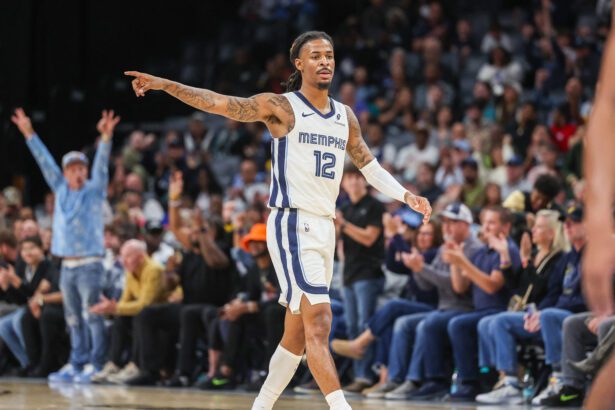
This one depends on the Grizzlies taking one clear direction. If they really move Ja Morant this offseason, Jrue Holiday becomes a logical bridge guard. The Grizzlies discussed Morant trades before the deadline, and some executives expect a better trade market this summer, even if his value is far lower than it was a few years ago. Morant played only 20 games this season and averaged 19.5 points, 3.3 rebounds, and 8.1 assists on 41.0% from the field.
The Grizzlies finished 25-57 and 13th in the West, so this is not a small retool anymore. It looks more like the start of a rebuild or at least a major reset. If Morant goes out, Holiday could come in as the adult guard who keeps the offense organized for their young pieces. That is not the same as chasing a title. It is about giving young players structure, defense, and late-clock stability instead of asking them to develop inside a loose offense.
The salary math can work if Kentavious Caldwell-Pope picks up his $21.6 million player option. Add Taylor Hendricks at $7.8 million, and Scotty Pippen Jr. at $2.5 million, and the Grizzlies send out roughly $31.9 million for Holiday’s $34.8 million salary. The gap is manageable because the Grizzlies are projected to have cap space, and the Trail Blazers would be taking back less money than they send out.
For the Trail Blazers, Hendricks is the main basketball piece. He is a young forward with size, defensive tools, and room to grow next to Scoot Henderson, Shaedon Sharpe, Deni Avdija, and Donovan Clingan. Pippen is also interesting as a backup guard after averaging 11.4 points, 2.2 rebounds, and 4.7 assists on 44.8% from the field this season. He is not a star, but he is cheap, young, and functional.
Caldwell-Pope would be mostly salary ballast, but not useless. He averaged 8.4 points, 2.5 rebounds, and 2.7 assists, and he still profiles as a veteran wing who can defend and space the floor. The real prize is the 2030 first-round pick. The Grizzlies received that unprotected pick from the Magic in the Desmond Bane trade, so they have the draft capital to build this kind of offer without touching every young piece.
For the Blazers, this is a strong middle-ground return: one young forward, one young guard, one first-round pick, and cleaner long-term flexibility.
3. Dallas Mavericks
Dallas Mavericks Receive: Jrue Holiday
Portland Trail Blazers Receive: PJ Washington, Klay Thompson, 2031 second-round pick
This is one of the more interesting ideas because it is not just a salary dump for the Trail Blazers. It gives them a real forward who can stay in the rotation beyond the trade.
The salary math is good. PJ Washington is owed $19.8 million in 2026-27, and Klay Thompson is owed $17.5 million. That gets the Mavericks to around $37.3 million outgoing for Jrue Holiday’s $34.8 million salary. The Mavericks would send out more money than they take back, which makes the structure much easier from a basic matching standpoint.
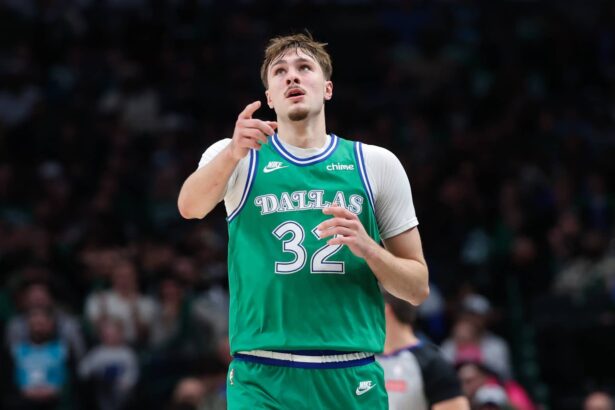
The Mavericks’ logic is pretty simple. They just finished 26-56, 12th in the West, and the whole franchise is starting a new front-office chapter after hiring Masai Ujiri as team president. ESPN reported the move on May 4, after a rough season that included the firing of Nico Harrison and a roster reset around the Rookie of the Year award winner Cooper Flagg.
Holiday would not make the Mavericks a contender by himself, but he would give them an adult guard next to Flagg. That matters. A young star wing needs spacing, defensive structure, and someone who can get him the ball in the right spots. Holiday can do that while also taking the tougher guard assignment most nights. He is not just a locker-room veteran. He is still a useful two-way starter if the role is right.
For the Trail Blazers, Washington is the whole point. PJ Washington averaged 14.2 points, 7.0 rebounds, and 1.8 assists while shooting 45.0% from the field this season. That is not star production, but it is exactly the kind of forward profile the Blazers should want: size, strength, defensive flexibility, and enough shooting to fit next to Scoot Henderson, Shaedon Sharpe, Deni Avdija, and Donovan Clingan.
Thompson is different. Klay Thompson averaged 11.7 points, 2.1 rebounds, and 1.4 assists on 39.3% from the field, so the Trail Blazers would not be making this trade for peak shooting value. They would be taking him as a one-year salary piece, a veteran spacer, and a contract that clears in 2027.
That is why this deal ranks high. The Trail Blazers get Washington, a player who can actually help their core, while also turning Holiday’s $37.2 million player option for 2027-28 into cleaner future money. The only weakness is the pick. A single second-round pick is light. If the Mavericks are serious, the Trail Blazers should push for better draft compensation. But even as written, Washington gives this package real value.
2. Denver Nuggets
Denver Nuggets Receive: Jrue Holiday
Portland Trail Blazers Receive: Christian Braun, Zeke Nnaji, Julian Strawther, Jalen Pickett, 2031 second-round pick
This is the best pure player-return deal outside the No. 1 option. The Nuggets would be taking a big swing on playoff defense, while the Trail Blazers would be getting a young starting-caliber wing and multiple smaller pieces.
The salary math is workable. Christian Braun is owed $21.6 million in 2026-27, Zeke Nnaji is owed $7.5 million, Julian Strawther is owed $4.8 million, and Jalen Pickett is owed $2.4 million. That puts the Nuggets at roughly $36.3 million outgoing. They would also be sending out more salary than they receive, which matters for a team operating near expensive roster territory.
The Nuggets’ case is clear. They went 54-28 and finished third in the West, but their season still ended in the first round against the weakened Timberwolves. That kind of exit changes the conversation. When a team has Nikola Jokic, Jamal Murray, and Aaron Gordon, losing early usually pushes the front office toward proven playoff players, not more patience.
Holiday would be a very strong fit next to Jokic and Murray. He would take pressure off Murray as a secondary ball-handler, defend the best opposing guard, and give the Nuggets another player who can survive late-game playoff possessions. He would not need to dominate the ball. That is the point. Holiday can play as a connector, cutter, spot-up option, and defensive guard while Jokic still controls the offense.
For the Trail Blazers, Braun is the prize. Christian Braun averaged 12.0 points, 4.8 rebounds, and 2.7 assists on 51.9% from the field this season. He is not a creator, but he is a strong two-way wing who can run, cut, defend, and play fast. That fits the Blazers better than an older guard on a huge contract.
The concern is the contract. Braun signed a five-year, $125.0 million extension, and that makes him expensive before he has fully proven he can be more than a high-level role player. The extension came after his third-year leap, when he averaged 15.4 points and shot 58.0% from the field in 2024-25. That gives the upside case, but the Trail Blazers would still be absorbing big money for a player who underperformed in the postseason.
Strawther would be the second interesting piece. He averaged 7.2 points, 2.0 rebounds, and 1.1 assists on 46.7% from the field this season. He is not a guaranteed rotation player, but his shooting profile gives the Blazers something they need around Henderson and Sharpe.
Pickett is useful guard depth after averaging 5.2 points, 2.3 rebounds, and 2.3 assists, while Nnaji is mostly salary ballast at this stage after averaging 3.7 points and 2.6 rebounds. The Trail Blazers would not be doing this for them. They would be doing it for Braun, Strawther, and the chance to get younger without fully bottoming out.
This is a strong offer because it gives the Trail Blazers a real wing who can help now. It is not perfect because Braun’s contract is large, and the draft compensation is light. Still, if the Nuggets are desperate to maximize the Jokic window after another playoff disappointment, this is the kind of aggressive veteran move that would at least make basketball sense.
1. Orlando Magic
Orlando Magic Receive: Jrue Holiday
Portland Trail Blazers Receive: Anthony Black, Jonathan Isaac, Goga Bitadze, Tristan Da Silva
This is the best trade idea for the Trail Blazers because it gives them the best mix of youth, size, defense, and contract control. It also makes sense for the Magic if they decide their first-round collapse was not just a coaching issue.
The Magic blew a 3-1 lead against the Pistons, lost Game 7 by 22 points, and fired Jamahl Mosley after a third straight first-round exit. The worst part was Game 6, when they blew a 24-point second-half lead, missed 23 straight shots, and got booed by their own fans. President of Basketball Operations Jeff Weltman said the team needed a “new perspective” and had to study “what works, what doesn’t work.” That should include the roster, not just the bench.
The backcourt is the obvious place to start. Jalen Suggs should not be thrown away, but he is going to face hard questions. Suggs averaged 12.0 points and 4.2 assists in the series while shooting 30.8% from the field and 26.0% from three, as the experiment of using him as a point guard was murky against the Pistons. That does not mean the Magic must move him, but it does mean they need a more stable guard next to Paolo Banchero and Franz Wagner.
That is where Jrue Holiday fits. Holiday would not fix the shooting problem alone, but he would fix a lot of the organization problem. He can run offense, defend the best guard, and keep Banchero and Wagner from creating against a loaded defense every trip. For a team that just collapsed because its offense stopped functioning, that has real value.
The shooting issue is also why Anthony Black could become the sacrifice. The Magic shot only 34.3% from three this season, as their offensive struggles, especially from outside, became a reason for Mosley’s firing. Black averaged 15.0 points, 3.8 rebounds, and 3.7 assists on 44.7% from the field, so he has real value, but his long-term fit becomes harder if the Magic decide they need more spacing and better guard roles around their stars.
There is also a contract angle. Black is extension-eligible this offseason, and he could demand starter money even though he has mostly come off the bench. That matters for a team already getting expensive. The Magic are projected to have around $217.0 million in salary with Banchero’s extension kicking in, roughly $9.4 million above the first apron and only $3.6 million below the second apron.
The salary math works. Black is owed $10.1 million in 2026-27, Jonathan Isaac is owed $14.5 million, Goga Bitadze is owed $7.6 million, and Tristan Da Silva is owed $4.0 million. That gets the Magic to about $36.2 million outgoing for Holiday’s salary.
For the Trail Blazers, Black is the prize. He is a big guard with defensive tools, secondary playmaking, and enough production to bet on. Da Silva is another useful forward prospect after averaging 9.9 points, 3.7 rebounds, and 1.6 assists. Bitadze averaged 5.9 points and 5.0 rebounds on 67.6% from the field, giving the Blazers a movable big. Isaac is not a long-term centerpiece, but his defense and $14.5 million salary can still have value if managed correctly.
This is the best deal because the Trail Blazers would not just be dumping Holiday’s contract. They would be turning an older guard into a young backcourt piece, another forward, a useful big, and cleaner flexibility. If the Magic are serious about changing the roster after that collapse, Black is exactly the kind of talented but imperfect player who could become available.