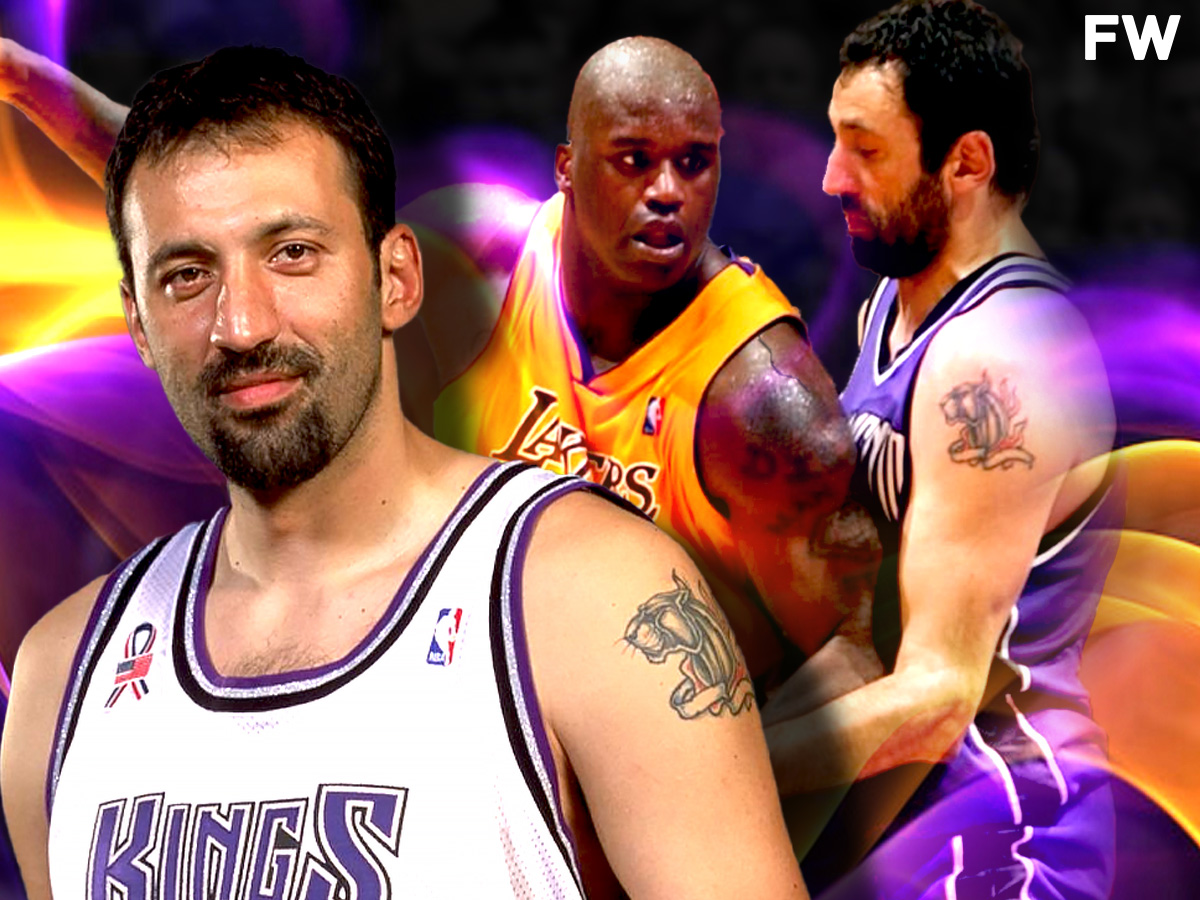
Vlade Divac admitted he leaned on an unusual tactic to survive one of the most dominant forces in basketball history. Facing Shaquille O’Neal at his peak left little room for traditional defense, so Divac looked for any edge he could find. His answer was simple and calculated. He turned flopping into a strategy.
Speaking on Byron Scott’s Fast Break podcast, Divac explained how preparation against O’Neal required a different mindset.
“My approach when I was playing against him, watching film before the games, I tried to find other ways, not to beat him, but to make him tougher. I realized if I go up and down, if I start running fast breaks, I can make him tired because of his size. So he may have less energy on offense. And obviously, I created flopping.”
“There was a point where he would go into you, and there’s no way you can stand, and the referee wouldn’t call a foul, especially when we played at home. I would go down, make the crowd react, put pressure on the referees, and they started calling it. I said, ‘Oh, this is going to work.'”
“Every game before the game, I’d say, what’s up big fella, you got two fouls already, man. He was pissed.”
“Soccer players did that in Europe, and I love watching soccer, so I just brought it to the NBA. But I was doing it against Shaquille O’Neal.”
Divac traced the idea back to watching soccer in Europe, where players regularly used similar tactics to influence referees. He brought that approach into the NBA and applied it specifically against O’Neal. Over time, it became part of his identity in those matchups. He even used psychological tactics, joking with O’Neal before games and telling him he already had fouls, trying to plant doubt and frustration before tipoff.
The numbers highlight how difficult the matchup remained. O’Neal and Divac faced each other 48 times, with O’Neal holding a 27-21 edge overall. In the regular season, the matchup was even at 16-16, but the playoffs told a different story, where Shaq led 11-5. Statistically, O’Neal dominated. He averaged 29.1 points, 13.7 rebounds, and 2.2 blocks in those games. Divac, by comparison, averaged 10.9 points, 8.3 rebounds, and 2.9 assists.
Their most intense battles came during the 2002 Western Conference Finals between the Los Angeles Lakers and Sacramento Kings. That series remains one of the most debated in NBA history, particularly Game 6, where officiating decisions drew heavy criticism. Divac’s flopping became a talking point throughout that series, both as a tactic and as a symbol of how teams tried to counter O’Neal’s physical dominance.
Beyond the controversy, Divac’s admission reflects a broader truth about that era. There were few answers for O’Neal in the paint. Teams had to improvise, whether through double teams, fouls, or mind games. Divac chose a method that forced referees into the equation. It did not stop O’Neal, but it created moments where the game could shift.
On the same podcast, Divac reflected on key career moments, saying he would trade an entire team for Kobe Bryant. He admitted passing on Luka Doncic was a mistake, praised Arvydas Sabonis as an all-time level talent, and claimed Michael Jordan and Magic Johnson would dominate even more today.
In today’s NBA, flopping has become a league-wide issue, with fines and rule changes aimed at limiting it. Divac’s comments show that the roots of that tactic go back decades, shaped by necessity against players who pushed the limits of physical dominance.