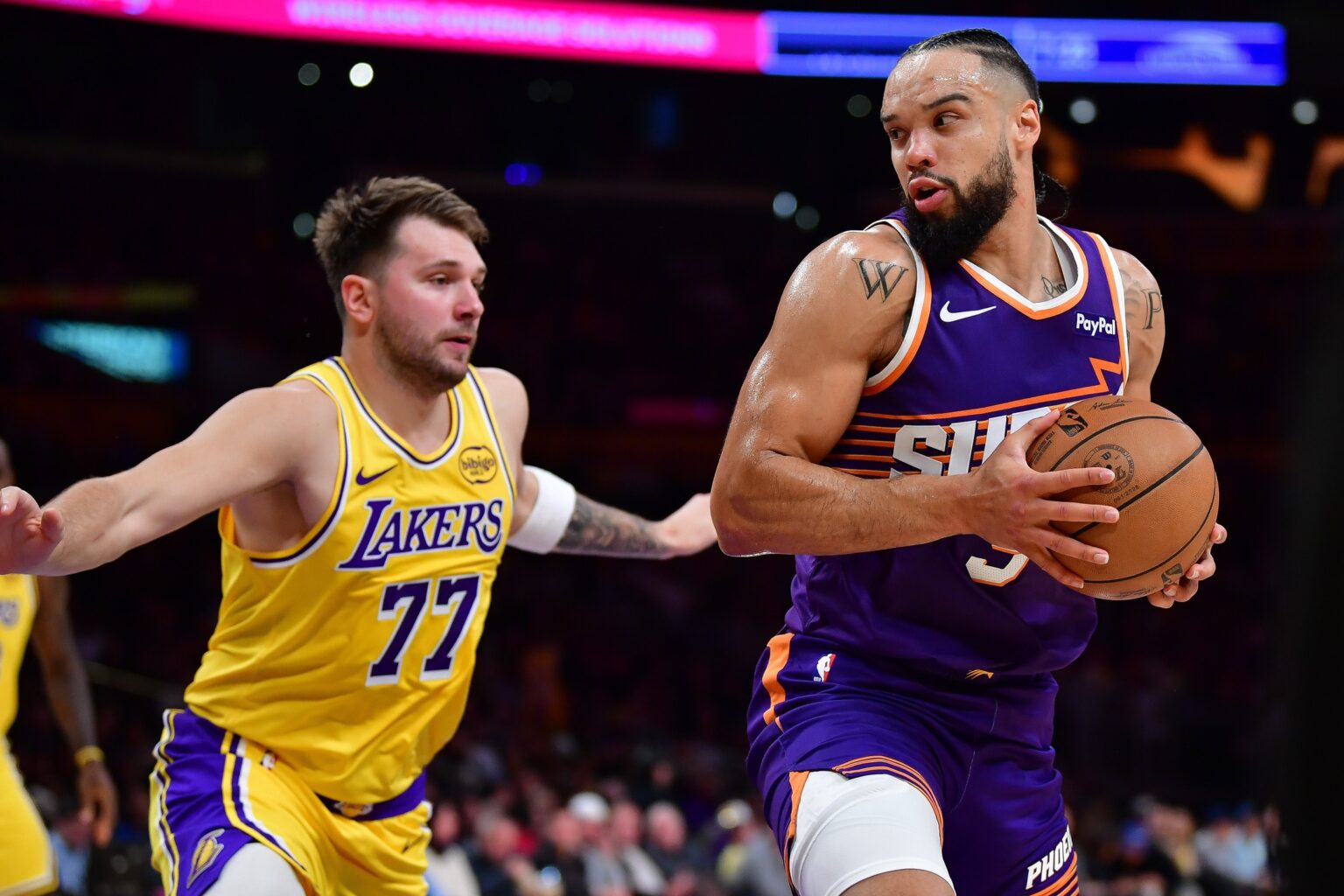
The Los Angeles Lakers can score with anybody, but they still can’t consistently stop anybody. And that’s exactly why one name keeps popping up as the deadline creeps closer: Dillon Brooks.
Bleacher Report’s Dan Favale recently listed Brooks as one of the Lakers’ top trade targets as they look for a real perimeter stopper who can take the nastiest wing assignment every night. And honestly, it checks out. The Lakers are 21-11, sitting 1st in the Pacific and 5th in the West, but their defense has been a roller coaster all season.
They own a 118.4 defensive rating, which ranks 25th in the league. Even their latest win came with the vibe of a team grinding for air, since that victory over the Memphis Grizzlies was only their second win in six games.
Brooks, now with the Phoenix Suns, is having one of those seasons that forces you to take him seriously, even if you hate the antics. He’s putting up 21.5 points, 3.1 rebounds, 1.7 assists, and 1.3 steals, while shooting 45.7% from the field and 33.9% from three. That’s not “just a defender” production, that’s a legit two-way wing line, even if the shot selection still screams chaos.
And yeah, the elephant in the room is the LeBron James beef. Brooks famously leaned into the villain role in that old playoff series, calling LeBron “old” and bragging about “poking bears.” So the idea of him walking into the Lakers locker room is either a disaster… or the exact kind of uncomfortable edge this team desperately needs.
If the Lakers want to stop bleeding points on the perimeter and actually look like a team that can survive four playoff rounds, they need a guy who lives for the ugly work. Brooks is that guy.
So… here are three potential trade scenarios that could realistically land Dillon Brooks on the Lakers.
Trade Scenario 1: The “Give LeBron A Bodyguard” Deal
Lakers Receive: Dillon Brooks
Suns Receive: Jarred Vanderbilt, Gabe Vincent, 2031 first-round pick
This is the cleanest, most believable version of a Dillon Brooks-to-Lakers swing because it matches the exact thing Dan Favale highlighted when he tossed Brooks into the Lakers’ target pool: they need a perimeter stopper with bite, not another “maybe he’ll try on defense tonight” option.
From the Lakers’ side, Jarred Vanderbilt is the obvious sacrifice. He’s a useful chaos-forward, but his current production is basically a role-player’s role-player: 5.0 points and 5.3 rebounds a night. The Lakers can live without that if the return is a wing who actually changes matchups in a playoff series. And if we’re being real, the Lakers’ biggest issue isn’t “we need more hustle rebounds.” It’s that teams torch them from deep, with opponents hitting 38.1% from three against them. Brooks directly attacks that problem because he gives you a guy who will pick up full-speed, fight through screens, and make scorers work for every breath.
Gabe Vincent is the sweetener salary-wise, but it’s also an honest basketball fit for the Suns. He’s only at 4.7 points per game and shooting 35.0% from the field this season, and he’s been out, so the Lakers aren’t exactly moving a cornerstone. But to the Suns, that’s a low-risk guard flyer plus a real defender in Vanderbilt, plus the part that actually matters: a first.
Why would the Suns even listen? Because Brooks has been so important to their identity that the only way you even get them to pick up the phone is by paying in future flexibility. That first-rounder is the lever. The Suns also get two defensive-minded pieces back for a team that still wants to win now, not a full teardown.
Money-wise, it’s simple enough to sell in a meeting. Brooks sits around $21.1 million this season, while Vanderbilt and Vincent combine to roughly the same neighborhood, and the Lakers aren’t doing anything exotic here.
The real risk for the Lakers is obvious: you’re attaching a first for a guy who comes with… a personality. But if you’re watching this team give up clean threes all season, you can talk yourself into it fast. This is the move that screams, “we’re done being polite.”
Trade Scenario 2: The Win-Now Extra Package
Lakers Receive: Dillon Brooks, Nick Richards
Suns Receive: Gabe Vincent, Maxi Kleber, Dalton Knecht, 2032 first-round pick, 2032 second-round pick
This is the aggressive one. Not “throw a pick in” aggressive, but “we’re trying to win a round or two right now” aggressive.
If the Lakers are serious about upgrading their defense without pretending they don’t also need functional size behind Deandre Ayton, Richards is the sneaky add. He isn’t putting up loud numbers, with 3.3 points and 3.5 rebounds per game, but he’s a real center body you can use in the regular season to keep the frontcourt fresh every night. The sell is workload management without saying “load management.”
The price is heavier because the Suns are giving up two rotation solutions, so they demand actual assets. Dalton Knecht is the name that stings. He’s at 5.4 points per game on 46.7% from the field, and he’s exactly the kind of cheap shooter teams talk themselves into developing. The Suns would love that on a roster that already has star gravity.
Kleber is mostly salary structure and frontcourt insurance. His numbers are rough: 1.8 points per game and 31.0% from the field, but the Suns wouldn’t be trading for him to score anyway. They’d be trading for an expiring $11 million contract and a stretch look they can plug in when they want spacing.
Vincent is the same logic: a contract that helps make the math work, plus a guard you can hope looks better in a different environment. Then the picks do the real talking. A 2032 first is the type of asset that keeps a front office from feeling like it just gifted a rival a playoff weapon.
Realism-wise, this is the kind of deal that happens when one side wants to consolidate, and the other wants volume. The Suns get three players and two picks, which is exactly what a team does when it loves the player but hates the idea of losing him for nothing. The Lakers get the exact thing they need: a defense-first tone shift with teeth.
This one hurts, but it also feels like the Lakers finally admitting something out loud: the current formula is too flimsy when the games get ugly.
Trade Scenario 3: The “Suns Cash In, Lakers Go Full Villain” Blockbuster
Lakers Receive: Dillon Brooks, Jordan Goodwin
Suns Receive: Rui Hachimura, Dalton Knecht, Adou Thiero, 2031 first-round pick, 2032 second-round pick
If you want the version that would make fans argue for three straight days, it’s this one.
From the Lakers’ perspective, you’re basically choosing violence. You’re not just adding Brooks, you’re also grabbing Goodwin, a hard-nosed guard who plays like every possession is personal.
He’s at 8.7 points, 4.6 rebounds, and 2.2 assists a night, even if the efficiency hasn’t been pretty at 39.8% from the field. But that’s not why you want him. You want him because the Lakers have too many stretches where the intensity disappears, and Goodwin doesn’t have an “off switch.”
The Suns’ return is about controlled value. Rui Hachimura is the best player they get, and he’s producing: 12.7 points per game while shooting 52.1% from the field. That’s a real wing scorer who can fit next to Devin Booker and Jalen Green without needing the ball every possession. Knecht gives them a young shooter archetype, and Thiero is a developmental flier, 1.3 points per game right now, but still a cheap upside swing.
And then come the picks, which is the part that makes the Suns even consider moving a guy who has become a cultural engine for them. A 2031 first is distant, but that’s exactly why it has juice. Front offices love “the pick after the window.” Add the 2032 second, and suddenly the Suns can sell it internally as a retool without calling it a step back.
This is the type of deal you see when one team wants a cleaner playoff identity and the other team wants to avoid being trapped in one lane. Also, the Suns are winning right now, but that doesn’t mean they ignore value if the offer gets reasonable enough.
For the Lakers, the cost is obvious. You’re giving up a real scorer in Hachimura plus a recent first-round talent in Knecht. That’s not nothing. But if you believe the Lakers’ biggest issue is that opponents bomb threes and clean paint drives on them all season, you can justify paying for a true defensive tone-setter.
This is the “we’re done being nice” trade. If the Lakers want to scare teams in April, this is how they do it.
Final Thoughts: What’s The Best Package, And How Likely Is Any Of This?
This isn’t just about “finding a wing.” This is about the Lakers admitting they have a very specific problem, and the Suns knowing it.
When a contender broadcasts a need this loudly, the price usually goes up, not down. Everybody can see the Lakers getting hunted on the perimeter, everybody can see why Brooks fits, and that leverage matters.
That’s why I don’t really buy the idea that the Lakers can come in with a tidy, polite offer and steal him. If the Suns even entertain this, they’re going to push for an overpay, because they can. They’re the ones holding the exact archetype the Lakers don’t have, and those guys don’t hit the market often.
Now add the bigger issue: LeBron James. This isn’t some old playoff storyline that people meme about once a year.
It literally flared up again this season, with the Lakers and Suns having multiple heated games, including one where Brooks got ejected after getting into it with LeBron in the final seconds. That matters, because this trade only works if LeBron signs off on the locker-room reality of it.
You’re asking him to share a huddle with the guy who has spent years trying to embarrass him, and who just escalated the rivalry again on the court this season. The basketball fit can be perfect, and it still dies right there.
If we’re talking “best package,” I still lean Scenario 1 as the best basketball value for the Lakers, because it upgrades the exact problem without ripping out too much of the rotation’s scoring structure. But if we’re talking how the real world works, Scenario 1 might not be enough if the Suns decide to play hardball. The Lakers can call it an overpay, the Suns can call it the cost of desperation, and both can be right.
That’s where Scenario 3 starts to feel like the most realistic path if talks ever get serious. Not because the Lakers should want to bleed depth, but because the Suns would want something that actually makes them feel like they won the trade the second it’s announced.
A legit rotation scorer, a young shooter prospect, and picks is the kind of package that stops this from being “why did we help the Lakers?” and turns it into “we just cashed a chip in at peak value.” It’s also the kind of offer that could force the Lakers to prove how badly they want this.
How likely is any of it? Right now, I’d still call it unlikely. Not impossible, but unlikely. The Suns have zero reason to make the Lakers’ lives easier unless the return is so strong it’s irresponsible to turn down. And on the Lakers’ side, there’s a very real chance LeBron takes one look at the idea of sharing a season with Brooks after what just happened between them and says, “find me somebody else.”
So yeah, my read is this: if it happens, it probably looks more like an overpay than Lakers fans want to admit, and it only happens if the Lakers are all-in on the “villain defense” pivot and LeBron actually buys into it.
If either one of those things is shaky, this turns into exactly to a pivot to other wing defender options while the Brooks idea stays as a fun headline and a nasty what-if.