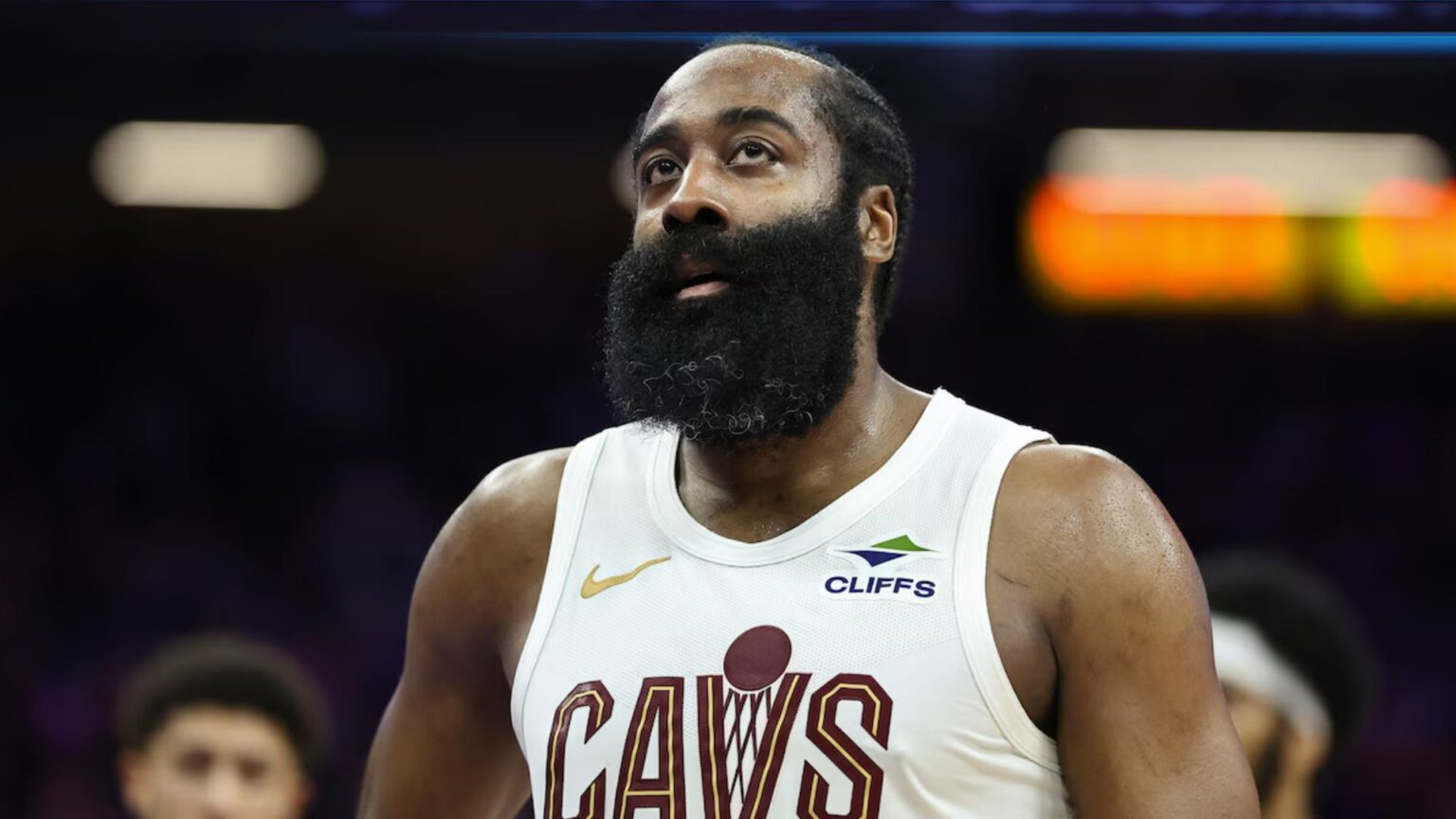
The Cleveland Cavaliers did not trade for James Harden to win in February. They did it because their postseason problem was obvious: when Donovan Mitchell sat, the offense could stall into empty possessions and late-clock pull-ups. The front office agreed it could not stand pat, even with a top-four seed, because the ceiling was still fragile in the exact moments that decide playoff series.
The Harden swing was clean and aggressive. The Cavaliers acquired him from the Clippers for Darius Garland and a future second-round pick, with Harden needing to approve the deal because of his contract structure. The move came with immediate return. A few days after the trade, the Cavaliers were 4-0 since acquiring Harden, and they have kept stacking wins since, sitting 36-22 and fourth in the East heading into March.
The question is not whether Harden can help in the regular season. He can. He’s scoring 24.7 points per game with 8.2 assists, getting to the line for 8.2 free throw attempts, and he’s still living at the skill intersection that breaks defenses: pull-up threes, foul pressure, and passing windows that most guards do not even see. The real question is the one he has carried for a decade. When the game slows, the scouting gets personal, and the whistle tightens, can he be trusted this time?
Why The Cavaliers Made The Harden Bet
The Cavaliers’ logic starts with Donovan Mitchell’s reality. Mitchell is having a monster season at 28.6 points, 4.5 rebounds, and 5.9 assists on 48.6% from the field. He can carry an offense for long stretches. He cannot carry every minute, every game, every series without help, especially when the opponent’s plan is to sell out on the first action and force the ball into a second creator’s hands.
That is where the Darius Garland situation matters. Garland is a good player, but the season did not cooperate. He had been sidelined since mid-January with a toe injury and was averaging 18.0 points and 6.9 assists in 26 games. If you are trying to win now, you cannot build your postseason offense around “maybe he’s right by April.” Harden is older, but he is also more plug-and-play in a playoff offense. One ball handler, one screener, one corner shooter, and you can create an advantage that looks the same every night.
The Cavaliers also did not stop with Harden. Before the deadline, they moved De’Andre Hunter in a deal that brought in Dennis Schroder and Keon Ellis, as Schroder was averaging 12.8 points and 5.3 assists, and Ellis was at 5.6 points and 1.1 steals. That matters for two reasons. First, it gives coach Kenny Atkinson more ways to cover for Harden defensively with a real perimeter stopper next to him. Second, it creates a lineup structure where Mitchell does not have to do everything with the ball, and Harden does not have to cover for him every time he sits, either. In the playoffs, that balance is oxygen.
There is also a contract reality underneath it all. Harden is expensive, and the Cavaliers knew that going in. He sits at $39.2 million this season with a $42.3 million Player Option next to it. The Cavaliers still did it because their goal is not to “win the transaction.” It is to win the series that ends their season every spring.
What Harden Has Actually Changed On The Floor
Start with the macro profile. The Cavaliers are not winning by accident. They have an 118.5 offensive rating and a 4.2 net rating, which is the kind of shape real contenders live in over big samples. NBA.com’s advanced metrics also have them fifth in offensive rating at 117.6, reinforcing that this is an upper-tier offense, not a hot streak offense.
Harden’s specific value is that he makes good offense feel inevitable. His true shooting percentage is 60.4% this season. He is not doing it with pure explosion anymore. He is doing it with pace control. He walks defenders into screens, drags bigs a half-step too far, then picks the pass that turns “contained” into a layup or a corner three.
This is where Evan Mobley and Jarrett Allen become central to the Harden argument, not side characters. Evan Mobley is at 17.7 points, 8.6 rebounds, and 3.9 assists on 51.4% from the field. Jarrett Allen is at 14.8 points and 8.5 rebounds while shooting 62.8% from the field. Put those two in actions with Harden, and the reads simplify. If the big is up, Harden throws behind the defense. If the big is back, Harden walks into the pull-up three or snakes into the paint to force help.
The other big shift is how the Cavaliers can now manage Mitchell’s minutes. A lot of Mitchell’s toughest playoff moments have not been about his talent. They have been about workload. With Harden, the Cavaliers can keep a real creator on the floor almost all the time. That reduces the “survive these four minutes” stretches that show up in every postseason series.
Lineups data backs up the feel. The Cavaliers have posted a 128.1 offensive rating with Harden on the floor, and a 132.0 offensive rating in the minutes Harden and Mitchell share. Those are video-game numbers, and even if you treat them as small-sample caution signs, they point to a real truth: the Cavaliers’ offense looks harder to guard when the opponent cannot load up on one creator.
It also fits the team’s tempo. The Cavaliers are now seventh in pace at 101.06, which is fast enough to weaponize Harden’s early-offense passing without turning the game into chaos. That’s the sweet spot. Harden doesn’t need to sprint. He needs the defense to be a half-organized defense, not a fully-set defense.
Why “Trusting Harden” Still Feels Dangerous
If you’re writing the skeptical case, you start with the part that never goes away: the playoffs change the rules. Harden has a long track record of brilliant regular-season offense and uneven postseason outcomes. He is 10-16 in career elimination games. And in elimination games over a long stretch with the Rockets, Harden averaged 26.0 points but shot 40.6% from the field and 33.9% from three.
That does not mean he “can’t” play in the playoffs. It means the margin is thinner than people want to admit. When the whistle tightens, you need clean shots. Harden still gets to the line a lot, but that is not a guarantee in May. He is also still a high-turnover creator, averaging 3.6 turnovers per game this season. Playoff defenses live for those. They do not need to stop you every trip. They just need you to give them two live-ball mistakes a quarter.
Then there is defense, the part that either gets ignored or hand-waved away. Harden is strong, and he can hold up in switches for a possession. Over a series, he will be targeted. He will be dragged into every screening action until the opponent finds the coverage crack that forces help and creates the open shot. While Harden has been transformative offensively, the Cavaliers’ defense has dropped with him on the floor. If Harden is on the court deep in the playoffs, the Cavaliers have to win those minutes with offense. There is no other way.
Health is the final piece of the distrust argument, because Harden’s history is not clean. The hamstring has been an issue in past playoff runs, and it quickly changed the Nets series against the Bucks in 2021 when he exited early after re-injuring it. Harden has been durable lately, and durability is part of the appeal in the deadline context, but the question still exists because it has existed before.
So if “trust” means “bet your season on Harden being your best player,” the answer should still be no. That is not what this is.
What “Trust” Should Mean For This Cavaliers Team
The strongest argument for Harden in Cavaliers colors is that he does not have to be the top guy. Mitchell is the alpha scorer. Mobley and Allen are the interior backbone that can keep the defense functional even when perimeter matchups get hunted. That changes Harden’s job description from “carry us” to “organize us.”
That’s also why the Cavaliers’ record since the deal matters, even if it’s not proof. The 4-0 start after acquiring Harden is part of a broader surge, and the Cavaliers have remained near the top of the East and unbeaten until Sunday against the Thunder. This is not a roster that needs Harden to average 30. They need him to keep the offense coherent for 48 minutes.
The East context is where it gets real. The Pistons are first, the Celtics second, the Knicks third, and the Cavaliers fourth. If the Cavaliers want to get out of that bracket and give themselves a clearer path, they need to bank wins. They also need to look like a team that can win two different kinds of playoff games: the fast, free-flowing nights and the ugly, late-clock nights.
Harden helps with the second type, but only if the Cavaliers commit to what he does best. That means living in pick-and-roll, forcing switches, and then punishing the mismatch without over-dribbling. It also means accepting that the prettiest version of the offense is not always the best version. The best version is the one that creates the same advantage over and over, even when the opponent knows it’s coming.
There’s a second, quieter benefit, too. The Cavaliers can now keep Mitchell fresher late. In the postseason, that can decide a series. When Mitchell is asked to initiate every action, he ends up finishing possessions he didn’t create. Harden flips that. He can create the advantage, and Mitchell can finish it. That is a better use of both players, and it’s why the pairing has looked so dangerous in early data.
My take is simple: Harden can be trusted if the Cavaliers define the trust correctly. Trust him to raise your offensive floor, to stabilize the non-Mitchell minutes, and to manufacture decent shots when the play is dead.
Do not trust him as a one-man playoff solution like the Rockets, Nets, and 76ers did. Back then, he was not only the organizer but also the primary scorer most of the time. The Cavaliers cannot let that happen again, and they have the pieces to avoid the late “please save us” moments that Harden has struggled with during his entire postseason career.
Can Harden Beat His Reputation This Time?
James Harden’s postseason reputation was not built on random bad nights. It was built on the specific type of burden that shows up in May: when one player is asked to score, create, and be the entire structure of an offense while the defense sells out to remove his first option.
The clearest modern example is still the 2023 East semifinals against the Celtics. Harden had signature highs in that series, but the ending is what stuck. In Game 7, with everything on the line, Harden finished with nine points on 3-of-11 shooting (1-of-5 from three), five turnovers, and a -30 plus-minus in a 112-88 loss.
That game became the summary of the fear teams have always had with him: when the defense loads up, the legs get heavy, and the possessions turn into late-clock isolation, Harden’s scoring can disappear at the worst time.
The bigger sample points in the same direction. In elimination games for his career, Harden averages 22.1 points, 6.5 assists, and 5.4 rebounds, with a 38.5 win percentage. Those aren’t terrible numbers in a vacuum. But they do not match the standard required when you are the primary reference point for a contender, especially when opponents are willing to force the ball out of your hands and live with the chaos.
That is why “trust” has to be defined carefully with the Cavaliers. If Harden is being asked to be the heliocentric engine, history says the odds get worse when the games get tighter. If he’s being asked to stabilize the offense, win the non-Donovan Mitchell minutes, and keep the team organized against playoff pressure, that is a more realistic use of what he still does at a high level.
That is the difference between repeating an old story and writing a new one.