The Houston Rockets saw their season end in brutal fashion in Game 6 against the Los Angeles Lakers, and one stretch of play summed up exactly why major changes are needed. In an elimination game at home, Houston produced one of the worst offensive sequences of the postseason, scoring just three points over a 10-minute 24-second stretch that completely flipped the game.
What started as a competitive 16-11 contest quickly spiraled into a 39-19 deficit after a devastating 27-3 Lakers run. From the 5:19 mark in the first quarter to 6:55 in the second, the Rockets failed to score a single field goal. Their only points came from free throws, highlighting how completely the offense stalled under pressure.
The Rockets’ game 6 was lost when they scored 3 points in 9:49 minutes of game time… a 27-3 run to the Lakers
16-11 became
39-19 down
Houston during that stretch:
0/15 FG
0 assists
6 turnovers
8.9 TS%
0.17 points per possession
25.0 REB%
1 offensive rebound
0… pic.twitter.com/55u75eCgm0
— Steven Adams Stats (@funakistats) May 2, 2026
The numbers from that stretch are alarming. Houston went 0-15 from the field, recorded zero assists, and committed six turnovers. They posted an 8.9 true shooting percentage and averaged just 0.17 points per possession. There was no ball movement, no shot creation, and no rhythm. Even on the glass, they struggled, grabbing just one offensive rebound and generating zero second-chance points or fast break opportunities.
This was not just a cold shooting stretch. It exposed deeper structural issues. The Rockets lacked a reliable offensive identity when their initial actions broke down. Possessions became stagnant, players settled for contested looks, and there was little cohesion in execution.
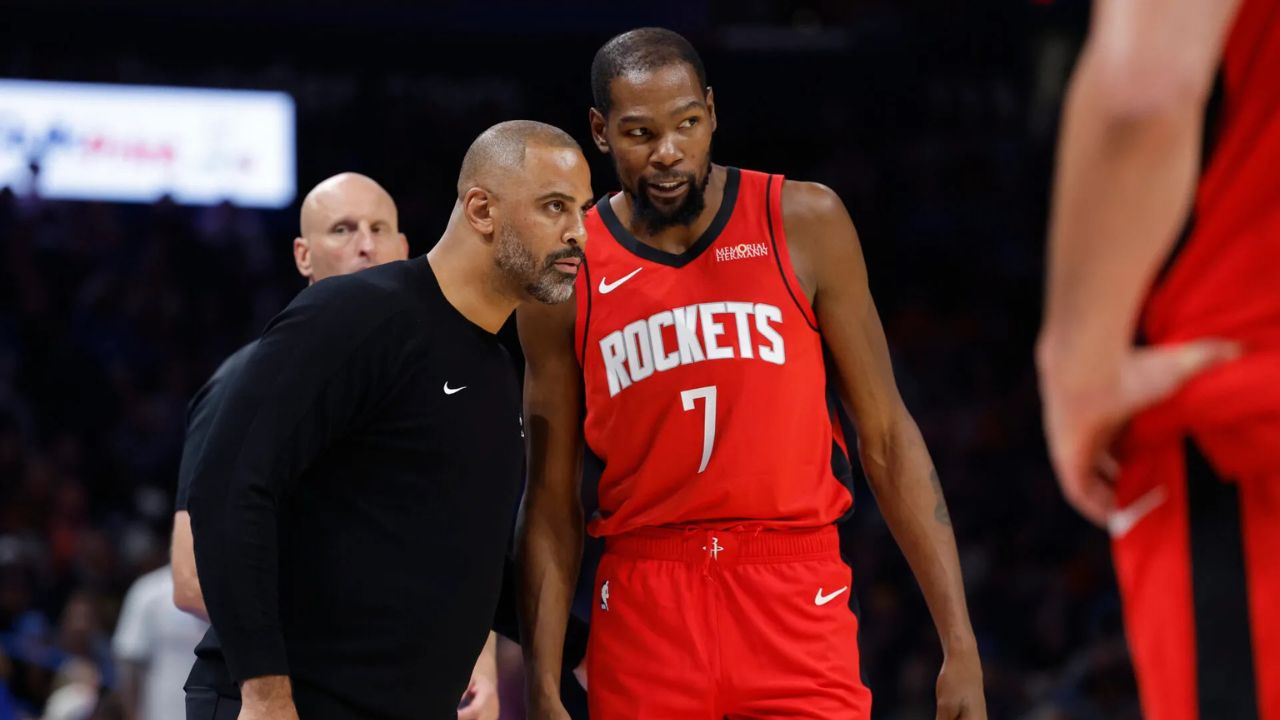
Head coach Ime Udoka attempted to stop the bleeding early, calling a timeout during a 9-0 run. However, the lineup that followed failed to respond. A group featuring Aaron Holiday, Amen Thompson, Jabari Smith Jr., Josh Okogie, and Dorian Finney-Smith managed zero made field goals and committed three turnovers in just over two minutes. That stretch only deepened the deficit and removed any chance of recovery.
The absence of Kevin Durant was a factor, but it does not excuse a collapse of this magnitude. Scoring three points in nearly ten minutes during a playoff elimination game is unacceptable at any level. It reflects not only missing talent but also a lack of offensive structure and adaptability.
Across the full game, the Rockets shot just 35% from the field and under 18% from three-point range. They finished with 13 points in the second quarter and trailed by 18 at halftime. Turnovers and poor shot selection repeatedly killed any momentum, while the Lakers capitalized on efficient scoring and transition opportunities.
This stretch reinforces a clear reality. The Rockets cannot run this back with the same offensive approach. The roster has talent, especially in young players like Amen Thompson and Alperen Sengun, but the system does not maximize their strengths. There is a visible disconnect between personnel and the scheme.
Houston showed resilience by pushing the series to six games after falling behind 3-0. Still, Game 6 exposed the gap between potential and execution. If the Rockets want to take the next step, they need a reset. That means reworking the offensive system, adding reliable shot creators, and building a structure that holds up under playoff pressure.
This loss was not just about one bad quarter. It was a clear signal that change is required.