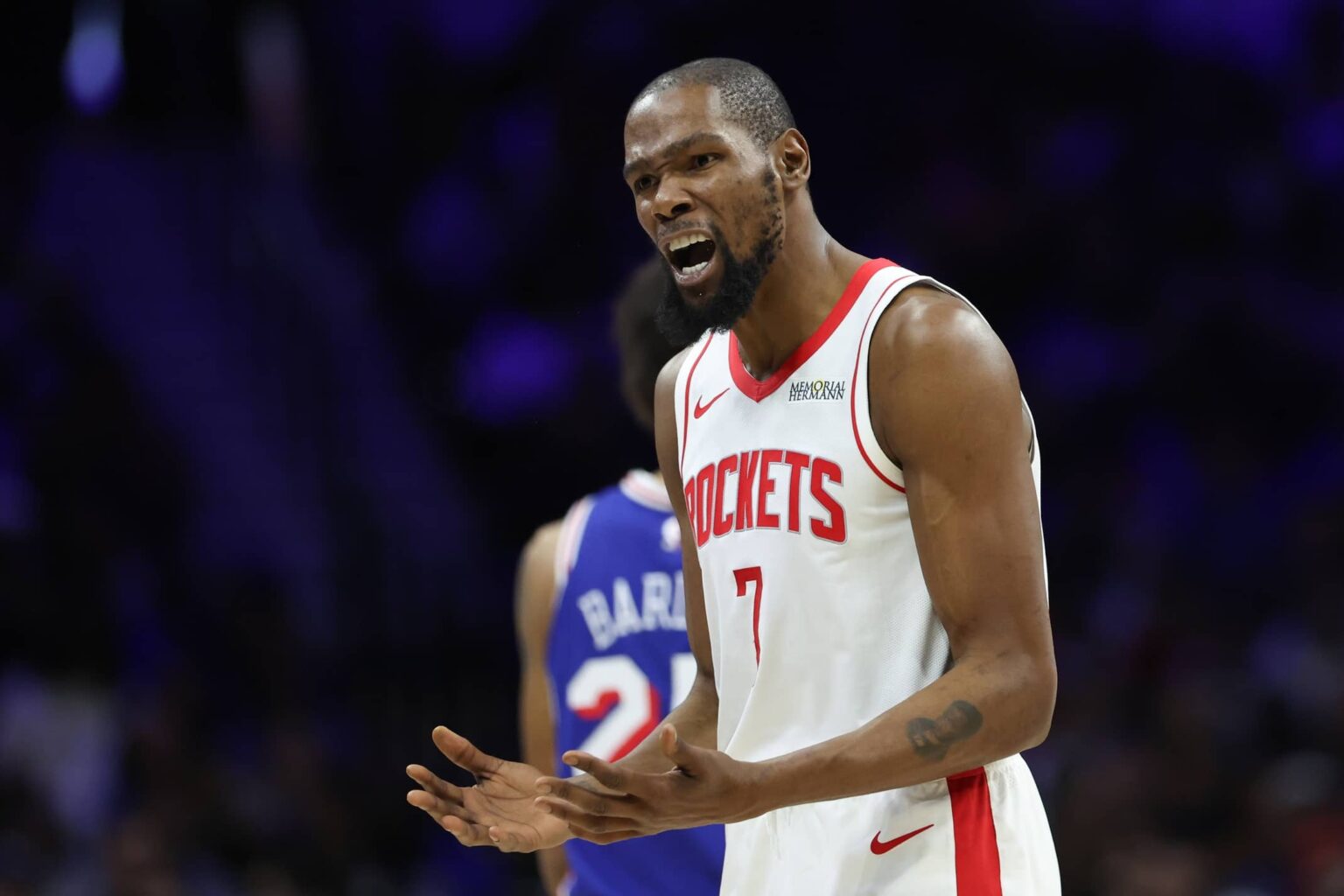
The Rockets didn’t trade for Kevin Durant to stay on the same timeline. The move was supposed to accelerate everything: raise the ceiling, tighten the playoff margin, and turn a good young team into something that actually scares contenders. The trade was finalized on July 6 as part of a seven-team deal, with the Rockets betting that Durant’s half-court shotmaking would be the separator they did not have.
So far, the standings case has not matched the headline. The Rockets are 34-21 right now, and that number is basically a copy-paste of where they were last season at the same point. In 2024-25, the Rockets were 35-22 through 57 games. The trade was supposed to buy them a step forward, not a sideways season with a bigger payroll and higher expectations.
Then the Durant part of the story showed up again in the way it always does: online noise turning into a real distraction. Over the last week, multiple reports tied Durant to allegations involving a burner X account that took shots at teammates, with Durant publicly dismissing it as “Twitter nonsense.” Even if the locker room shrugs, that kind of story only gains oxygen when the on-court results are not clearly better than before.
Are They Better Than Last Season?
In the standings, the answer is basically no. The Rockets are 34-21 right now and sitting fourth in the West. At roughly the same point last season, they were 35-22 and still held the fourth seed. The trade for Kevin Durant was supposed to create separation. The record says the separation has not shown up.
The more interesting answer is in the profile. The Rockets are scoring 117.9 points per 100 possessions and allowing 112.9, a +5.05 net rating. Last season, they were at 115.2 offense, 110.8 defense, a +4.3 net. That is a slight efficiency improvement overall, even if the defense has slipped a bit. Their SRS (Simple Rating System) also ticks up (4.87 this season vs. 4.51 last season) on Basketball Reference, which suggests the team-level performance has been at least comparable, if not marginally stronger, than the raw record implies.
The identity is still clear. The Rockets are dominating the possession battle. They lead the league in rebounds per game at 48.4, and they are first in offensive rebounds per game at 15.6. That is how they survive the math problem that keeps showing up in their offense. They do not win by bombing threes. They win by creating extra shots.
That is also where the “better than last year” argument gets fragile, because the edges are more dependent on specific personnel. With Steven Adams out for the season, the team loses a major source of extra possessions, and the rotation points to a heavier reliance on wing-heavy lineups to keep the defense elite while trying to patch the offense. They are also near the bottom of the league in three-point attempts (29th) and only 25th in made threes. That is a narrow path when playoff defenses force you into half-court shotmaking.
The biggest difference from last season is late-game execution. The Rockets rank 22nd in clutch offensive rating, and their clutch turnover rate is second-worst in the league. That is where the “record shows otherwise” headline is earned. They may be slightly better in overall efficiency, but they have not been more reliable when games tighten.
Is Durant’s Production Worth It?
Kevin Durant has delivered the individual production the Rockets were buying. He’s at 26.1 points, 5.4 rebounds, and 4.4 assists in 52 games, and he’s doing it efficiently: 50.6% from the field, 40.4% on threes, 88.1% at the line, with a 62.7 true shooting percentage. The Rockets’ offense is better with him, too. With Durant on the floor, the team sits in the plus rating, and the on/off split shows a clear drop when he sits.
The issue is the cost, and it’s not theoretical. The Rockets didn’t just “add a star.” They paid with two real rotation pieces and draft capital: Jalen Green, Dillon Brooks, the No. 10 pick (Khaman Maluach), plus additional picks and outgoing filler, in a seven-team structure. That’s the part that forces the question. If you’re giving up that much, the new offense has to look like Durant is the organizing principle, not just an elite finisher who gets his 26 and then waits his turn.
Brooks is the cleanest example of why it feels pricey. Dillon Brooks has been having a career year with the Suns at 21.2 points per game before a broken left hand knocked him out, which matters because it shows the Rockets didn’t move a low-usage defender. They moved a two-way wing who was also giving them real scoring this season. Green has been volatile, but even he’s had “swing the night” moments, including the recent game-winner that reminded everyone why teams keep betting on his shotmaking.
That’s why the fit critique lands. The Rockets are a strong team on paper, with a top-10 offense and defense by efficiency and a top-tier net rating. But the offense still feels like it’s trying to be egalitarian first and Durant-driven second. When you trade this much for a scorer of Durant’s caliber, you want the late-clock possessions, the playoff possessions, and the “we need one bucket” possessions to be unmistakably built around him. Right now, it’s more like the Rockets are hoping Durant can solve possessions that the system didn’t. That can work in February. It’s a shaky plan in May.
How The Burner Might Crush The Season
Kevin Durant’s alleged burner account story is not just noise because of who it targets. The leaked screenshots are pointed at the two young pillars the Rockets are supposed to build with, not around. According to reports, the account criticized Alperen Sengun’s defense and overall value, questioned Jabari Smith Jr.’s reliability in big moments, and included a slur directed at Smith. None of it is confirmed, but the damage does not require confirmation to start spreading once teammates and agents see it.
This hits the Rockets at a bad time because the on-court stuff already looks fragile. They’re 34-21 and fourth in the West, but they’re also chasing the Thunder and the Spurs, and the gap is real: the Spurs are 40-16 and sitting second. The Rockets aren’t losing because they lack talent. They’re losing because the margins keep slipping in the moments that decide playoff series.
The clutch profile is the clearest example. The Rockets are 20th in clutch effective field goal percentage (47.1%) and 29th in clutch turnover rate (16.3 per 100 possessions). That’s not a small red flag. That’s a team telling you it doesn’t trust what it’s running, or who is supposed to run it, when the clock gets tight.
Now layer the burner on top of that. If Sengun and Smith feel even a little bit dismissed, you get the worst version of a contender: quiet resentment, passive possessions, and a late-game hierarchy that no one fully buys into. That matters specifically for this roster, because the offense already looks like it’s trying to be fair instead of being sharp. The Rockets are also living on a narrow shot profile, averaging just 30.7 threes per game. When you don’t spam threes, you have to be elite in execution and decision-making.
The Spurs don’t have this problem. Their identity is clean: one clear center of gravity, one clear timeline, and a roster that knows exactly where the ball is going late. The Rockets are still negotiating that part, and the burner story threatens to turn that negotiation into a trust issue. If that happens, the season won’t collapse because of Twitter. It’ll collapse because a team that already struggles in clutch possessions can’t afford even one more reason to hesitate.
Was The Trade Worth It Then?
Yes, the trade was worth it, even if the season has been messier than the marketing.
The Rockets were never going to become a real threat on the current track without a top-end half-court scorer. Kevin Durant is still one of the few players in the league who can manufacture a good shot when the play breaks, the spacing gets tight, and the opponent knows what’s coming. That matters more in April than it does in January. And the numbers back up the baseline premise: Durant is at 26.1 points on 50.6% from the field this season.
The counter is obvious: the cost was huge. The Rockets sent out Jalen Green and Dillon Brooks, plus the No. 10 pick and a stack of second-rounders in the seven-team construction. Brooks has been excellent for the Suns when healthy, averaging a career-high 21.2 points before breaking his left hand. So it’s fair to say the Rockets didn’t just ship out “salary.” They shipped out real minutes and real two-way value.
But the key detail is this: Green was not becoming the offensive star the Rockets needed on a contender timeline. His 2025-26 season with the Suns is sitting at 13.3 points per game on 38.2% from the field. Even if you believe in his talent long-term, that isn’t a profile you bet your playoff ceiling on right now. The Rockets needed a proven closer, not another development bet.
Where the trade looks shaky is not Durant’s production. It’s the integration. The Rockets still play like they’re negotiating hierarchy late in games, and that shows up in the clutch data. If you trade for Durant, those possessions should be simpler and sharper.
The burner-account situation is also a real risk factor, because it touches the exact two guys the Rockets need to feel fully bought in: Alperen Sengun and Jabari Smith Jr. Reports describe the alleged account criticizing Sengun’s defense and using a slur toward Smith, with Durant calling it “Twitter nonsense.” Even if the locker room moves on, it’s a needless complication on a team that already has on-court friction in role and usage.
Bottom line: the trade was the right bet. The Rockets just haven’t finished the job of building a Durant-centric offense and a clean internal pecking order. If they do, the deal looks justified. If they don’t, they’ll keep living in the same place: good record, real talent, and a ceiling that never fully shows up.