The Orlando Magic enter the 2026 NBA Playoffs as the eighth seed after surviving the play-in tournament, finishing the regular season with a 45–37 record. On paper, they sit firmly in the middle tier of the league.
They ranked 18th in offensive rating, 13th in defensive rating, and 17th in net rating. Those numbers reflect a team without a clear identity, and internal concerns have only added to the uncertainty, including reported tension between Paolo Banchero and head coach Jamahl Mosley.
Starters
Jalen Suggs, Desmond Bane, Franz Wagner, Paolo Banchero, Wendell Carter Jr.
Jalen Suggs continues to anchor the backcourt with energy and defensive pressure. He averaged 13.8 points, 3.9 rebounds, and 5.5 assists, along with 1.8 steals per game. His shooting numbers remain average at 43.5% from the field and 33.9% from three, which limits spacing. His value comes from ball pressure and playmaking, especially in transition.
Desmond Bane has been the most reliable offensive piece on the roster. He averaged 20.1 points, 4.1 rebounds, and 4.1 assists while shooting 48.4% from the field and 39.1% from three. He played all 82 games, giving the Magic durability and consistency they lacked elsewhere. His ability to stretch the floor is critical for a team that struggles from deep.
Franz Wagner dealt with injuries during the season but still produced 20.6 points, 5.2 rebounds, and 3.3 assists on 48.1% shooting and 34.5% from three. When healthy, he provides secondary scoring and playmaking, but his rhythm has been inconsistent due to missed time.
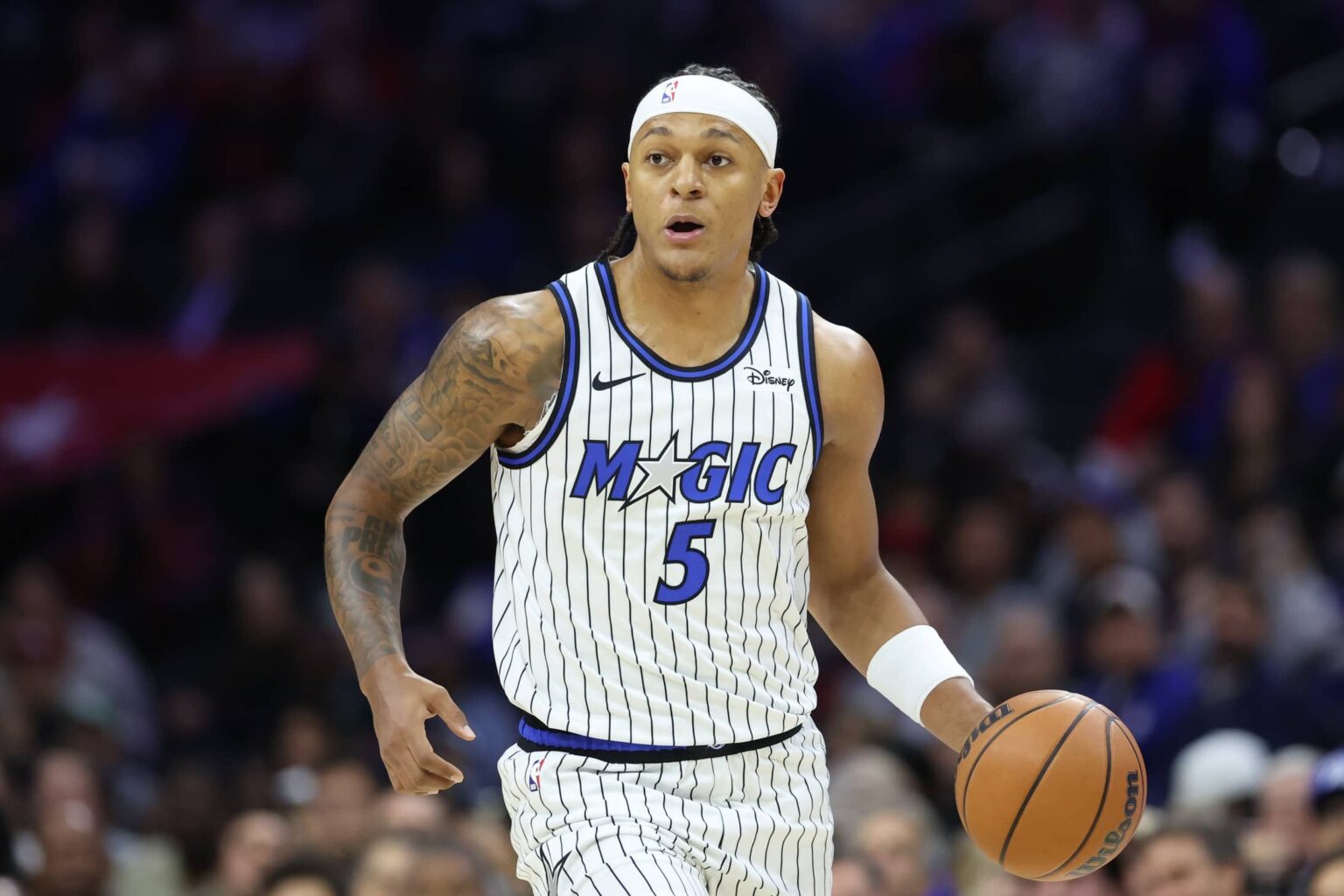
Paolo Banchero remains the focal point, but his season has been uneven. He averaged 22.2 points, 8.4 rebounds, and 5.2 assists, but shot just 45.9% from the field and 30.5% from three. His efficiency dip has been a major storyline. For Orlando to compete, he must improve shot selection and decision-making under pressure.
Wendell Carter Jr. rounds out the starting unit with 11.8 points, 7.4 rebounds, and 2.0 assists, shooting 51.2% from the field and 31.9% from three. He provides interior stability but does not stretch defenses consistently.
Bench
Anthony Black, Jett Howard, Jevon Carter, Jase Richardson, Jamal Cain, Noah Penda, Tristan Da Silva, Goga Bitadze, Moritz Wagner
The bench offers depth but lacks elite impact. Anthony Black has emerged as the most productive reserve, averaging 15.0 points, 3.8 rebounds, 3.7 assists, and 1.4 steals on 44.7% shooting. His ability to handle the ball and create offense gives Orlando a needed spark.
Jett Howard adds 5.5 points per game but remains a limited contributor. Jevon Carter provides veteran presence with 7.2 points, 2.1 rebounds, and 2.3 assists, shooting 40.2% from the field and 33.6% from three.
Tristan Da Silva has been efficient, averaging 9.9 points, 3.7 rebounds, and 1.6 assists while shooting 45.0% from the field and 37.4% from three. He offers spacing, which the team lacks overall. Moritz Wagner contributes 6.9 points and 3.2 rebounds, while Goga Bitadze adds 5.9 points and 5.0 rebounds on an efficient 67.6% shooting.
Other contributors like Jamal Cain and Noah Penda provide depth but are unlikely to play major playoff minutes.
Closing Lineup
Jalen Suggs, Desmond Bane, Franz Wagner, Paolo Banchero, Wendell Carter Jr.
The closing lineup will likely mirror the starters. Orlando relies on size and defensive switching late in games, but their lack of consistent three-point shooting becomes a problem. They rank among the bottom five teams in three-point percentage, which limits comeback potential and half-court efficiency in tight playoff situations.
In crunch time, defenses collapse into the paint, forcing Orlando into low-efficiency jumpers. Without a reliable perimeter threat, their offense becomes predictable, especially against disciplined playoff defenses that can load up on Banchero and Wagner.
Road To The NBA Finals
Their playoff path is difficult. They face the No. 1-seeded Detroit Pistons in the first round. The season series was split 2–2, but Detroit enters the matchup healthier and more balanced. Orlando lacks the offensive firepower to consistently match them over a seven-game series.
If they manage an upset, the next round likely brings the Cleveland Cavaliers, who won the season series 3–1. Cleveland’s structured offense and rim protection present major problems for Orlando’s inconsistent scoring.
Further ahead, potential matchups with the Boston Celtics or New York Knicks in the Eastern Conference Finals only increase the challenge. Boston won the season series 3–1, while New York split 2–2 but holds a clear advantage in offensive execution.
Orlando’s strength lies in size, defensive versatility, and a balanced scoring approach. Their weakness is clear. They lack elite shot creation and reliable perimeter shooting. In the playoffs, those flaws are exposed quickly. Unless Banchero elevates his efficiency and the team finds an unexpected offensive rhythm, their postseason run is likely short.