The Jazz have been stockpiling picks for years, so this deadline was a clear change of posture. They traded for Jaren Jackson Jr. in an eight-player deal, adding John Konchar, Vince Williams Jr., and Jock Landale from the Grizzlies.
The Grizzlies got Taylor Hendricks, Walter Clayton Jr., Kyle Anderson, and Georges Niang, plus three first-round picks, including the most favorable 2027 first-round pick between the Jazz, Timberwolves, and Cavaliers, the Lakers’ 2027 first-round pick (top-four protected), and the Suns’ 2031 unprotected first-round pick.
Landale is already gone again. He was flipped almost immediately and debuted for the Hawks the next day, so the real Jazz takeaway is Jackson plus the two wings.
It’s a big swing for a team that’s still sitting at 16-36. But the logic is simple: the Jazz can score (115.0 offensive rating), and they still can’t stop anyone (123.3 defensive rating). Jackson is the rare player who can help both problems at once.
Now let’s look at what the Jazz can realistically put on the floor after the Jackson swing, and what the rotation starts to look like when the roster is healthy.
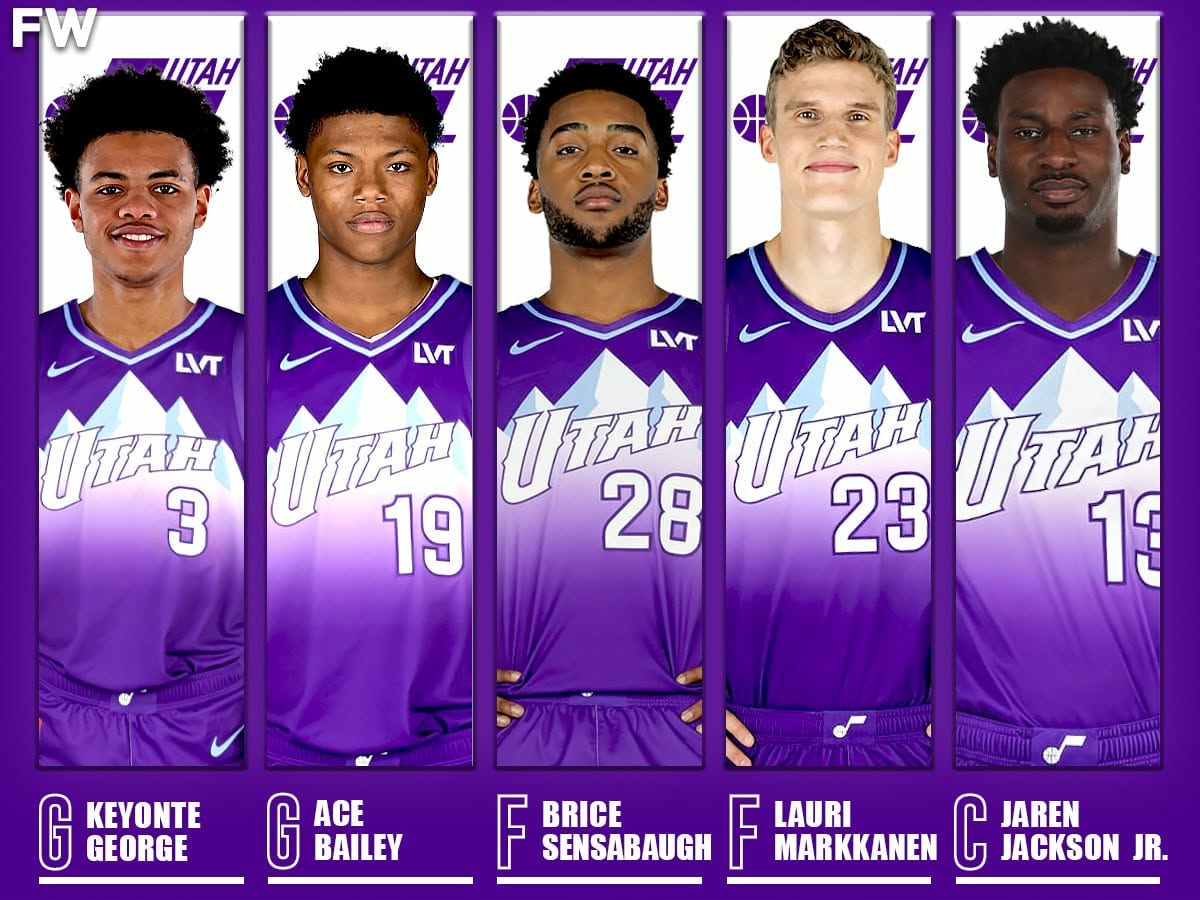
Starters
Point guard: Keyonte George
Shooting guard: Ace Bailey
Small forward: Brice Sensabaugh
Power forward: Lauri Markkanen
Center: Jaren Jackson Jr.
Keyonte George is the engine. He’s having a breakout season at 24.2 points, 6.6 assists, and 4.0 rebounds while shooting 45.9% from the field, 37.7% from three, and 89.3% at the line. If the Jazz are going to play real basketball again after the deadline, it starts with George getting the offense organized and getting downhill early.
Ace Bailey at shooting guard is the “let it grow” choice, but it has a real purpose. He’s at 11.2 points and 3.6 rebounds in a smaller role this season, and the three-point volume is already there, even if the efficiency still swings. Putting him next to George and Markkanen gives him cleaner looks, and it keeps the floor spaced enough for Jackson to do his damage as a cutter and short-roll finisher.
Brice Sensabaugh at small forward is the part that makes this five feel more coherent. He’s been on fire lately (17.2 points in his last 10), and is averaging 11.7 points with 3.0 rebounds and 1.5 assists, and he’s had nights recently where the scoring looked like it could carry a whole team, not just survive minutes. In this lineup, he doesn’t need to be a creator. He needs to hit open threes, punish closeouts, and keep the offense from stalling when defenses load up on Markkanen.
Lauri Markkanen is still the star and the best scorer on the roster. He’s at 27.1 points and 6.9 rebounds on 47.7% from the field and 36.1% from three. The cleanest version of this team is Markkanen as the scoring hub, with George getting him to his spots and Jackson making the defense pay for sending extra help.
Jaren Jackson Jr. is the reason this trade exists. He was at 19.2 points, 5.8 rebounds, and 1.5 blocks this season in Memphis, and he comes with real résumé weight as a former Defensive Player of the Year. The Jazz do not need him to be perfect. They need him to change possessions. Fewer layups, fewer free throws, more missed shots at the rim. That alone shifts the feel of the team.
Bench Unit
Isaiah Collier, Cody Williams, Vince Williams Jr., Svi Mykhailiuk, John Konchar, Kyle Filipowski, Walker Kessler, Elijah Harkless, Jusuf Nurkic, Kevin Love, and Oscar Tshiebwe.
Isaiah Collier stays as the main table-setter off the bench, and he’s already producing at 9.2 points and 6.7 assists. That’s valuable because it lets the Jazz keep a real passer on the floor even when George sits. Also, Cody Williams becomes a cleaner “defend, run, keep it simple” wing instead of being asked to carry starter usage every night.
The deadline additions fit here, too. Vince Williams Jr. gives them a real connector wing at 8.0 points, 4.0 rebounds, and 4.4 assists, even if the shooting has been rough. John Konchar is the opposite type of help: low-usage, rebound, defend, move the ball, and stay out of the way. Those are the exact profiles young teams need when they’re trying to build habits instead of just hunting stats.
Up front, the Jazz suddenly have options. Walker Kessler has been huge statistically at 14.4 points, 10.8 rebounds, and 1.8 blocks, but an early injury cut his season short. For that reason, Kessler may be likely to come off the bench at first for the Jazz next season, since he is not suiting up for this one. I’d expect him to eventually start again, with the Jazz sliding Lauri Markkanen to the small forward role and Jackson Jr. as the power forward.
Then, Kyle Filipowski also gives them another big man who has been productive recently, and the extra size matters because the Jazz were getting bullied too often before the deadline.
Why The Fit Makes Sense
This move is not about one regular-season record. It’s about giving the roster a spine.
The Jazz offense is already middle-of-the-pack respectable, but the defense has been at the bottom of the league. Jackson is the rare acquisition who attacks the biggest weakness without killing the spacing Markkanen needs. And the Bailey-Sensabaugh wing pairing, even if it’s imperfect defensively, is at least aligned with what the Jazz should be doing right now: identifying who can score and who can fit next to the two pillars.
The cost was real, especially with three first-round picks going out. But if the Jazz were serious about avoiding a long, empty tank, this is what that looks like. You pay for a player who changes your floor. Then you let the young pieces grow around him, instead of asking teenagers to carry a defense that can’t hold up.