It has been almost a week since the February trade deadline, and several teams have already started finalizing their rosters for the remainder of the season. With many notable players being waived or bought out during this period, the buyout market is officially the only remaining avenue for teams to make necessary upgrades.
Teams like the Milwaukee Bucks have already made moves, adding Cam Thomas to their ranks to boost their offensive firepower. In this regard, contenders like the Los Angeles Lakers and the Golden State Warriors are also likely to exercise their options in due time.
Although the current pool of talent appears thin, there is a growing likelihood that more players might become available on the buyout market. With players such as D’Angelo Russell and Russell Westbrook becoming potential buyout candidates, here is a list of players who may become available in the market soon:
Russell Westbrook
Chris Paul
D’Angelo Russell
Kevon Looney
DeAndre Jordan
Kevin Love
Jusuf Nurkic
Kelly Olynyk
Cole Anthony
Khris Middleton
Marvin Bagley III
Sacramento Kings guard Russell Westbrook could be considered among the top buyout candidates moving forward. Individually, the nine-time All-Star and former MVP has been nothing short of terrific this season. While on a vet minimum contract of $2.2 million this season, Westbrook has displayed tremendous value, averaging 15.3 points, 5.7 rebounds, and 6.6 assists per game.
Although Westbrook has shown new signs of life this season, the Sacramento Kings (12-44) are the lowest-ranked team in the West. With the greater likelihood of the team embracing a rebuild (by tanking), retaining a player like Westbrook may not align with their plans.
Currently, Westbrook has immense value. While many teams may potentially emerge as suitors, teams like the Toronto Raptors, the Minnesota Timberwolves, and the Boston Celtics may be ideal landing spots.
Chris Paul is another potential buyout candidate this season. Although signing with the Los Angeles Clippers for his final season seemed to be a fitting end, things took an unfortunate turn after the franchise decided to move on from the veteran guard.
Since being traded to the Raptors, rumors have suggested that the team will eventually waive him. Despite being on a vet minimum deal, his averages of 2.9 points and 3.3 assists per game are underwhelming. Though a young team like the Charlotte Hornets may be intrigued by the idea of adding him as a mentor, Paul may not garner much interest in the market.
Like Paul, rumors have also indicated that the Washington Wizards will look to move on from D’Angelo Russell after acquiring him from the Dallas Mavericks. With a $5.6 million cap hit this season and a $5.9 million player option for next year, the Wizards may see more merit in parting ways with the former All-Star guard.
For the 2025-26 season, Russell is averaging 10.2 points and 4.0 assists per game while shooting 40.5% from the field. Considering that he could still add value as a role player off the bench, teams like the Celtics, Clippers, and the Wolves may emerge as potential suitors.
New Orleans Pelicans big man Kevon Looney could also be an interesting buyout candidate. Given the Pelicans’ current frontcourt depth, Looney isn’t likely to earn further playing time. When additionally factoring in his two-year, $16.0 million contract, retaining him may not align with New Orleans’ plans.
This season, Looney is averaging 2.9 points and 5.3 rebounds per game. While unimpressive, given that he is only 30 years old and has notable championship experience, teams like the Lakers and the Knicks may be interested in signing him.
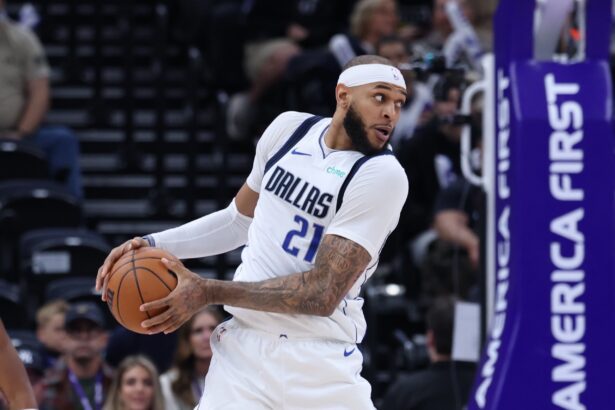
Although he is on a vet minimum contract, DeAndre Jordan may find himself in a similar situation to Looney with the Pelicans. With averages of 4.5 points and 5.0 rebounds, however, he may garner marginally more interest, with the Raptors seeming like an ideal landing spot.
Like many veterans, Kevin Love may also become a potential buyout candidate. Given the Utah Jazz’s approach toward tanking, Love is more likely to be waived as the team changes its approach for the season.
Love’s wishes of joining a big market team like the Lakers or the Knicks in the offseason were noted. However, with averages of 7.0 points and 5.9 rebounds per game this season, teams may not be as intrigued.
Like Love, Jazz big man Jusuf Nurkic may also find himself on the buyout market soon. Despite his uptick in performances, due to the Jazz’s current outlook, and his $19.3 million contract, Utah may choose to move on from the big man.
Nurkic may generate considerable interest if he becomes available. With averages of 10.9 points and 10.4 rebounds per game this season, teams like the Clippers, the Raptors, and the Knicks may emerge as potential landing spots.
Phoenix Suns guard Cole Anthony could also be a top candidate to be waived. Although he’s positioned himself as a skilled scoring guard, Anthony has struggled to carve out a role in the rotation.
During his short tenure with the Bucks, Anthony averaged 6.7 points and 2.5 rebounds per game. Although the Suns may see some benefit in retaining him, Phoenix may see more merit in waiving him to create roster space and address pressing issues.
Apart from the aforementioned players, Khris Middleton, Kelly Olynyk, and Marvin Bagley III may also emerge as candidates for a buyout. However, they are less likely to be bought out in comparison to the others.
In Olynyk’s case, the San Antonio Spurs may choose to offload his $13.4 million contract to open up another roster spot. However, since the team has already waived Jeremy Sochan, Olynyk may inadvertently retain his place in the rotation.
Both Bagley and Middleton found themselves on the Dallas Mavericks following the Anthony Davis trade. Though Bagley may still earn a place in the rotation this season due to Dallas’ depleted frontcourt, Middleton’s multi-year deal (three years, $93.0 million) and averages of 10.4 points and 4.0 rebounds this season may make him a more likely candidate.
Although the chances of each player being bought out vary considerably, it is becoming apparent that these players won’t necessarily be considered valuable by their current teams.
With context becoming an important criterion for determining performance, there is reason to believe that they could still have upside as role players in other situations.