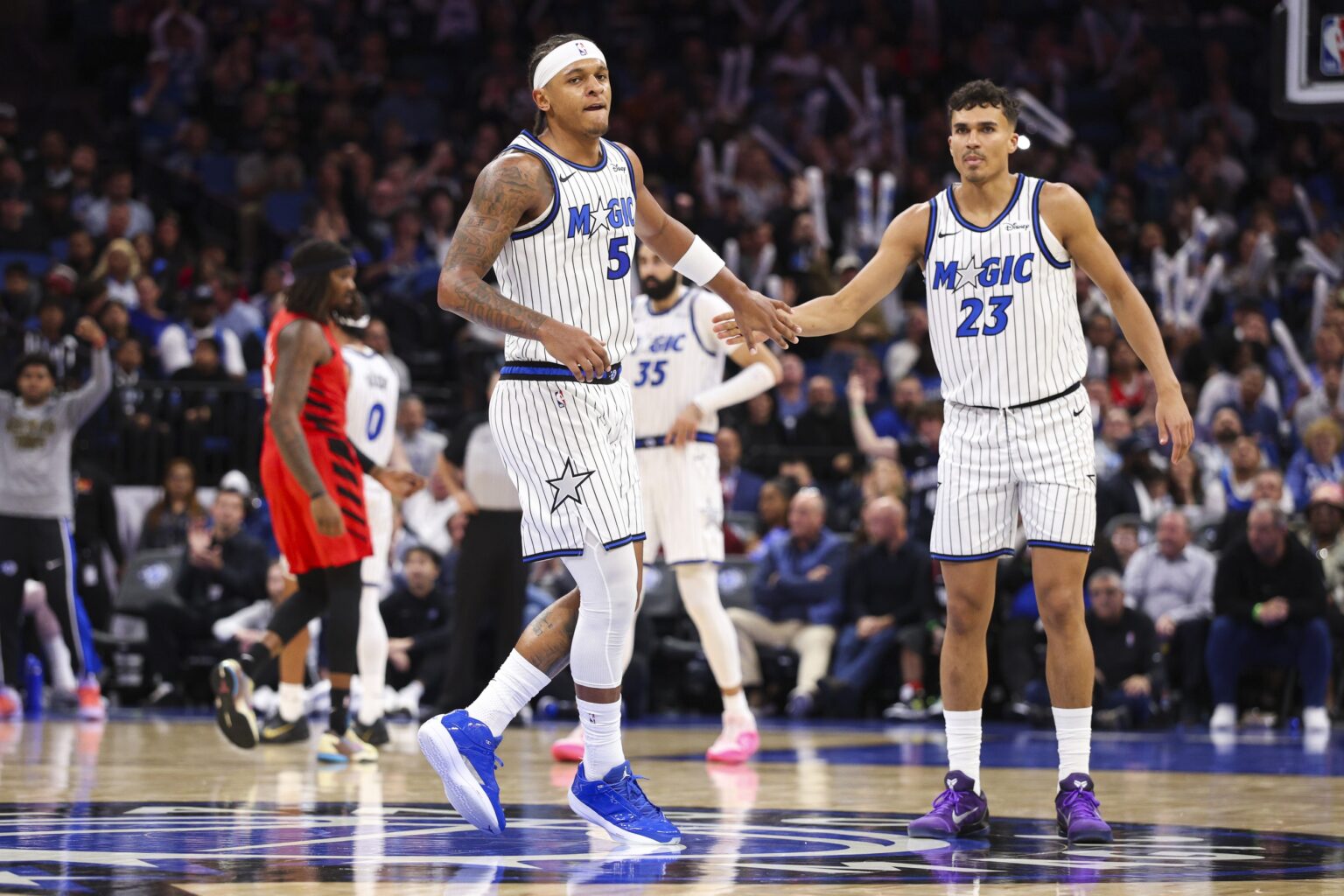
The Orlando Magic are in a good spot, but not a comfortable one. They’re 15-11, sitting fourth in the East, and they look like a real playoff team when the defense is locked in and the tempo stays under control.
The issue is the ceiling. This roster still has nights where the half-court offense feels like it’s one missed jumper away from stalling out completely, and that’s exactly the kind of flaw that gets exposed once the games turn slower and nastier after the All-Star break.
Franz Wagner’s injury only made that tension louder. ESPN reported Wagner avoided a major injury, but the MRI confirmed a high left ankle sprain, which forces the Magic into a stretch where roles get reshuffled and “do we have enough creation?” becomes a daily question.
And then there’s the biggest context piece of all: Desmond Bane is in his first season with the Magic after the June blockbuster trade that cost a massive pile of draft capital, a move that basically screamed “we’re done waiting.” If you already paid that price to accelerate the timeline, it would be shocking if the front office didn’t at least explore one more deadline swing.
Trade Candidates
– Jalen Suggs ($35.0 million)
– Jonathan Isaac ($15.0 million)
– Wendell Carter Jr. ($10.8 million)
– Goga Bitadze ($8.3 million)
– Anthony Black ($7.9 million)
– Tyus Jones ($7.0 million)
– Jett Howard ($5.5 million)
– Moritz Wagner ($5.0 million)
– Tristan da Silva ($3.8 million)
– Jase Richardson ($2.9 million)
– Noah Penda ($1.2 million)
This isn’t an “everyone is available” list. It’s a “these are the names that actually help you build a legal trade and reshape the rotation” list.
Big contracts matter because they unlock real talent. Mid-tier salaries matter because they let you tweak without blowing up your identity. Cheap rookie deals matter because every team wants young production at a discount.
Jalen Suggs is the loudest name here because of the salary numbers, but moving him would mean the Magic are going all-in on a totally different roster shape.
Suggs is the tone-setter defensively and a real secondary creator, the kind of guy playoff teams hate playing against because he turns games into fistfights. He is posting 15.4 points, 4.8 assists, and 3.7 rebounds with solid defense and three-point shooting, and would only be part of a trade if the Magic can get a true top-10 player in the league.
The more realistic “trade engine” is the frontcourt money. Jonathan Isaac and Wendell Carter Jr. are exactly the type of contracts teams ask about, because they can either be part of a consolidation package for a star, or they can be flipped for multiple rotation pieces if the Magic decide they need more shooting and decision-making around the core. Bitadze and Moritz Wagner also sit in that zone where they’re useful enough to matter, but not so irreplaceable that you stop taking calls.
Then you’ve got the young chips. Black, Howard, da Silva, Richardson, and Penda are the kinds of prospects that make another team say, “okay, now we’re listening.” They’re the leverage. If the Magic want a real upgrade without gutting the top of the roster, one of these guys is the type rebuilding teams demand as the price of admission.
Why The Magic Are Even Considering A Move
This isn’t a panic situation. The Magic have already built a solid foundation; they defend, rebound, play hard, and have multiple players who can get downhill. The record backs that up.
But being “good” isn’t the goal anymore. Not after the Bane trade. When you ship out that many picks for a win-now guard, you’re basically admitting you want to be in the second-round conversation, and you want it soon.
That’s why this deadline feels important. It’s not about chasing a random name. It’s about fixing the parts of the roster that still feel a little unfinished. The Magic can win a lot of regular-season games with defense and athleticism, but playoff series get decided by half-court execution, decision-making, and whether you have a reliable “get a good shot no matter what” option when the other team knows every action you’re running.
Franz Wagner being out with the high ankle sprain basically stress-tests the roster. If the offense looks shaky without him, it’s a flashing sign that the Magic need another creator or another hub. If they survive and Bane consistently fills that void, it might push them toward a smaller move. Either way, the answers matter.
A Domantas Sabonis Swing?
If the Magic want the cleanest “raise our floor and our ceiling” move, the Domantas Sabonis idea is exactly the type of deadline swing that makes sense.
Sabonis is still one of the best connective bigs in basketball, a rebound vacuum who can run offense through the elbows, and he’s putting up 17.2 points, 12.3 rebounds, and 3.7 assists while shooting 51.0% from the field this season.
The reason this fit feels obvious is because it solves multiple problems at once. It gives the Magic a true interior hub who can punish switches and stabilize the offense when things get chaotic.
It also makes life easier for the guards. Instead of every possession being “beat your man, collapse the defense, kick it out,” you can run actions through a big who reads the floor and creates advantage with positioning and passing.
The proposed framework, Isaac and Carter Jr. plus a first or two firsts, is the kind of offer that at least looks serious because it sends real money and real players back.
Isaac gives you defense and versatility when healthy, Carter Jr. gives you a functional starting center, and the picks are the real incentive. Whether the Sacramento Kings would actually do it depends on where they are as a franchise, but if they ever decide to reshape the roster or get younger, that’s the type of package that starts a conversation.
The real question for the Magic would be philosophical. Sabonis is a “win-now structure” player. You’re trading optionality for certainty. You’re also committing to a specific style, because once you add him, the offense naturally tilts toward playing through the big, cutting harder, and surrounding him with movement and shooting.
And I’ll be honest: I think that’s a good thing. The Magic sometimes play like a team that wants to win with talent alone. Sabonis forces structure. He forces decisions. He forces an identity. You don’t sleepwalk through possessions with him, because the ball is always going somewhere.
If the Magic believe they can win now and still keep the long-term core intact, this is the kind of move that can change the entire vibe of the season.
The Darius Garland Flyer
The other swing is more risky, but it’s also the kind of gamble that can look genius if it hits: taking a flyer on Darius Garland.
Garland’s numbers this season are 15.5 points and 6.5 assists, but the ugly part is the efficiency, with 36.2% from the field. That’s why he’s a “flyer” concept in the first place. You’re betting that a change of environment, a different role, and less pressure to carry every possession brings back the version of Garland who bends defenses with handle and pace.
The fit is easy to see. The Magic have size and strength on the wings. They have defensive teeth. What they sometimes lack is that jittery guard who can snake a pick and roll, force two defenders to commit, and create clean looks without needing everything to be perfect.
A package like Isaac, Anthony Black, Tyus Jones, plus a couple swap picks is basically the Magic saying, “we’ll give you depth, youth, and flexibility, and we’ll take the risk on the talent.” It’s not a trade you make unless you really believe in your development system, but that’s kind of the point. If you’re confident, you exploit other teams’ uncertainty.
Would the Cleveland Cavaliers actually move him? That’s the hard part. But in a hypothetical sense, this is the type of deal that aligns with how teams actually negotiate. One team wants a higher ceiling. The other team wants stability and controllable pieces.
Smaller Moves That Still Matter
Not every deadline play has to be a blockbuster. Sometimes the best move is the boring one that fixes two problems at once.
Tyus Jones is a perfect example. A steady guard on a movable salary is exactly the type of player teams chase in February when they realize their second unit is leaking points. If the Magic decide they need a different skill set, Jones can become a useful tool, either as a direct trade piece or as part of a larger salary structure.
The same logic applies to the frontcourt depth. Bitadze and Moritz Wagner can help teams that need big minutes, and Carter Jr. is the kind of contract that can get reused in multiple trade constructions. Even Howard or da Silva can be the kind of young shooter or wing prospect that makes a rebuilding team say yes instead of no.
The big picture is simple: the Magic have options. They can go star hunting. They can make a consolidation move. Or they can make a smaller “fit” trade that tightens the rotation for the playoffs.
Final Thoughts
The Magic are ahead of schedule, but they’re also at the part of the timeline where patience starts getting expensive. The Bane trade already told you they’re not trying to be a cute young team anymore.
So now the question is whether they want to use February to chase a higher ceiling, or whether they trust the internal growth to get them there. Either way, this roster has enough tradeable money and enough young chips that the Magic can be one of the teams that actually shapes the deadline instead of just watching it happen.