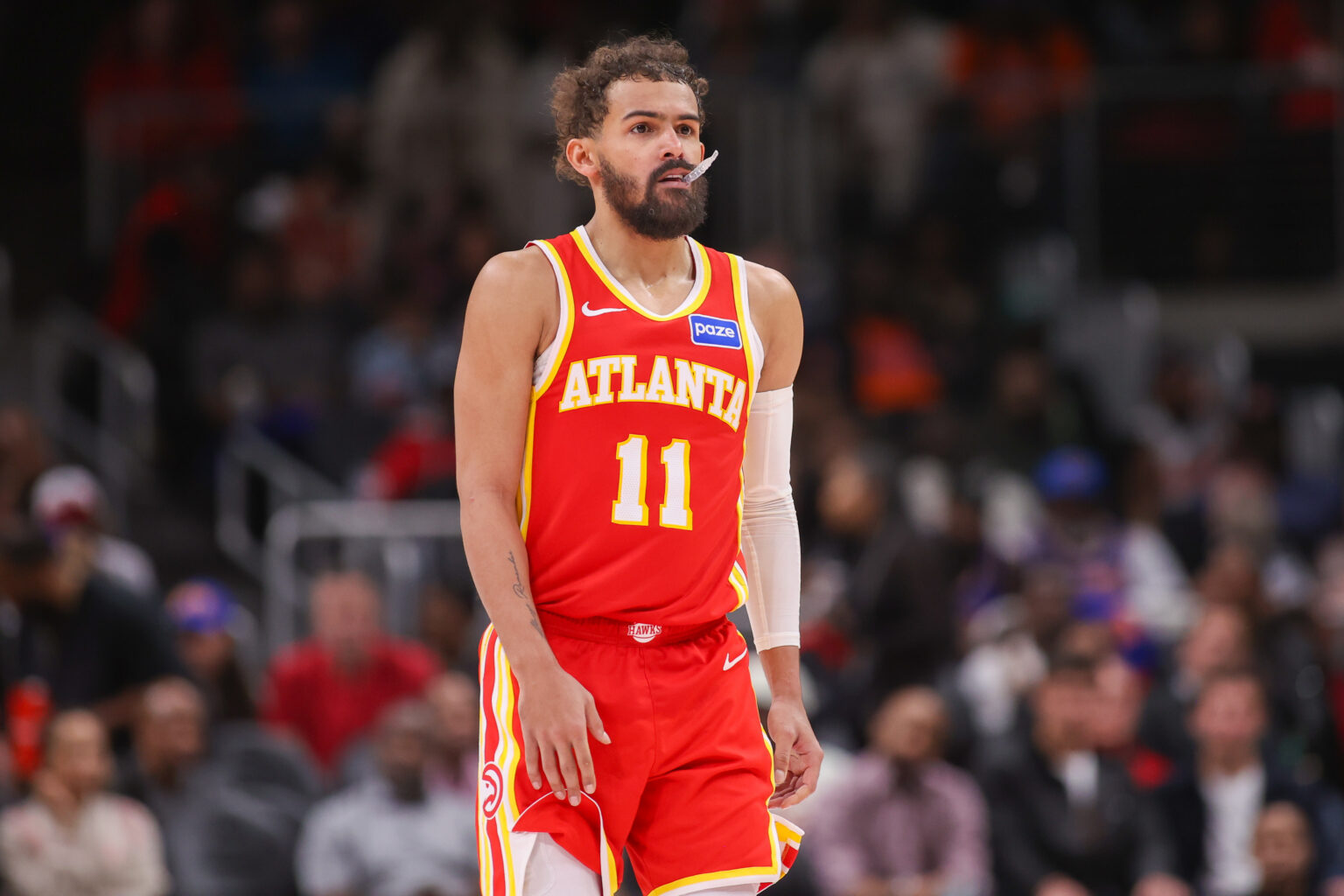
The deal is finally done. Four-time All-Star and the NBA’s reigning assist champion Trae Young is no longer a member of the Atlanta Hawks, a franchise that took the 6’1″ point guard No. 5 overall in the 2018 Draft. Young was traded to the Wizards in a package featuring CJ McCollum and Corey Kispert, with no picks heading either way.
Young led the Hawks to the Eastern Conference Finals in the 2020-21 season, has averaged a career 25.2 PPG and 9.8 APG with the franchise, and has been one of the best pure floor generals in the game since his rookie campaign. But after falling out with the Hawks and being made excess to requirements, Young made his wish clear: he wanted to be in Washington.
We anticipate the reasons include being in a position to get another max deal, controlling the offense with the ball in his hands, and helping make a struggling franchise relevant again. Meanwhile, the Hawks look to retool their roster with veterans CJ McCollum and Corey Kispert, even without future picks being included in the deal.
As the biggest trade of the 2025-26 regular season so far, there is a ton to unpack in this deal, and we go ahead and grade the trade for both teams and major players involved in the deal.
Washington Wizards: A
For a franchise starved of relevance, landing Trae Young without giving up a single draft pick is a home run. Washington acquires a 25-point, 10-assist engine who instantly becomes the best offensive player the organization has had since Bradley Beal. Young’s presence alone transforms the Wizards’ offense, and Washington finally has a guard capable of dominating defenses.
In a league where primary creators are the hardest asset to acquire, the Wizards solved their biggest issue in one move. Equally important is timing. Washington gets Young as he enters his prime (only 27 years old), not on the decline, and places him in a situation where the offense is unquestionably his.
The Wizards didn’t give up future assets, didn’t add protections, and didn’t take on long-term bad money as they look to give Young max dollars. CJ McCollum’s contract coming off the books offsets Young’s max trajectory, while Kispert was a luxury for a team that desperately needed a star.
Atlanta Hawks: C+
From Atlanta’s perspective, this was about getting whatever was best in the market. Once Trae Young and the franchise knew there would be no future together, and the relationship had deteriorated, leverage evaporated. In that context, extracting two proven NBA contributors without taking on draft obligations has value.
CJ McCollum (18.8 PPG, 3.6 APG this season) gives the Hawks a steady veteran presence, secondary shot creation, and playoff experience, while Corey Kispert (9.2 PPG, 39.5% 3-PT FG) adds movement shooting and lineup flexibility on the wing. That said, it’s difficult to ignore what’s missing: future upside.
No picks, no young blue-chip prospect, and no long-term cornerstone coming back for a franchise player in his prime. McCollum is 34 and not a defensive stopper (although he is heading into free agency this summer), while Kispert profiles more as a complementary piece than a building block. The Hawks just wanted to get something for Young because their future is Jalen Johnson and Dyson Daniels, but still, this wasn’t a fantastic deal for them by any means.
Trae Young: B+
For Young, this move is about control of his career. Washington offers him something Atlanta no longer could: a team built around his strengths. He’ll have the ball, dictate pace, and be empowered to shape the offense every possession. From a marketing standpoint, Young also becomes the face of a franchise, something that enhances his long-term earning potential.
The slight downgrade from an A comes down to a lack of competition and desire to win. Washington is still a work in progress, and Young will need to carry a heavier load nightly to keep the team afloat. Young clearly doesn’t value winning as much as playing basketball his way and getting max money, but that’s his decision to make. He got what he wanted, so he gets at least a B+, but we can’t put it higher because winning should be taken into account.
CJ McCollum: B-
McCollum steps into Atlanta as a stabilizer. His scoring, professionalism, and playoff resume bring immediate credibility to a Hawks backcourt that suddenly needed leadership. He can play on or off the ball, run second units, and is a clutch performer.
However, expectations must be managed. McCollum is no longer a primary engine for winning at the highest level, and defensively, he doesn’t move the needle. Still, for CJ, this is a solid landing spot that maximizes his remaining strengths, but it’s clear he’s a bridge piece, not a pillar, as he heads into free agency after this summer.
Corey Kispert: B-
Kispert’s value lies in his playing style. He spaces the floor and moves without the ball, skills every team needs, especially one transitioning away from a one-man offense. In Atlanta, his shooting should immediately open lanes for drivers and provide lineups with better balance. He’s young enough to grow with the roster and affordable enough to retain flexibility.
The limitation is the ceiling. Kispert is a high-end role player, not a creator or defensive difference-maker. He won’t swing a playoff series on his own, and his impact depends heavily on who’s setting the table. For Atlanta, he’s a useful piece in a broader reshuffle, and his contract (until 2027-28) means he will make the Hawks his team moving forward.