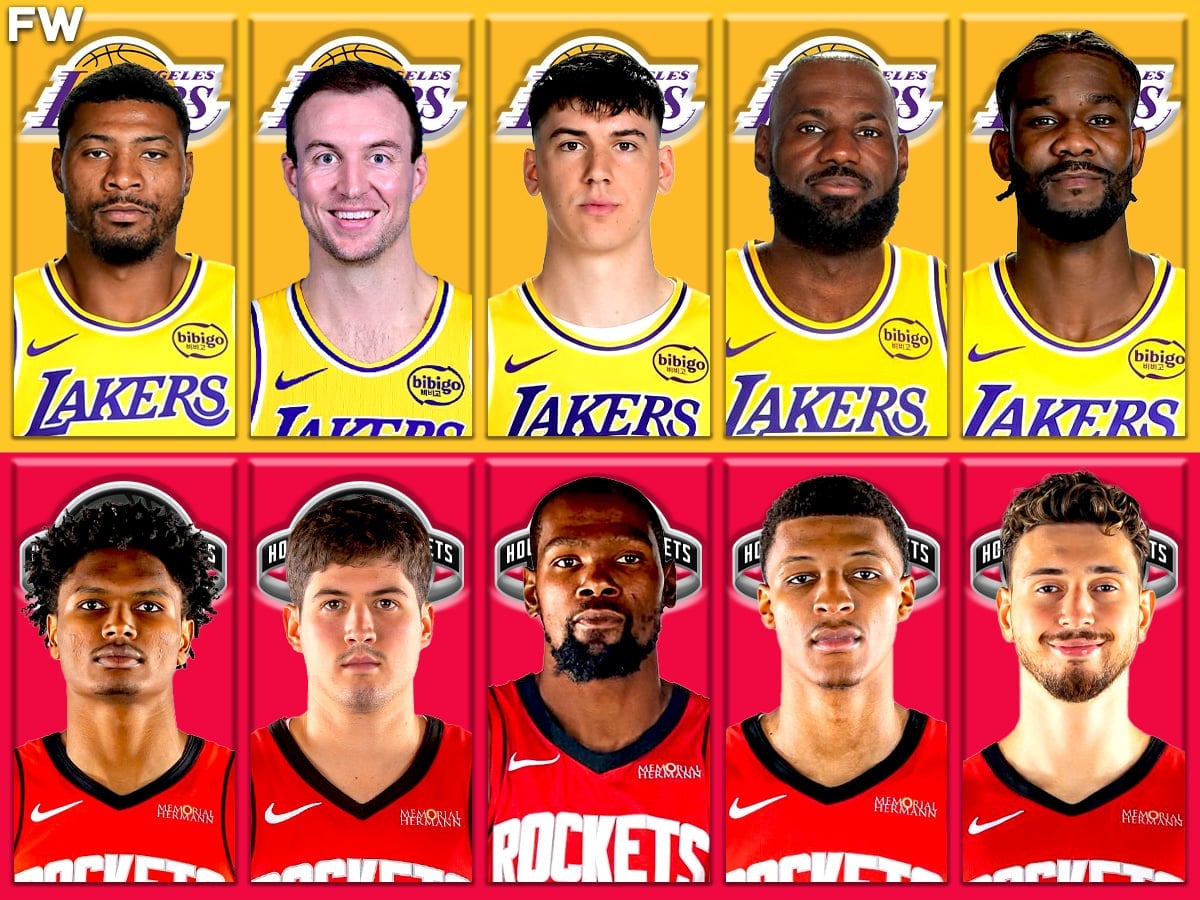
The Los Angeles Lakers host the Houston Rockets in Game 1 of their first-round series on Saturday, April 18, at 8:30 PM ET at Crypto.com Arena. The Lakers secured the West’s No. 4 seed at 53-29, which gives them home court. The Rockets finished right behind them at 52-30 as the No. 5 seed, so this is one of the tightest first-round matchups on the board.
The season series went 2-1 to the Lakers, though the context is important. The Rockets won 119-96 on December 25. The Lakers responded with a 100-92 win on March 16 and a 124-116 win on March 18. Luka Doncic produced 76 total points in those two March wins, which is a big reason the regular-season head-to-head does not fully capture what this series is now.
The star power is still real on both sides. LeBron James closed the regular season with 20.9 points, 6.1 rebounds, and 7.2 assists in 60 games, while Deandre Ayton gave the Lakers 12.5 points, 8.0 rebounds, and 1.0 blocks on 67.1% from the field.
The Rockets counter with Kevin Durant, who posted 26.0 points, 5.5 rebounds, and 4.8 assists on 52.0% from the field and 41.3% from three, and Alperen Sengun, who finished at 20.4 points, 8.9 rebounds, and 6.2 assists. Amen Thompson adds another major piece after putting up 18.3 points, 7.8 rebounds, and 5.3 assists.
Luka Doncic and Austin Reaves are not expected to play at the start of the series. JJ Redick said both are out indefinitely, and the two combined for 56.8 points, 13.8 assists, and 12.4 rebounds per game this season. That shifts the entire shape of the matchup before it even begins.
Lakers Analysis For The Series
The Lakers enter this series with the clearest problem any playoff team can have. Their normal offense is built around two high-volume creators, and both are missing. Doncic finished the season at 33.5 points, 7.7 rebounds, and 8.3 assists, while Reaves gave them 23.3 points, 4.7 rebounds, and 5.5 assists. Remove that from the lineup, and the playbook has to change. This is no longer about matching the Rockets’ firepower. It is about surviving possession to possession with far less self-created offense.
That usually leads to one question: who takes those touches? The answer looks more like redistribution than replacement. Moving Luke Kennard and Rui Hachimura into the starting lineup hurts the Lakers’ depth, while Marcus Smart returned before the postseason, and Bronny James was told to stay ready because the series will require all available guards.
That means more initiation from James, more secondary handling from Smart and Kennard, and a larger scoring burden on Hachimura. It is workable, but it is a thinner version of the team.
There is still a real offensive path for the Lakers because their core strengths did not disappear. They finished the regular season with a 118.2 offensive rating, ninth in the league, and led the NBA in field-goal percentage in the paint at 63.0%. Ayton is central to that. James can still get two feet in the lane, and Ayton remains one of the most efficient interior finishers in the league. If the Lakers can force the defense to collapse and then cash in on simple paint touches instead of living on hard pull-up jumpers, they can keep games under control.
The deeper issue is that their margin for error is small, even before the injuries are considered. The Lakers finished 19th in defensive rating at 116.4 and 14th in net rating at plus-1.7. Against the Rockets, the rebounding gap was brutal across the season series, with the Rockets owning a 130-91 edge on the glass. That is the kind of number that can erase a hot shooting night. In a playoff setting, where possessions tighten and free points are harder to find, it is difficult to win four times if the other team is consistently getting the last shot of the possession and then another one after that.
The best Lakers argument is tied to forcing disorder. The Rockets’ ball security is one of the main pressure points in the series. The Rockets committed 15.7 turnovers per 100 possessions in the regular season, the fourth-highest rate in the league, and they also coughed it up 15.4 times per game. If the Lakers can turn Smart, James, and their wings into a disruptive group at the point of attack, then some of their cleanest offense can come before the defense is set. That is especially important because the Lakers’ half-court options are far more limited without Doncic and Reaves.
There is one more reason the Lakers are not dead on arrival. James still gives them a control center. In the final stretch of the regular season, over four games in the last eight days, he put up 25.5 points on 56.0% shooting, and the Lakers outscored opponents by 11 points per 100 possessions in James’ minutes without both Doncic and Reaves. That does not mean they suddenly become favorites. It does mean the series can stay competitive if James dictates tempo, the Lakers avoid foul trouble, and the role players hit enough open shots to keep the Rockets from loading the paint every trip.
Rockets Analysis For The Series
The Rockets have the stronger season-long profile, and that is the cleanest place to start. They finished with an 118.6 offensive rating, a 113.2 defensive rating, and a plus-5.4 net rating. Those are better marks than the Lakers across the board, and they reflect a more stable two-way base. They also won eight straight late in the regular season to lock in the No. 5 seed. This is not a flimsy lower seed. It is a team whose underlying numbers already looked like a top-four profile.
The defining Rockets edge is possession control. They led the league in offensive rebound percentage at 34.8%, and their season profile shows exactly how that plays out: 48.1 total rebounds per game and 15.0 offensive boards per night. They also ranked 29th in pace, which is important because it shows how they play. The Rockets do not need a fast game to pressure you. They are comfortable in a slower series because they extend possessions through rebounding and force opponents to defend longer than they want to. Against a short-handed Lakers team, that is a heavy burden.
The Rockets also have more ways to score without becoming predictable. Durant is the best healthy shot-maker in the series. Sengun gives them an elbow and a post hub who can score, pass, and punish switches. Thompson adds rim pressure, transition force, and another playmaker who does not need to dominate the ball to leave a mark. That variety is important in playoff basketball because it lowers the chance that one defensive scheme can shut off the entire offense. The Lakers can key in on one action. It is much harder to handle Durant in space, Sengun on the block, and Thompson attacking the weak side in the same game.
The defense is the other reason the Rockets deserve the edge. Their 113.2 defensive rating was top-tier, and they have had a top-five defense for the second straight year. More importantly for this matchup, they have the right mix of size and athleticism to throw multiple bodies at James without breaking the rest of the structure.
Thompson, Jabari Smith Jr., Durant, and the rest of that frontcourt can switch more than most teams, and the absence of Doncic and Reaves means the Rockets do not have to over-help as often on the perimeter. That lets the Rockets stay bigger on the glass and more organized behind the ball.
This team is not perfect, though, and this is where the Lakers have to attack. The Rockets’ turnover problem is real, and their late-clock profile is shaky enough to keep a series alive. They took 24% of their shots in the last six seconds of the shot clock, the second-highest rate in the league, yet they were only middle of the pack in late-clock effective field-goal percentage at 46.9%.
In other words, they spend a lot of possessions playing from the edge of the clock without always getting elite return on those shots. If the Lakers can take away the offensive boards and force them into more of those late-clock situations, the games can get tighter than the raw team numbers suggest.
Still, the math of the series favors the Rockets. They have the better point differential, the better rebounding profile, the better defense, and the healthier top-end rotation. Even in the matchups the Lakers won during the regular season, Houston’s weak spot was not talent. It was execution.
The Rockets do not need to become something else to win this series. They just need to be themselves: big on the glass, solid on the defensive end, and good enough with the ball to keep the Lakers from building easy offense in transition. If that happens, they should control more of the series than the 2-1 regular-season split suggests.
Key Factors
Rui Hachimura is a major swing piece for the Lakers because his role is no longer optional offense. He finished the regular season with 11.5 points, 3.3 rebounds, and 0.8 assists while shooting 51.4% from the field and 44.3% from three. The Lakers need someone besides James who can produce a bucket when the first action breaks down. Hachimura will also spend stretches on Durant, which means his job is not just scoring. If he hits open threes, attacks closeouts, and holds up well enough defensively, the Lakers can keep their lineups balanced.
Marcus Smart is the other Laker who can shift the feel of the series without posting star numbers. He finished the season with 9.3 points, 2.8 rebounds, 3.0 assists, and 1.4 steals, and he returned just before the playoffs after missing time. The stat line is modest, but the role is not. Smart has to help organize possessions, take some of the creation load off James, and pressure ballhandlers enough to create transition chances. If he can give them competent offense and disruptive defense in the same minutes, that can steal a game in a series like this.
Reed Sheppard played a key role late in the year and finished the regular season with 13.5 points, 2.9 rebounds, 3.4 assists, and 1.5 steals in 26.2 minutes per game, while shooting 43.0% from the field and 39.4% from three. He gives the Rockets another guard who can move the ball, hit spot-up threes, and punish shaky closeouts when the Lakers send extra help toward Kevin Durant or Alperen Sengun. If Sheppard keeps the floor spaced and makes quick decisions off the catch, he can swing one of the middle games in the series and give the Rockets a real edge in the non-star minutes.
Jabari Smith Jr. is a quieter but equally important factor for the Rockets. He posted 15.8 points, 6.9 rebounds, and 1.9 assists while shooting 36.3% from three, as he can space the floor, rebound, and defend bigger forwards without needing plays called for him. He also gives the team another body in the matchup against James and another shooter who can pull Ayton away from the paint. If Smith wins his minutes, the Rockets’ lineup flexibility becomes even more difficult for the Lakers to manage over a long series.
Prediction
The Lakers have a real chance to make this more competitive than the injury headlines suggest because James still gives them structure, and the Rockets have weak spots in turnover rate and late-clock execution. But over a seven-game series, the broader profile is hard to ignore. The Rockets finished the season with the better offense, the better defense, the better net rating, and the best offensive rebounding percentage in the league, while the Lakers enter the matchup without the two players who carried so much of their shot creation. The regular-season 2-1 edge for the Lakers is worth noting, but it came in a different health context, and that changes the equation. I think the Lakers steal one behind James and one behind shot variance at home, but the cleaner team is the Rockets.
Winner: Rockets in 6