The Lakers enter the 2026 offseason with two different realities. The first is obvious: Luka Doncic is the center of the franchise, Austin Reaves is still a priority during extension talks, and the front office has a real chance to reshape the roster around a younger offensive core.
The second is more difficult: LeBron James’ future is unresolved, the team was swept by the Thunder in the second round, and Doncic missed the playoffs because of a hamstring injury. That makes this offseason less about names and more about fit. The Lakers need defenders, size, shooting, and players who can survive playoff matchups next to Doncic and Reaves.
The financial path is also complicated. The Lakers can operate as a cap-space team, but that depends on what happens with James, Reaves, Deandre Ayton, Rui Hachimura, Marcus Smart, Luke Kennard, and other free agents or option decisions. The Lakers might have a little more than $48.0 million in cap space if they keep Reaves’ cap hold and clear most of the rest of the books.
That means this is not a “sign everyone” list. The Lakers cannot chase all 10 players. They need to build different paths: one expensive defensive wing, one medium-salary shooter, one retained forward, or one low-cost role player. The main target has to answer a direct question: Does this player make Doncic easier to build around in May?
10. Bruce Brown
Contract Status: Unrestricted Free Agent
Bruce Brown is a fit because he does the work around stars. The Lakers need players who can cut, defend, rebound, screen, and make quick reads. Brown is not a pure shooter and not a full-time point guard, but he has enough connective skill to help lineups that already have creators.
Brown averaged 7.9 points, 3.9 rebounds, 2.1 assists, and 1.0 steals in 82 games this season while shooting 47.5% from the field and 38.5% from three. The 82 games are important. The Lakers have had too many rotation plans break because of availability. Brown’s value starts with being ready, physical, and usable across different matchups.
His contract situation should also keep the number reasonable. Brown is an unrestricted free agent after signing a one-year, $3.1 million deal with the Nuggets. He should get more than that if teams value his playoff history, but he should not be near the top of the wing market.
For the Lakers, Brown would help in three areas. First, he gives Doncic another cutter. Doncic punishes weak-side defenders who lose sight of the baseline. Brown is good at living in those spaces. Second, he gives the Lakers a guard-wing who can defend physically without needing touches. Third, he can handle the ball for short stretches, which helps when Reaves is pressured.
The shooting has to be viewed carefully. Brown shot well this season, but he is not Kevin Huerter. Defenses may still test him in playoff series. The Lakers cannot build spacing around him. They can use him as a physical piece inside a lineup that already has spacing.
That is why two years and $14.0 million is the right range. Brown should be a secondary target. If the Lakers miss on higher-upside wings, he gives them a proven rotation player who can play next to Doncic without demanding usage.
The mistake would be paying for the idea of Brown from 2023 instead of the player now. He is still useful, but the Lakers need to keep the role realistic: 18 to 24 minutes, matchup defense, cuts, rebounds, and short-ball handling.
9. Kevin Huerter
Contract Status: Unrestricted Free Agent
Kevin Huerter is the shooting target. The Lakers need real volume from three, not just forwards who can make open shots when left alone. Huerter gives them size at guard, movement shooting, and enough passing to fit next to Doncic.
Huerter averaged 10.0 points, 3.5 rebounds, and 2.6 assists this season while shooting 45.1% from the field. His 2025-26 full line included 38.5% from three on 4.7 attempts per game. That volume is the reason he belongs on this list.
Huerter is entering free agency with the Pistons after a four-year, $65.0 million extension, with a previous average salary of $16.25 million. He is not a minimum player. He is a mid-tier shooter who should still have a market if teams trust the defense enough.
The Lakers should like him because Doncic bends defenses in ways that create rhythm threes. Huerter can run off screens, lift from the corner, and hit shots above the break. He can also make the next pass, which is important. Some shooters stop the ball. Huerter can keep the action moving.
The defensive issue is a setback. He is not Dort, Watson, Ellis, or Grimes. He is not coming to guard elite scorers. If the Lakers sign him, they need enough defense elsewhere. Huerter can survive in the right lineup, but he cannot be asked to cover the toughest guard every night.
That limits the contract. Two years and $28.0 million, averaging $14.0 million per season, is acceptable if the Lakers have enough room after bigger decisions. A third guaranteed year would be risky. Shooters with defensive limitations can become hard to move if the shot dips.
The upside is offensive clarity. Huerter would give the Lakers a player defenses respect from the first possession. With Doncic, that has real value. Doncic does not need every teammate to create. He needs enough teammates who punish help without thinking twice.
8. Rui Hachimura
Contract Status: Unrestricted Free Agent
The Lakers know who Rui Hachimura is at this point. They know his strengths. They know the defensive limitations. They know what he looks like next to Reaves, James, and Doncic. The question is price.
Hachimura averaged 11.5 points, 3.3 rebounds, and 0.8 assists in 68 regular-season games while shooting 51.4% from the field. The more important number is the shooting growth. Hachimura shot 44.3% from three in the regular season and then 56.9% from three in the playoffs on 33-of-58 shooting. That is not a small development.
His postseason offense was strong. He ended at 17.5 points, 4.0 rebounds, and 1.7 assists in 10 playoff games while shooting 54.9% from the field and 56.9% from three. In a stretch where the Lakers were missing Doncic, Hachimura gave them efficient scoring in a larger role.
The case for keeping him is simple. Hachimura is a big forward who can shoot, attack smaller defenders, finish through contact, and play as a release valve. Doncic will create open corner threes and mismatches. Hachimura can benefit from both.
The case against overpaying is also clear. Hachimura is not a high-level rebounder for his size. He is not a disruptive defender. He can guard some forwards, but he is not a primary stopper. If the Lakers are paying $18.0 million or more per year, they need a stronger two-way profile.
Three years and $45.0 million is the right line. An average of $15 million per year gives Hachimura a strong contract after a great shooting season, but it does not treat him like a top-three player on a contender. If the price climbs toward $20.0 million per season, the Lakers should look at the broader market first.
7. Tobias Harris
Contract Status: Unrestricted Free Agent
In case Hachimura slips past the Lakers in free agency, they can still get a veteran forward option. Tobias Harris will not change the franchise ceiling by himself, but he fits the part of the roster that needs size, shooting, and adult decision-making.
Harris averaged 13.3 points, 5.1 rebounds, and 2.5 assists this season while shooting 46.9% from the field. He is coming off a two-year, $52.0 million contract with the Pistons and is in the middle of an impressive postseason stretch, posting 18.1 points, 7.2 rebounds, and giving the Pistons a big release valve so far.
The first reason he fits is size. The Lakers need forwards who can play the 3 and 4 without forcing smaller guards into bad matchups. Harris is not an elite defender, but he has a strong frame, enough experience, and enough offensive skill to play in structured playoff minutes.
The second reason is shot diet. Harris can hit spot-up threes, attack closeouts, post smaller defenders, and play without standing still the entire set. Doncic needs that type of forward. When defenses trap, stunt, or rotate, Harris can take the first open shot or punish the late closeout with more decision-making than Hachimura.
The risk is age and price. Harris turns 34 in July, and he should not be paid like a long-term core piece. ESPN’s Bobby Marks reportedly valued a Harris offer around two years and $38.0 million, which shows he may still have a strong market. For the Lakers, $19.0 million per season feels high for a secondary player.
Two years and $32.0 million is more disciplined. It gives Harris a meaningful role and salary, but it keeps the contract short. The Lakers should not go three years unless the final season is non-guaranteed or partially guaranteed.
Harris is not a perfect target. He does not solve point-of-attack defense, and he is not a high-volume movement shooter. But he would give the Lakers a stable forward who can help the regular-season floor and hold up physically in playoff matchups. On a roster built around Doncic, that has value.
6. Keon Ellis
Contract Status: Unrestricted Free Agent
Keon Ellis was the Lakers’ main trade target before the deadline. He does not have the name of Dort or Watson, but he fits the Lakers’ needs almost perfectly. He defends, plays low-usage basketball, shoots enough, creates turnovers, and does not need the ball.
Ellis averaged 6.7 points, 1.9 rebounds, and 1.0 assists this season while shooting 44.0% from the field. His basic numbers are low because his role was small, but that is the point. The Lakers do not need every target to have a 15-point average. They need role players who can play off stars and defend All-Star guards.
For the Lakers, Ellis would be a direct answer to their perimeter problem. Doncic and Reaves are gifted offensive players, but they need protection around them. Ellis can take harder guard assignments, pressure the ball, and keep the Lakers from using Reaves too often against elite creators.
The offensive fit is low-maintenance. Ellis would stand in the corner, take open threes, cut when his defender turns his head, and attack only when the opening is already there. That is exactly how a role player should function next to Doncic. No forced dribbles. No wasted possessions. No need for touches.
The contract should be strong enough to be his top option, but not irresponsible. Three years and $36.0 million ($12.0 million per season) is a fair bet on a 26-year-old role player with defensive value. It also keeps him tradable if the Lakers later need to adjust the roster.
The downside is limited self-creation. Ellis will not fix the bench offense by himself. If the Lakers sign him, they still need shooting and another ball handler. But as a defensive guard-wing, he gives them something they cannot create internally with a minimum signing.
5. Quentin Grimes
Contract Status: Unrestricted Free Agent
One of the strongest realistic perimeter targets is definitely Quentin Grimes. He combines shooting, defense, and enough secondary creation. He is not just a standstill shooter. He can attack a closeout, guard both backcourt spots, and play in lineups where Doncic or Reaves controls the ball.
Grimes averaged 13.4 points, 3.6 rebounds, and 3.3 assists this season while shooting 45.0% from the field. He is entering unrestricted free agency after playing on an $8.7 million qualifying offer with the 76ers, and his market could be complicated after an inconsistent season and uneven playoff role.
That complication is exactly why the Lakers should be involved. If Grimes had a perfect season, he might price himself out of this range. Instead, the market may split between teams that see a streaky role player and teams that see a two-way guard still entering his prime.
The Lakers should be in the second group. Grimes gives them a player who can defend, shoot, and play off Doncic. That is the main requirement. He does not need to become a star. He needs to be a 28-minute playoff guard who can take the opponent’s better guard assignment and hit enough threes to punish help.
The risk is consistency. Grimes started well in a sixth-man role before his shooting and confidence dipped. That cannot be ignored. The Lakers would be paying for the bigger picture, not just the last season.
Three years and $54.0 million is aggressive but still realistic. It is more than a cheap role-player contract at $18.0 million per year, but it is not star money. If Grimes reaches his best version, that deal becomes very workable. If he stays inconsistent, it becomes a medium-sized contract that can still be moved.
4. Peyton Watson
Contract Status: Restricted Free Agent
Peyton Watson is the upside play. He is difficult to get because he is a restricted free agent, and the Nuggets can match any offer sheet. But the Lakers should still test the market if their cap-space plan allows it. Young, athletic wings with defense and improving shooting rarely become available.
Watson averaged 14.6 points, 4.9 rebounds, and 2.1 assists this season while shooting 49.1% from the field. He even had 40 starts and 29.6 minutes per game, which shows how trusted he’s been. He became a major piece for the Nuggets before going down injured.
The Lakers have already been connected to him. ESPN’s Dave McMenamin reported that the Lakers had privately discussed Watson, and the Nuggets’ heavy salary sheet could create a path if they do not match a large contract offer.
The fit is obvious. Watson gives the Lakers length, weak-side defense, transition athleticism, and a forward who can grow next to Doncic instead of aging out of the window. If the shooting is stable, he becomes one of the best long-term fits on this list.
That is the key. Watson’s value changes if he is a real shooter. He poured 41.1% of his attempts from deep, shooting 3.6 threes per night this year. If he is a low-30s three-point shooter in a bigger Lakers’ volume, defenses can test him in May. If he is closer to his season average, he becomes a starting-level two-way wing. The Lakers would be betting on the second outcome.
The contract has to be aggressive because restricted free agency requires pressure. Four years and $88.0 million is not a discount. It is designed to make the Nuggets think. If the Lakers offer something too modest, it gets matched quickly. If they go above $22.0 million per season, they need to be sure Watson is a core piece, not just a toolsy wing.
Still, Watson should be near the top of the list. The Lakers need athletic forwards who can defend, run, and grow. He is the best young swing available if the door opens.
3. Luguentz Dort
Contract Status: $17.7 million Team Option
Luguentz Dort is the best outside target because he solves the most urgent roster problem. The Lakers need an elite point-of-attack defender next to Doncic and Reaves. Dort is one of the strongest guards in the league, has deep playoff experience, and does not need an offensive game to affect the outcome.
The contract situation is the only reason this is complicated. Dort has a $17.7 million team option for 2026-27, with a June 29 decision date. If the Thunder pick it up, he is not a free-agent target. If they decline it because of long-term payroll pressure or a larger roster plan, the Lakers should be ready.
Dort averaged 8.3 points, 3.6 rebounds, and 1.2 assists this season. The scoring is not the selling point. The defense is. Dort only averaged 0.9 steals this season, but opponents shot 40.8% from the field against him, as he had a top 10 volume of shots contested by guards.
Dort ranked in the 95th percentile in defensive turnovers, the 82nd percentile in defensive versatility, and the 74th percentile in rim defense, as well as having 1.7 deflections per game and a 30.0% of loose balls recovered.
The Thunder series showed the Lakers what this type of player can do in a playoff setting. Dort was not the star, but his physical defense is part of why the Thunder can survive guard-heavy matchups. The Lakers do not need more soft scoring around Doncic. They need players who can win possessions without shots.
The offense is good enough if the role is right. Dort cannot be treated like a high-usage wing. He has to shoot open threes, attack the occasional closeout, and stay out of the way when Doncic is manipulating the defense. If he does that while defending the opponent’s best guard, the value is clear.
Three years and $67.0 million is a serious offer, but it matches the market for high-end defensive guards at $22.0 million per season. Dort would be 27 next season, so the Lakers would be paying prime years, not decline years. That matters.
The risk is spacing. If Dort’s shot dips, playoff defenses will help off him. The Lakers would need enough shooting around him to survive. That is why a Dort signing would affect every other move. If he is the big-money target, the next additions must be shooters.
Still, he is No. 1 because the roster need is too big. Doncic and Reaves can carry offense. The Lakers need someone to take the hardest defensive guard assignment every night. Dort is the best possible version of that target if he reaches the market.
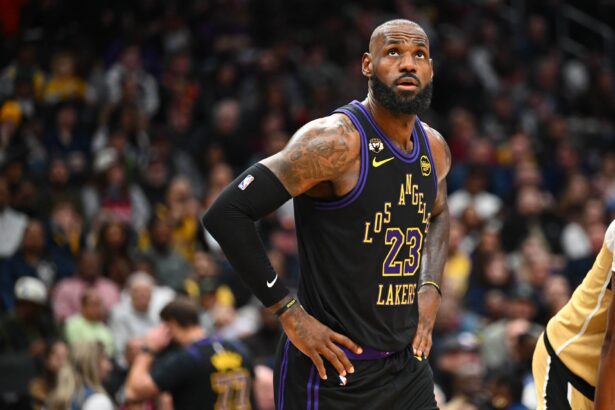
2. LeBron James
Contract Status: Unrestricted Free Agent
LeBron James is still the biggest decision because his contract number changes the whole offseason. This is not any free-agent target. This is a balance between respect, production, age, roster flexibility, and the Lakers’ need to build a real team around Luka Doncic.
James averaged 20.9 points, 6.1 rebounds, and 7.2 assists this season while shooting 51.5% from the field. He is 41, but the production is still starter-level and, in some stretches, more than that. The Lakers were also forced to lean on him as a first option in the postseason. That is a key because James was not just a legacy player on the roster. He was still carrying a main offensive responsibility.
The contract has to be the serious part. ESPN’s Bobby Marks listed one year, $30.0 million as the type of offer he would make to James. That feels like the right structure. It is enough money to respect his level, but it does not destroy the Lakers’ ability to chase defensive wings and shooters. A larger one-year number is possible because the Lakers have his Bird rights, but going too high would hurt the entire plan.
The basketball fit is still obvious if the role changes. James can play more off Doncic, attack tilted defenses, punish switches, and run second-unit possessions when Doncic rests. The Lakers do not need him to be a 35-minute engine every night. They need him as a high-level forward who can score, pass, control tempo, and close games when healthy.
The risk is not talent. It is cost and role. If James wants a max-type number or a long commitment, the Lakers should hesitate. If he takes a shorter deal around $30.0 million, he becomes the best veteran target on the board.
1. Austin Reaves
Contract Status: $14.9 million Player Option
Austin Reaves has to be No. 1 because he is the Lakers’ most important free-agent decision. Not the biggest name. The most important decision. He is younger than James, already fits next to Doncic, and gives the Lakers a second offensive creator without forcing a trade. Reaves is widely expected to decline his Player Option and test the free agency market, where a big offer from the Lakers awaits.
Reaves averaged 23.3 points, 4.7 rebounds, and 5.5 assists this season while shooting 49.0% from the field. That is not role-player production anymore. That is an All-Star caliber offensive guard. His scoring jump also changes the contract conversation. The Lakers cannot treat him like the same value piece who signed for $53.8 million over four years in 2023. He is in a different tier now.
The Lakers should not play games here. Reaves can handle, shoot, get to the line, run pick-and-roll, and play off Doncic. He is not the defender Dort is, and that is why the Lakers still need a stopper. But losing Reaves would create a bigger problem than it solves.
Five years and $190.0 million is expensive, but that is the market for a 23-point scorer with Bird rights on a team trying to win now. So about $38.0 million per season feels like a realistic number if he is pushing towards the 40s, as some project. If the Lakers want to build around Doncic, keeping Reaves is the first move. Everything else comes after that.
Final Take
The Lakers’ offseason starts with Austin Reaves and LeBron James. Reaves is the long-term priority because he is in his prime, fits next to Luka Doncic, and gives the Lakers a real second creator. James is still too productive to ignore, but the contract has to protect flexibility.
After that, the board should turn to defense. Luguentz Dort is the best external fit if he becomes available. Payton Watson is the strongest young wing swing. Quentin Grimes and Keon Ellis would give the Lakers cheaper two-way options.
The mistake would be spending big money on names without fixing the real issues. The Lakers don’t need a flashy offseason. They need one real defender, enough shooting around Doncic, and role players who can stay on the floor in May.