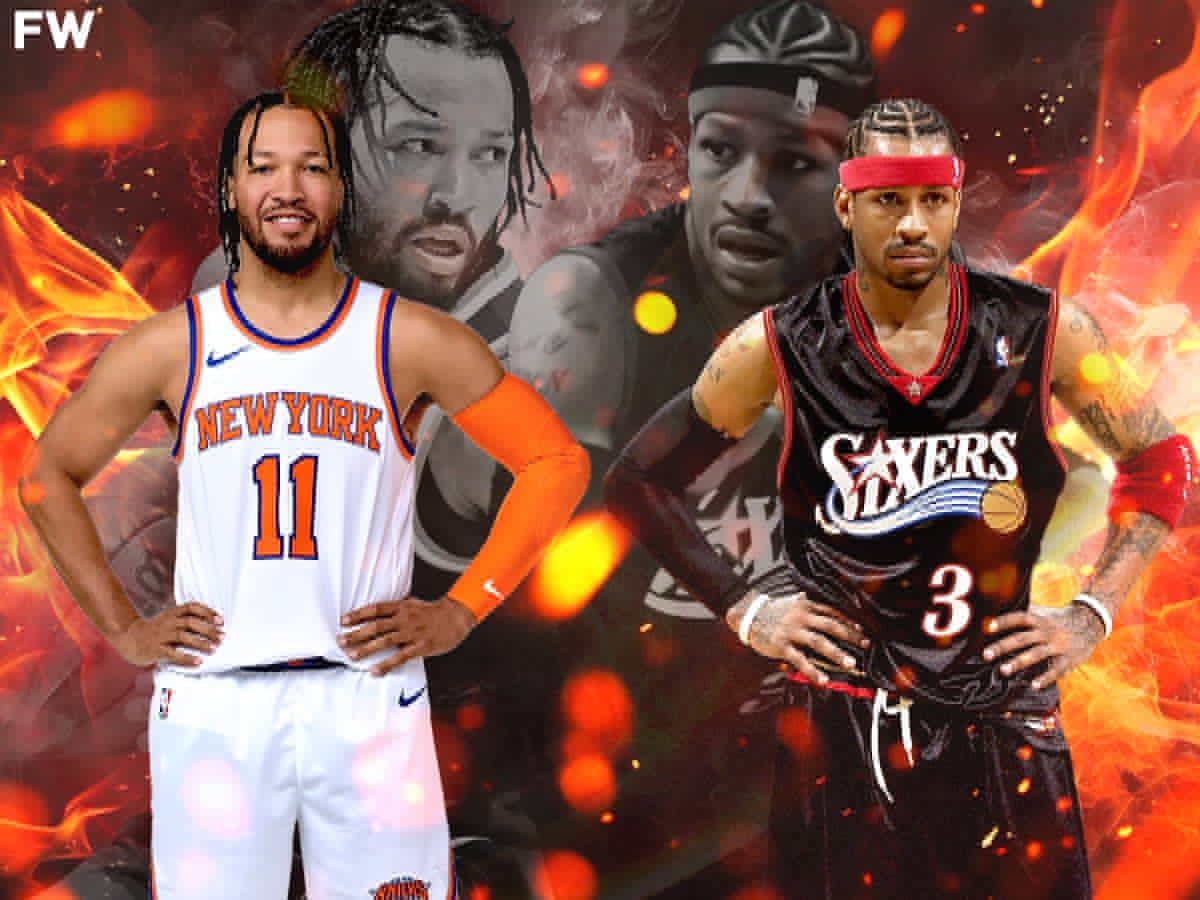
Allen Iverson was one of the most influential players in NBA history. He changed basketball and dominated the NBA despite standing barely 6’0″ tall, won an MVP award, captured four scoring titles, and dragged an undermanned Philadelphia 76ers roster to the 2001 NBA Finals.
For years, comparing most point guards to Iverson was easy. They simply couldn’t match up to his accolades or impact.
But now there is Jalen Brunson.
The New York Knicks superstar has put together a Hall of Fame resume of his own despite being a second-round draft pick, culminating in a historic 2026 championship run that ended New York’s 53-year title drought. Brunson also won Finals MVP while leading one of the most dominant 16-3 postseason runs in recent memory.
So who deserves the edge: the icon who won an MVP award and redefined the league, or the championship-winning guard who delivered New York its most important basketball moment in over 50 years?
Let’s compare them category by category.
NBA Championships
Jalen Brunson: 1 (2026)
Allen Iverson: 0
Brunson’s biggest advantage in this debate is obvious. He accomplished something Allen Iverson never did: lead his team to a championship as the best player. The 2026 playoffs elevated Brunson into a different tier. New York finished 16-3 in the postseason, overcame multiple double-digit deficits against Victor Wembanyama and the San Antonio Spurs, and captured the franchise’s first title since 1973. Brunson averaged 32.6 PPG and 4.6 APG throughout the Finals while repeatedly delivering in clutch situations.
On the other side, Iverson came agonizingly close in 2001. That season remains one of the greatest individual carry jobs in NBA history. Iverson averaged 31.1 points during the regular season, won MVP, and led Philadelphia to the Finals despite lacking another true superstar. His iconic 48-point Game 1 performance against the Los Angeles Lakers handed Shaquille O’Neal and Kobe Bryant their only postseason loss.
Unfortunately, history remembers championships. Despite reaching the Finals, Iverson never captured a title. Championships aren’t everything, but when comparing all-time great point guards, being the best player on a title team makes a huge difference.
Advantage: Jalen Brunson
Finals MVP Awards
Jalen Brunson: 1 (2026)
Allen Iverson: 0
Brunson’s Finals MVP changed his legacy. Against San Antonio, he averaged all-time great scoring and playmaking numbers while leading comeback victories in Games 4 and 5. The award validated what everyone had witnessed throughout the postseason: New York’s championship run revolved around Brunson’s leadership and shot creation. The guard posted 32.6 PPG, 4.2 RPG, 4.6 APG, and 2.0 SPG on 42.1% FG, 38.9% 3-PT FG, and 86.0% FT.
Few point guards in league history own a Finals MVP trophy, and Iverson never won Finals MVP because Philadelphia never won the championship. His 2001 Finals performance was outstanding: 35.6 PPG, 5.6 RPG, 3.8 APG, and 1.8 SPG on 40.7% FG, 28.2% 3-PT FG, and 72.9% FT, along with countless memorable moments, but awards will follow championships.
Brunson owns an accolade that Iverson simply cannot match.
Advantage: Jalen Brunson
MVP Awards
Jalen Brunson: 0
Allen Iverson: 1 (2001)
Brunson has produced a couple of MVP-caliber seasons with the Knicks and has finished as high as 5th place (2023-24), but he has yet to capture the league’s highest individual honor. The presence of Nikola Jokic, Joel Embiid, and Shai Gilgeous-Alexander has made winning MVP extraordinarily difficult during Brunson’s era. Still, an MVP remains absent from his resume.
Iverson’s 2000-01 season remains legendary. He averaged 31.1 points, 4.6 assists, and 2.5 steals while carrying one of the NBA’s least offensively talented contenders. He became the first guard since Michael Jordan to dominate the league as both a scorer and a cultural phenomenon simultaneously. Winning MVP places Iverson in rare historical company.
Advantage: Allen Iverson
Scoring Titles
Jalen Brunson: 0
Allen Iverson: 4 (1999, 2001, 2002, 2005)
Brunson has consistently averaged at least 24.0 PPG per season since landing in New York, but he has never led the NBA in points per game. His game revolves around efficiency, decision-making, and controlling the game rather than overwhelming opponents with sheer volume.
Iverson won scoring titles in 1999, 2001, 2002, and 2005. For nearly a decade, he was the most feared isolation scorer in basketball despite being dramatically smaller than the players defending him. His combination of speed, handles, toughness, and creativity made him impossible to contain. He averaged 26.8 PPG in 1991, 31.1 PPG in 2001, 31.4 PPG in 2002, and 30.7 PPG in 2005.
Only a handful of players in NBA history own four scoring crowns, and Iverson easily takes the edge.
Advantage: Allen Iverson
All-NBA Teams
Jalen Brunson: 3 (3 Second Team)
Allen Iverson: 7 (3 First Team, 3 Second Team, 1 Third Team)
Brunson has quickly accumulated All-NBA selections with the Knicks and established himself as one of the defining guards of his generation. His combination of scoring efficiency, leadership, and playoff success has made him a fixture on All-NBA ballots. At his current pace, he could eventually challenge Iverson’s total, but has three All-NBA Second Teams so far.
Iverson earned seven All-NBA selections, including three First Team honors. For much of the early 2000s, he was universally recognized as one of the NBA’s best players regardless of position. His excellence for a long time gives him a significant advantage, although Brunson might catch up one day.
Advantage: Allen Iverson
All-Star Appearances
Jalen Brunson: 3
Allen Iverson: 11
Brunson’s rise from second-round pick to perennial 3-time All-Star is one of the league’s great success stories. His popularity exploded after transforming the Knicks into championship contenders and eventually champions. We certainly didn’t expect Brunson to go from role player to NBA All-Star stalwart like this.
Iverson was one of the most popular athletes on the planet during his prime. He earned 11 All-Star appearances and frequently ranked among the league’s leading vote-getters. His influence extended far beyond basketball. The longevity advantage is substantial, and he takes the nod again.
Advantage: Allen Iverson
Regular Season Career Statistics
Jalen Brunson: 19.2 PPG, 3.2 RPG, 5.3 APG, 0.7 SPG, 0.1 BPG
Allen Iverson: 26.7 PPG, 3.7 RPG, 6.2 APG, 2.2 SPG, 0.2 BPG
Brunson’s numbers reflect efficiency and are a bit skewed considering his average with the Knicks is 26.3 PPG, 3.4 RPG, and 6.8 APG after only averaging 11.9 PPG, 3.0 RPG, and 3.7 APG during his stint in Dallas. He scores without dominating possessions and consistently elevates teammates through his playmaking. His stats align with traditional championship point guards.
Iverson’s production was ridiculous for his size. Few guards have ever combined elite scoring volume with playmaking the way he did. His efficiency suffered due to the era and offensive burden he carried, but the raw numbers remain extraordinary, and he has the easy advantage overall.
Advantage: Allen Iverson
Playoff Career Statistics
Jalen Brunson: 26.0 PPG, 3.7 RPG, 5.5 APG, 0.8 SPG, 0.1 BPG
Allen Iverson: 29.7 PPG, 3.8 RPG, 6.0 APG, 2.1 SPG, 0.2 BPG
Brunson’s playoff resume is arguably his strongest argument in this entire debate. His production rises when games matter most, and he now owns a championship run that rivals some of the greatest postseason performances by a point guard.
However, make no mistake, Iverson was a playoff monster. His scoring average is ranked 3rd in NBA postseason history, and his 2001 playoff run remains one of the greatest individual performances ever produced by a guard. The volume and consistency are difficult to ignore, and he gets the nod again.
Advantage: Allen Iverson
Total Win Shares
Jalen Brunson: 54.2
Allen Iverson: 99.0
Brunson’s number continues to rise as he enters the prime years of his career. Winning a championship and leading elite regular-season teams have accelerated his accumulation of advanced statistical value.
Iverson finished with nearly 100 Win Shares despite carrying enormous offensive burdens throughout his career. His longevity and sustained star-level production provide a clear edge.
Advantage: Allen Iverson
Career Player Efficiency Rating (PER):
Jalen Brunson: 19.2
Allen Iverson: 20.9
Brunson shines in advanced metrics, as he continues to improve his PER over time. His elite efficiency, low turnover rate, and offensive impact make him one of the most analytically friendly guards of the modern era.
Iverson’s PER remains impressive considering the pace, efficiency standards, and offensive responsibilities of his era. Iverson wasn’t exactly an efficiency fiend that we see from guards today, but he still holds the edge over Brunson. Another edge to the iconic player from the 2000s.
Advantage: Allen Iverson
Final Score
Allen Iverson vs. Jalen Brunson 8-2
When comparing category by category, Allen Iverson emerges as the clear winner. The Hall of Fame guard claims victories in MVP awards, scoring titles, All-NBA selections, All-Star appearances, regular-season statistics, playoff statistics, total PER and Win Shares, and overall individual accomplishments.
At his peak, Iverson was one of the most dominant players the NBA has ever seen.
Brunson counters with the two categories that every superstar covets most: NBA championships and Finals MVP awards. His historic 2026 title run with the Knicks instantly elevated him into basketball immortality, which Iverson never achieved during his legendary career.
However, Iverson’s body of work remains difficult to overcome. An MVP award, four scoring titles, seven All-NBA selections, 11 All-Star appearances, and nearly a decade as one of the league’s premier superstars give him a significantly deeper resume.
He carried teams in a way few guards in NBA history have ever managed and remains one of the most influential players the sport has seen.
That said, Brunson’s story is still being written as an all-time great Knick, and at just 29 years old, he already owns a championship, a Finals MVP, three All-NBA selections, and the distinction of ending New York’s 53-year title drought. If he adds another title, another Finals MVP, or continues stacking All-NBA seasons throughout his prime, the gap could close quickly.