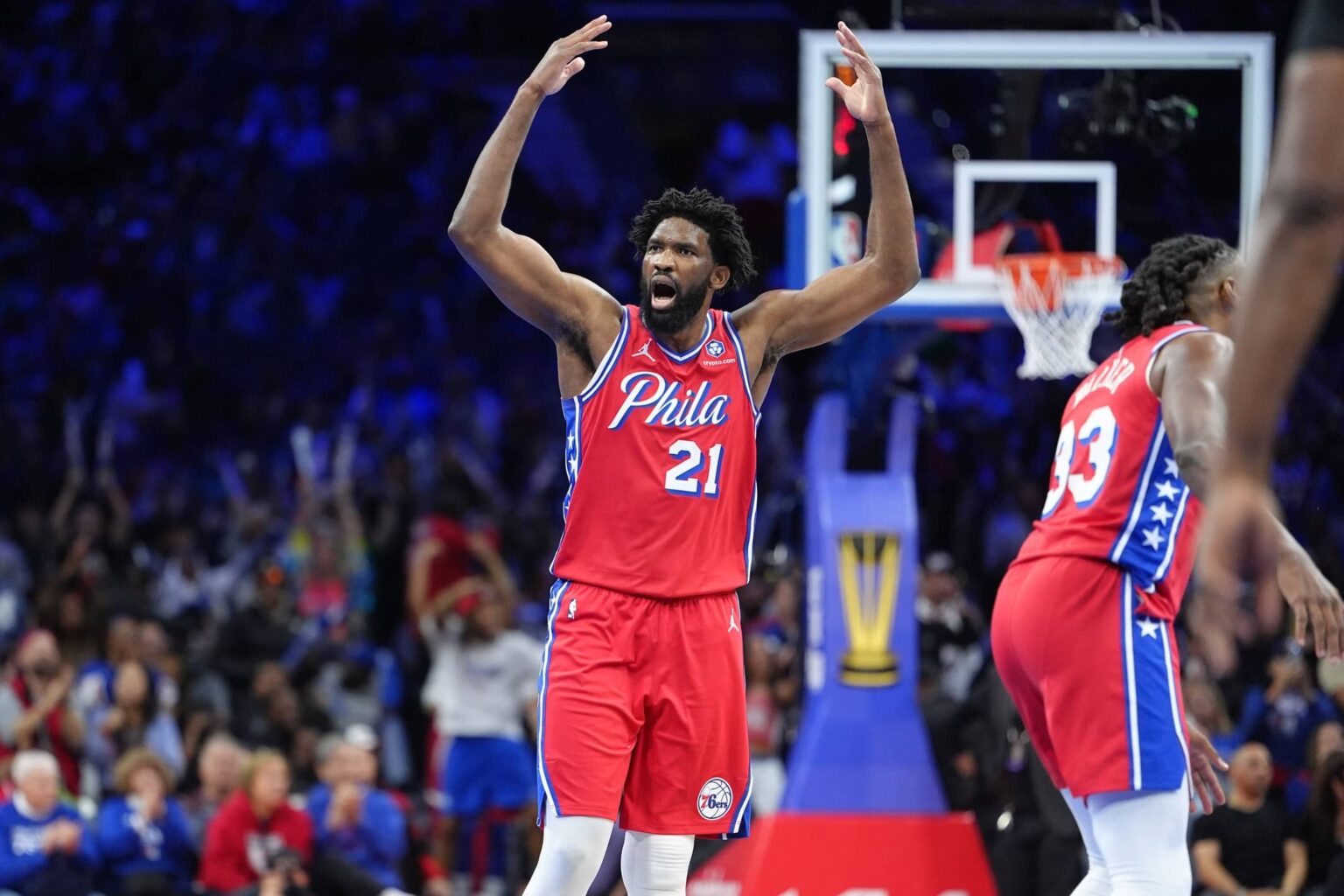
Joel Embiid’s latest setback changed the full discussion around the 76ers. He underwent an appendectomy this week, was released from the hospital, and the team still has no timeline for his return to basketball activity. That is a brutal hit for a team that is 44-37 and sitting eighth in the East with the Play-In close.
It is even bigger because Embiid was still producing at a star level when available. In 38 games this season, he averaged 26.9 points, 7.7 rebounds, 3.9 assists, 1.2 blocks, shot 48.9% from the field, 33.3% from three, and posted a 60.5 true shooting percentage. Even in a season with injuries and interruptions, he was still the 76ers’ best scorer, best interior defender, and the player who gave shape to both ends of the floor.
Now the question is very direct: can the 76ers win a playoff round without him? Not survive a game. Not stay competitive for a week. Win four times in one series. The answer depends on whether Tyrese Maxey can carry the offense at a star level, whether Paul George can still be a real secondary engine, and whether their rotation players can hold the structure together without Embiid covering so many problems at once.
This is not really about emotion or leadership. It is about the lineup clicking, rim protection, half-court creation, rebounding control, and whether the 76ers still have enough two-way balance to beat a real playoff team over seven games.
The Numbers Paint A Blunt Picture
Start with the team split. With Embiid on the floor this season, the 76ers have played like a solid playoff team. Their offensive rating with him is 118.5, and their defensive rating is 114.8. Without him, the offense drops to 112.6 and the defense slides to 117.4. That is the full problem in one line. The attack becomes less efficient, but the bigger damage is on the other end, where the rim deterrence, post defense, and foul-drawing control all fall away. Based on those offensive and defensive splits, the 76ers move from a positive team with Embiid to a clearly negative one without him. They sit below .500 without him this season, at 20-23.
The overall team profile supports that read. The 76ers are at 115.8 points per game, 43.6 rebounds, and only 24.6 assists per game, which ranks near the bottom of the league in ball movement volume. They are not a high-flow, pass-heavy machine that can survive by committee the way some other playoff teams can. They also allow 116.2 points per game. The athletic tools are still there, though.
They are among the better teams in deflections at 20.3 per game, and they are near the top of the league in total blocks with 462. In other words, the baseline athletic pressure still exists. The problem is that Embiid is the piece that turns those loose disruptive actions into a real half-court defense. Without him, the 76ers can create chaos, but they do not always finish the possession cleanly.
There is also a sample-size issue that cuts both ways. The no-Embiid sample is large enough to matter, but it is not one clean version of the team. Some of those games came without George. Some came before Edgecombe fully settled in. Some came before the rotation stabilized at all. That is why the recent trend matters more than the broad season average.
In their last eight games without Embiid, the 76ers still scored 114.6 points per game and generated 26.3 assists. That is not elite, but it is enough to stay in games if the defense holds. The problem is that the defense has not consistently held. Recent no-Embiid losses to the Pistons and Rockets showed the same pattern: the offense can survive for stretches, but once the game slows down or the glass starts tilting, the margin disappears fast.
Tyrese Maxey Must Carry The Offensive Load
The first reason the 76ers are not completely dead without Embiid is Maxey. He is not just having a star season. He is having the exact kind of season that at least gives a team a puncher’s chance in a playoff series. Maxey is at 28.4 points, 6.7 assists, 4.2 rebounds, 1.9 steals, and a 58.8 true shooting percentage.
Those are high-end lead-guard numbers with real volume, not just efficiency built on low usage. Without Embiid this season, he has still produced 28.3 points and 5.8 assists in 34 games. That tells you the first option survives. The question is not whether Maxey can score without Embiid. He clearly can. The question is whether his scoring can anchor enough efficient half-court offense for four wins in seven games.
The offensive design without Embiid has to become even more guard-driven. That means more empty-corner pick-and-roll, more quick-hitting drag screens in transition, more Spain actions with a shooter behind the screener, and more possessions where Maxey gets the ball early instead of walking into a loaded floor with 12 seconds left.
The good news is that Maxey is still one of the fastest downhill guards in the league and one of the few on the roster who can consistently collapse the first line of defense by himself. The bad news is that playoff teams will load up on him hard. Without Embiid as a short-roll hub, post threat, and foul magnet, Maxey will see more switches, more drop defenders sitting on his pull-up, and more wings pinching in at the nail. That means the spacing around him has to be sharp every trip.
There is one small but real positive sign here. The 76ers have gone 8-4 in the sample where Maxey and George both played without Embiid, and Maxey’s own line in some no-Embiid games with Edgecombe and George jumps into star territory. Maxey is at 30.3 points and 6.0 assists in nine games without Embiid while sharing the floor with both Edgecombe and George.
That does not prove they are a real contender-level three-man engine. It does show the basic structure can work when the roster around Maxey is closer to full strength. If the 76ers are going to steal a series without Embiid, it will almost certainly require Maxey to be the best offensive player in at least four games. That is a hard ask, but it is not an impossible one.
The Swing Group Must Rise Instantly
The most important change from older Embiid-less 76ers teams is that this group actually has more than one perimeter creator. George has not had a superstar year by his own standards, but he is still giving the 76ers 17.5 points, 5.3 rebounds, 3.6 assists, 1.7 steals, 39.4% from three, and a 57.4 true shooting percentage. That is useful playoff offense, even if the burst is no longer the same.
Without Embiid this season, George is at 15.5 points, 4.6 rebounds, and 3.3 assists in a small 11-game sample. Those raw numbers are fine, but the more important part is the role. He cannot be the main engine anymore. What he can still do is stabilize a possession, attack a closeout, run second-side pick-and-roll, and make the extra pass without the play dying. That is a valuable playoff function next to Maxey.
VJ Edgecombe is probably the most important variable in the whole no-Embiid discussion. He is already giving the 76ers 16.1 points, 5.6 rebounds, 4.1 assists, 1.4 steals, and a 54.2 true shooting percentage as a rookie. Without Embiid, his production rises to 17.5 points, 5.6 rebounds, and 3.8 assists.
The 76ers need him to do three direct things. First, push the pace after misses so the offense gets easier points before the defense is set. Second, attack the second defender after Maxey bends the first action. Third, pressure the ball and jump passing lanes so the team can win a few ugly possession battles. That part is real already. The 76ers are one of the better deflection teams in the league, and Edgecombe’s activity is part of that identity.
Quentin Grimes is the other important piece because his game is made for great playoff production. He is at 13.3 points, 3.6 rebounds, and 3.2 assists on a 58.3 true shooting percentage for the season, and his no-Embiid split climbs to 15.7 points, 3.6 assists, and 3.4 rebounds. That is not star production, but it is exactly the kind of line that can change a first-round series when the margins are thin.
Grimes can take the lower-usage wing assignment on offense, spot up, attack a rotating defense, and give the 76ers one more player who can survive a closeout. He also lets Nick Nurse use smaller, faster groups without giving up too much physicality at the point of attack. The issue is that his season defensive rating is weak, which matches the eye test when the whole team loses backline support. He is better as a team defender when there is real rim protection behind him. Without Embiid, the burden on his screen navigation and recovery gets bigger.
Kelly Oubre Jr. belongs in this conversation too, even if he is less central to the offensive discussion. He is at 14.1 points, 5.0 rebounds, 1.3 steals, 36.6% from three, and a 58.3 true shooting percentage for the season. In his no-Embiid sample, he is at 15.6 points and 4.8 rebounds. Oubre is useful because he fills the gaps between the creators.
He cuts, runs, finishes, and gives the 76ers another long wing who can pressure the ball. In a no-Embiid series, that role gets more important because the team will need points from movement, not just from set offense. Oubre can give that. He is also one of the better candidates to close at the four in faster lineups, where Nurse wants to switch more, trap more, and simply raise the game’s speed.
The main takeaway from this perimeter group is that the 76ers have enough ball-handling and wing scoring to avoid collapsing offensively. That is a meaningful difference from some past versions of the team. The problem is ceiling. Maxey can be a top-level first option for stretches. George can still organize the second side. Edgecombe can add force. Grimes can connect plays. Oubre can fill gaps. That is enough to win games. It is not obviously enough to win four against a top East defense when the opponent knows the entire game plan begins with keeping Maxey out of the paint.
The Frontcourt Goes Into Survival Mode
This is where the case gets weak. Andre Drummond still gives the 76ers volume rebounding. He leads the team at 8.3 rebounds per game overall, and in the no-Embiid sample, he jumps to 7.5 points, 9.9 rebounds, and 1.7 assists, while his defensive rating stays much better than most of the perimeter rotation. That is useful. He can still screen, rebound, and finish dump-offs. But the playoff problem is not whether Drummond can rebound. It is whether he can anchor a half-court defense possession after possession against good guards and good shooting. Embiid covers mistakes with positioning, length, and free-throw control on the other end. Drummond does not give the same full package. He can help the 76ers survive the glass. He does not really replace the scheme.
Adem Bona may actually be the more interesting playoff option in some matchups. His season line is small at 4.9 points, 4.3 rebounds, and 1.2 blocks in 17.4 minutes, but his no-Embiid split rises to 6.8 points, 5.3 rebounds, and 1.3 blocks. He is also finishing with a 64.1 true shooting percentage. Bona is not ready to replace Embiid’s offensive command, obviously, but he gives the 76ers a more vertical and more reactive defensive option. If Nurse wants more speed, more rim-running, and more switching range around the screen level, Bona is probably the better answer than Drummond. If Nurse wants rebounding and more stable positional defense, Drummond is safer. The fact that the 76ers may need both answers in the same series tells you how hard the frontcourt math becomes without Embiid.
There is also a direct warning sign from actual game results. In the recent loss to the Pistons, the 76ers were beaten 45-33 on the glass and lost the second-chance points battle 21-11. That is the exact type of game they cannot afford in a playoff series without Embiid. If the defense is already weaker and the half-court offense already thinner, losing the possession battle is fatal. That is why the no-Embiid blueprint has to be built around winning the easy scorelines. The 76ers do not need to become dominant. They need to avoid giving away extra shots. Without Embiid, that is much harder than it sounds.
What The Playoff Blueprint Could Be Like
If the 76ers are going to win a round without Embiid, the style has to be very specific. First, they need to play faster. Not reckless, but faster. Maxey and Edgecombe have to turn every live rebound and every steal into early offense.
Second, they need to lean into three-guard and wing-heavy lineups more often, because the perimeter is the one part of the roster that still has enough shot creation. Third, they need to flatten the offense. That means fewer possessions waiting for a post entry that is not there, and more possessions where the first action happens at 20 seconds, not 12. The goal is to create enough rim pressure and enough spray-out threes that the offense survives without an elite post hub. That is why the Maxey-George-Edgecombe-Grimes cluster is so important.
On defense, the path is even narrower. The 76ers likely need to create offense from defense instead of trying to win four games through pure half-court stops. Their deflection numbers suggest they can do some of that. George, Edgecombe, Oubre, and Maxey all produce steals, and the team still has real length on the perimeter.
But because the no-Embiid defensive rating is sitting at 117.4, that pressure has to be selective and connected, not random. They cannot just gamble and leave the back line exposed. They need to shrink the floor, send help from the right spots, and trust the low man early. In other words, they have to defend like a smart, rotating playoff team, not like a regular-season chaos team. That is a difficult switch to flip without your best defensive organizer.
The bracket also matters. In theory, yes, a Maxey-led offense with enough wing scoring could beat a flawed opponent in six or seven games. In the current East, though, the likely paths are ugly. As the eighth seed, the 76ers are staring at a Play-In path and then a first-round matchup against one of the top teams. That means probably seeing either the Pistons or Celtics, depending on how the Play-In lands.
Both are bad draws without Embiid. The Pistons just bullied the 76ers on the glass without him. The Celtics are one of the best spacing-and-switching teams in the league and would make every weak defensive link work. Even if the 76ers climb to a sixth spot, the bracket still does not suddenly become friendly, with the Knicks waiting, a team that already eliminated them in the 2024 first round without Embiid for much of the series.
Final Thoughts
So can the 76ers win a single round without Joel Embiid? My answer is this: in pure basketball theory, yes. In the current East context, probably not. Maxey is good enough to carry the offense for stretches. George is still smart enough to organize the second side. Edgecombe has become a serious piece much faster than expected. There is enough talent here to avoid embarrassment. There may even be enough to win one or two games against a strong team.
But winning a round is a different standard. To do that, the 76ers would need Maxey to play like a top-10 playoff guard, George to stay at an All-Star level out of nowhere, Edgecombe to look ahead of schedule, Grimes and Oubre to hit open threes, and the center rotation to survive without losing the glass or the rim.
That is too many “ifs” against likely first-round opponents that are deeper, cleaner, and more stable on both ends. Without Embiid, the 76ers are still dangerous enough to make a series uncomfortable. They do not look complete enough to win one.