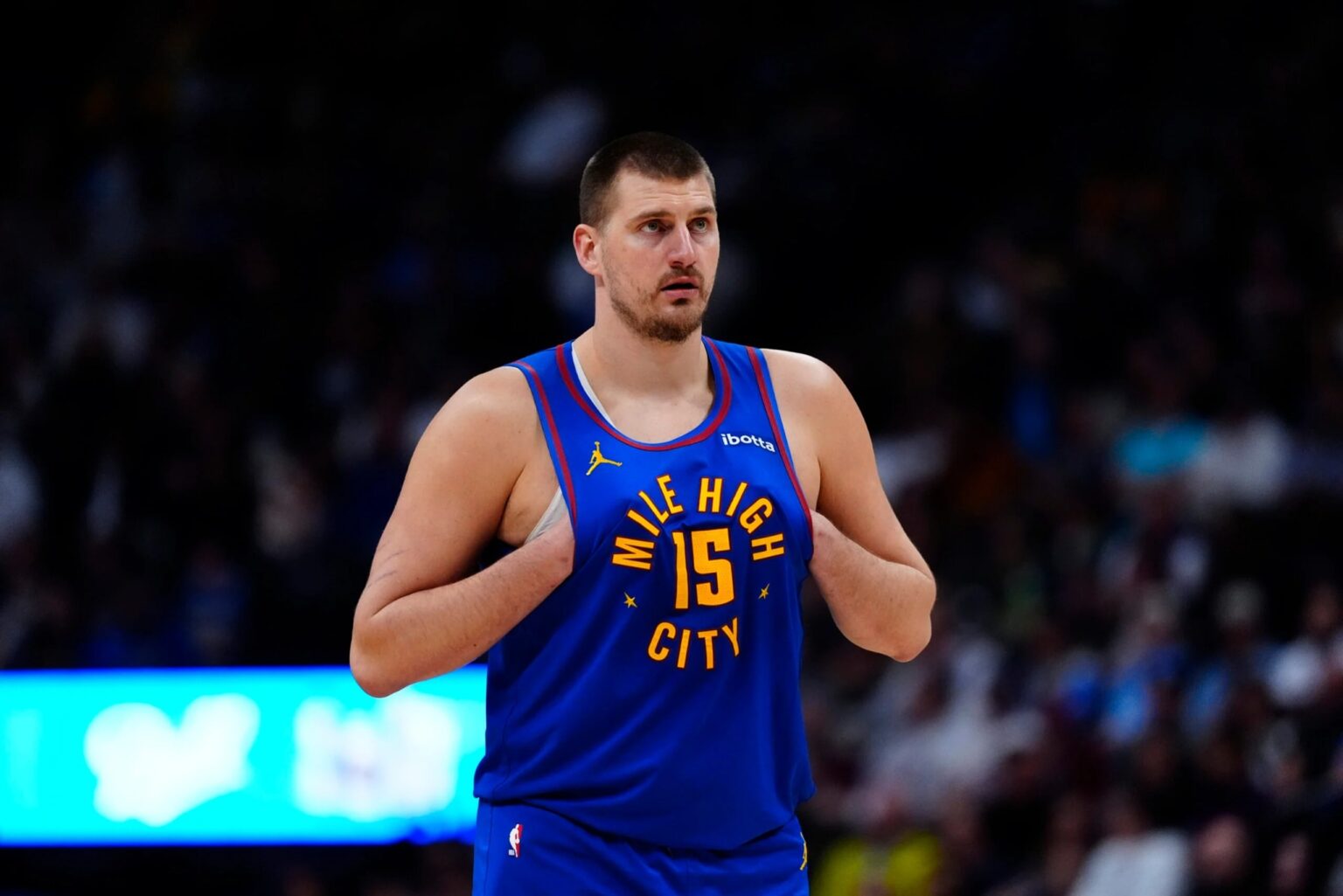
The Denver Nuggets are not eliminated, but the series against the Minnesota Timberwolves has already shown why a comeback will be hard. The Timberwolves lead 3-1 after winning Game 4, 112-96, even after losing Anthony Edwards and Donte DiVincenzo to major injuries.
Edwards is expected to miss multiple weeks with a left knee bone bruise and hyperextension, while DiVincenzo is out indefinitely after a ruptured right Achilles. That changes the series, but it does not erase what has already happened.
Through four games, the Timberwolves are averaging 112.3 points, 48.8 rebounds, and 26.0 assists. The Nuggets are at 105.5 points, 42.0 rebounds, and 22.0 assists. Nikola Jokic is still producing at 25.0 points, 14.5 rebounds, and 7.8 assists per game, but the Timberwolves have made his offense look slower and more difficult than usual.
Without Edwards now, the Nuggets have a real chance to cut into the Timberwolves’ lead tonight at home. A win would send the series back to Game 6 with the Nuggets down 3-2, still alive, and with the pressure starting to shift.
That does not mean the comeback is likely. The Timberwolves have been the better team through four games. But the door might open again with a statement win at Ball Arena.
With that in mind, here are the reasons the comeback is possible, and why the Nuggets’ chances are still slim.
One Less Star Matchup Without Edwards
This is the strongest reason to believe the Nuggets can make the series uncomfortable again. Anthony Edwards was the Timberwolves’ best scorer, best downhill guard, and cleanest answer when the offense broke down. During the regular season, Edwards led the Timberwolves with 28.8 points per game and made 39.9% of his 3s.
Without Edwards, the Timberwolves lose the one player who could consistently bend the Nuggets’ defense in an isolation playoff setting. Julius Randle can create. Ayo Dosunmu can pressure the rim. Naz Reid can space the floor. But none of them puts the same level of stress on a defense as Edwards. He forces low-man rotations. He gets two feet in the paint. He makes defenses load up early, which opens corner 3s and offensive rebounding lanes.
The Nuggets have not defended this series at a high level for long stretches. They need a simpler defensive map. Edwards being out gives them one. They no longer have to build the game plan around stopping a guard who can score 30 without a matchup advantage. They can place more help toward Randle’s left-hand drives, stay closer to Jaden McDaniels as a cutter, and live with more above-the-break creation from Dosunmu.
The other part is late-game structure. Edwards was the Timberwolves’ best shot-maker against a set defense. When the game slowed down, the Timberwolves could clear a side, run Edwards into a ball screen, or let him attack a switch. That option is gone. Randle is a strong offensive player, but his decision-making under pressure has always been more volatile. He is averaging 17.5 points, 7.8 rebounds, and 3.5 assists in this series, but he is shooting 42.6% from the field and 18.2% from 3.
That is the opening. The Nuggets do not need to shut the Timberwolves down completely. They need to win the final six minutes of games. Without Edwards, the Timberwolves’ half-court offense is more likely to stall into late-clock Randle drives, Dosunmu pull-ups, or McDaniels spot-up attempts. That is a very different problem than guarding Edwards downhill with Gobert screening and Reid stretching the floor.
The risk is that Edwards was not carrying the Timberwolves alone in this series. He is averaging 18.5 points on 35.8% from the field and 25.8% from 3 through four games. That means the Timberwolves already built a 3-1 lead without getting his best offensive version. Still, removing his gravity changes the next three games. Even when Edwards was missing, the Nuggets had to defend him like a star. Now they do not.
Jokic And Murray Still Give The Nuggets The Best Half-Court Answer
The Nuggets’ best comeback case starts with one simple idea: they still have the best offensive player in the series. Nikola Jokic averaged 27.7 points, 12.9 rebounds, and 10.7 assists in the regular season while shooting 56.9% from the field, 37.9% from 3, and 83.1% from the line. He also became the first player in NBA history to lead the league in rebounds and assists per game in the same season.
Jokic has not played to that level in this series. That is the problem. It is also why there is still room for the Nuggets to change the series. He is averaging 25.0 points, 14.5 rebounds, and 7.8 assists, but the Timberwolves have lowered his field-goal efficiency to 39.1% and forced him into tougher catches. He has had to work deeper into the clock, and Rudy Gobert has done a strong job contesting without overreacting.
The Nuggets need to move Jokic’s catches. Too many possessions have started with Jokic at the elbow or above the break while the Timberwolves load up behind Gobert. That lets McDaniels, Randle, and Reid crowd passing lanes. The better answer is more early offense: drag screens, step-up screens, quick post seals, and empty-corner two-man action before the Timberwolves can set their shell.
That is where Jamal Murray has to become the pressure point. Murray had the best regular season of his career, averaging 25.4 points, 7.1 assists, and 4.4 rebounds while shooting 48.3% from the field and 43.5% from 3. He also averaged 31.5 points against the Timberwolves in the regular season. The Nuggets’ regular-season offense with Murray and Jokic on the floor scored 127.8 points per 100 possessions, which is a massive number.
Game 4 showed both sides of the issue. Murray scored 30 points, but the Nuggets shot just 6-for-28 from 3, and Jokic and Murray combined to shoot 6-for-24 in the second half. That is not enough. The Nuggets need Murray’s shot-making, but they need it inside the structure, not as a rescue plan after the offense gets stuck.
The Timberwolves are now missing two starting guards. That should change Murray’s defensive matchup diet. Without DiVincenzo, the Timberwolves lose a strong point-of-attack defender and one of their better screen navigators. Without Edwards, they lose size and force at guard. Dosunmu is a strong defender, but he now has to handle more creation and more minutes. Mike Conley can organize the offense, but he is not a 35-minute answer against Murray’s pull-up game.
The Nuggets should hunt that pressure. Murray needs to force the Timberwolves to defend high screens repeatedly. If Gobert stays back, Murray has to take the pull-up 3 and the short midrange jumper. If Gobert is higher, Jokic can slip into the pocket and play four-on-three. If the Timberwolves switch, Jokic gets smaller defenders on the block. This is basic Nuggets basketball, but it has to be faster and better executed.
The Nuggets do not need a new identity. They need their old one to return. The offense cannot be a slow Jokic touch followed by four standing players. It needs movement around him, especially from Christian Braun and Cam Johnson. Braun is putting up 9.5 points, 4.5 rebounds, and 1.8 assists on 40.2% from the field. Johnson is at 10.0 points on 22.6% from deep. Those numbers need to be way up in efficiency for the Nuggets to thrive.
The Timberwolves’ New Guard Math Is Fragile Across Three Games
Ayo Dosunmu was brilliant in Game 4. He scored 43 points off the bench on 13-for-17 shooting, 5-for-5 from 3, and 12-for-12 from the line. It was one of the best bench playoff games in modern league history, and it came in the exact moment the Timberwolves needed it.
But that is not a stable formula. Dosunmu is a good player, not a normal 40-point scorer. He averaged 14.8 points, 3.4 rebounds, and 3.6 assists in the regular season. Since joining the Timberwolves, he averaged 14.4 points, 4.2 rebounds, and 3.5 assists in 24 regular-season games. His series average is now 22.8 points because Game 4 pushed it up.
That does not mean Dosunmu will disappear. He is quick, strong enough to finish through contact, and smart enough to attack seams when defenses overplay Randle or Reid. But asking him to be the leading scorer for three straight elimination games is a different burden. The Nuggets can live with Dosunmu making contested pull-ups more than they could live with Edwards getting downhill and forcing rotations.
DiVincenzo’s absence is also important because it removes volume shooting and connective passing. Donte DiVincenzo started all 82 regular-season games and averaged 12.2 points, 4.2 rebounds, and 3.5 assists. He gave the Timberwolves another guard who could play without the ball, attack a tilted defense, and guard with discipline.
Without him, the Timberwolves have to recalibrate the rotation. Conley becomes more important. Hyland becomes more dangerous and riskier. Reid has to score more. McDaniels has to take and make enough 3s to keep the floor open. That creates pressure points the Nuggets can attack.
The Nuggets should be more aggressive with ball pressure when Conley is off the floor. Hyland had eight points and seven assists in Game 4, but the Nuggets should still test his decision-making. He can score quickly. He can also take early-clock shots that help the defense. If the Nuggets can turn two or three Hyland possessions per half into misses or live-ball turnovers, the whole game changes.
The Timberwolves’ bench destroyed the Nuggets in Game 4, and that cannot happen again. The box score says it clearly. Dosunmu had 43 points, Reid had 17, Hyland had eight, and Conley had five. The Nuggets’ bench got 10 from Tim Hardaway Jr. and six from Bruce Brown. That is not a small gap. That is the game.
The path for the Nuggets is not only about Jokic and Murray scoring more. It is about making the Timberwolves’ new rotation feel the pressure of playoff basketball. If Dosunmu has to initiate, score, defend Murray, and play heavy minutes, the efficiency should come down. If Randle has to create against loaded gaps every trip, the turnovers should rise. If McDaniels has to become a primary offensive player, the Timberwolves become sloppier.
This is where a 3-1 deficit can start to shrink. Game 5 is at home for the Nuggets. Win that, and Game 6 becomes the real test of the Timberwolves’ new guard rotation. If the Timberwolves cannot close at home without Edwards and DiVincenzo, then Game 7 becomes a pressure game with the best player in the series on the other side.
The Timberwolves Defense Has Controlled The Series
The strongest reason to doubt the Nuggets is that the Timberwolves are not winning only because of Edwards or DiVincenzo. They are winning because their defense has controlled the terms. Through the playoff sample, the Timberwolves have a 105.2 defensive rating, fifth among playoff teams, and a +7.0 net rating. Their offense has been good enough, but the defense is the reason the Nuggets are down 3-1.
Game 3 was the clearest evidence. The Timberwolves held the Nuggets to 34.1% from the field and 25.0% from 3. Jokic finished with 27 points and 15 rebounds, but he shot 7-for-26. Murray scored 16 points on 5-for-17 shooting and went 0-for-5 from 3. The Nuggets were held under 100 points for just the third time all season.
That was not a random shooting game. The Timberwolves’ size has bothered the Nuggets’ normal passing windows. Gobert is not over-helping as much as he has in past playoff matchups. He is staying attached to Jokic’s body, using his length to contest, and trusting the weak side to cover cutters. McDaniels is taking hard matchups and forcing Murray to work before he gets into the action. Randle and Reid give the Timberwolves enough strength to survive switches and enough size to rebound.
That is why the Edwards injury does not automatically flip the series. The Timberwolves can still win ugly. They can still defend. They can still rebound. They can still put Gobert on Jokic, McDaniels on Murray, and enough length around them to crowd every pass. In the playoffs, that travels better than hot shooting.
The Nuggets also have to face the fact that their offense has not found a consistent counter. Jokic is seeing more bodies. Murray is being forced into harder shots. Braun and Johnson have not punished help enough. Gordon’s health has limited the cutting game. When Gordon is not explosive, the Timberwolves can stay home more often and worry less about backdoor cuts, short-roll finishes, and rim pressure.
A comeback needs more than one adjustment. It needs three straight games of better offensive timing, better shooting, better bench minutes, and better defensive rebounding. That is possible with Jokic. It is still a lot to ask against a defense that has already solved large parts of the matchup.
The Nuggets Are Not Healthy And Efficient Enough To Trust
The Timberwolves’ injuries are the headline, but the Nuggets are not exempt either. Aaron Gordon is dealing with left calf tightness and was listed as questionable for Game 5. Peyton Watson is out with a right hamstring strain. Gordon missed Game 3 and was limited to 23 minutes in Game 4.
Gordon is not optional in this matchup. He is one of the few Nuggets who can match the Timberwolves’ size and athleticism. He screens for Murray, cuts behind help, rebounds in traffic, and gives Jokic a release valve when the Timberwolves overload the strong side.
If Gordon is limited, the Nuggets become less threatening off-ball. The Timberwolves can shrink the floor. They can help harder off non-shooters. They can make Jokic score through crowds instead of passing to cutters. A healthy Gordon is a pressure point. A limited Gordon is more stationary, and that helps Gobert.
The Nuggets’ shooting is another concern. In Game 4, they shot 37.9% from the field and 21.4% from 3. Jokic had 24 points, 15 rebounds, and nine assists, but he shot 8-for-22 and went 0-for-3 from 3. Murray scored 30, but needed 25 shots. The role players did not give enough.
This is the problem with saying the Nuggets can simply “flip the switch.” They have already had four games to find a smooth offense. They won Game 1, then lost three straight. They have been outscored by 27 total points across the series. The Timberwolves are not just surviving. They have been the better team.
The Nuggets also have an emotional-control issue after Game 4. Jokic and Randle were both ejected after the late altercation, and the league fined Jokic. It does not decide the series, but it shows the pressure level. The Nuggets are frustrated, and frustration is dangerous when a team needs three straight wins.
The best version of the Nuggets is still good enough to beat this wounded Timberwolves team. But the current version has not played like that team. They need Jokic to be the most efficient player in the series again. They need Murray to score without hijacking possessions. They need Gordon to move well enough to punish pressure. They need Braun, Johnson, Hardaway, and Brown to hit enough shots to stop the Timberwolves from loading up.
That is a narrow path. It exists, but it is not wide.
Final Thoughts
The Nuggets can overcome this 3-1 deficit, but the path is hard. Edwards and DiVincenzo being out gives them a real basketball opening. The Timberwolves have lost their best scorer, their best late-clock creator, and a starting guard who gave them shooting, passing, and perimeter defense. That should help Murray, simplify the Nuggets’ defensive coverages, and put more pressure on secondary creators.
Still, the Timberwolves should not be treated like a broken team. They are winning the series because they have defended better, rebounded better, and forced the Nuggets into uncomfortable half-court possessions. Gobert, McDaniels, Randle, and Reid are still available. That frontcourt is the core of the matchup problem.
I think the Nuggets can push this to Game 6 and maybe Game 7, but they should not be trusted until Jokic looks like Jokic again. A comeback requires three straight games of great offense and stronger physicality. With Edwards and DiVincenzo out, the door is open. Based on the first four games, the Timberwolves are still closer to walking through it.