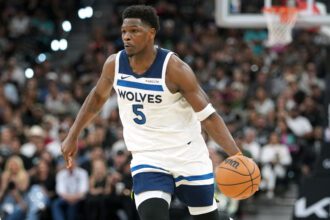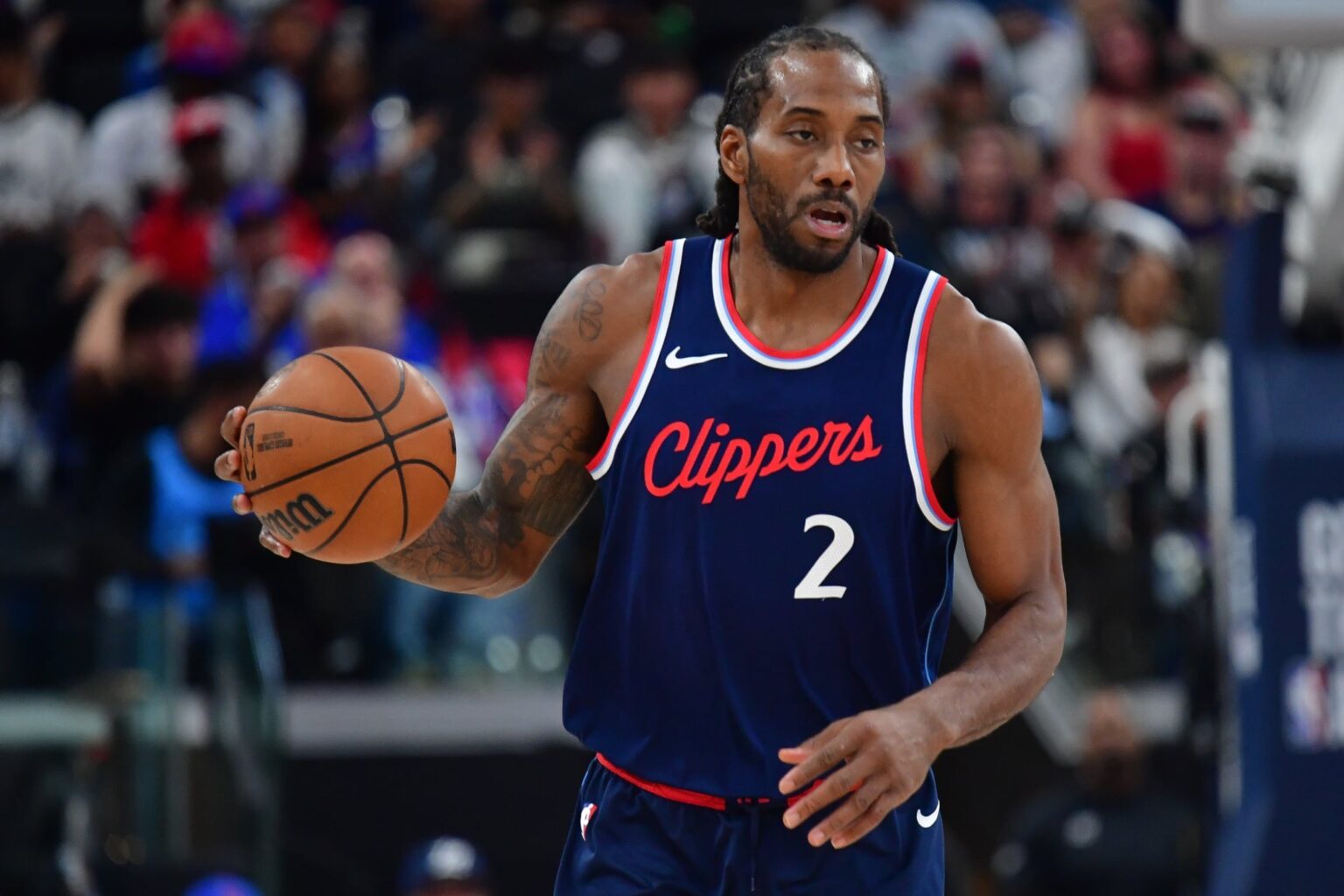
The Clippers are heading into a defining offseason after their season ended with a 126-121 play-in loss to the Warriors. It was a brutal exit for a team that still had real playoff expectations once Kawhi Leonard got healthy and started playing at an All-NBA level again. Instead, the Clippers are back in the same place they have been too often in the Leonard era: talent on the roster, pressure on the front office, and no clear path to real contention.
Leonard did not give any strong public commitment to the franchise after the loss. When asked about his future, he said the conversations would happen later, once he had time to process the defeat. Leonard is entering the final year of his contract, and he will be eligible to sign a two-year extension worth up to $126.1 million after the NBA Finals.
There is also more noise around the situation than usual. The NBA’s ongoing investigation into Leonard’s former Aspiration endorsement deal is still hanging over the franchise, and the Warriors checked on Leonard’s availability before the deadline, with an expectation that trade talks could resurface this summer. If the Clippers decide this core has hit its ceiling, Leonard instantly becomes one of the biggest names who could shake up the entire offseason.
Here are six Kawhi Leonard trade ideas for the upcoming summer that would absolutely shake up the entire NBA landscape.
6. Washington Wizards
Potential Trae Idea:
Washington Wizards Receive: Kawhi Leonard
Los Angeles Clippers Receive: Bilal Coulibaly, Jaden Hardy, D’Angelo Russell, Cam Whitmore, Bub Carrington, Will Riley, Kyshawn George, Tristan Vukcevic, 2028 first-round pick, 2030 first-round pick swap
This is the kind of all-in swing that would completely change the Wizards. Financially, it is legal, but it has to be built as a depth-for-star trade. Kawhi Leonard is set to make $50.3 million in 2026-27, the final year of his current contract. The Wizards project to have $174.6 million in active roster salary for 2026-27, with about $34.4 million in room below the first apron, so this is not a clean cap-space absorption.
It has to work through salary matching. The outgoing package here totals about $41.4 million, and teams below the first apron can take back up to 125% of outgoing salary once they send out more than $29.0 million. That gives the Wizards enough room to legally bring in Leonard, and they would still sit about $25.4 million below the first apron after the trade. This framework also assumes D’Angelo Russell picks up his $6.0 million player option, because his salary is part of what makes the math work.
From a basketball standpoint, the appeal is obvious. Kawhi Leonard just averaged 27.9 points, 6.4 rebounds, and 3.6 assists in 65 games while shooting 50.5% from the field, 38.7% from three, and 89.2% from the line. That is still elite first-option production. Put that next to Trae Young and Anthony Davis, and the Wizards suddenly have a real chance at contention next season. Young bends the floor with pick-and-roll creation and passing. Davis gives them the vertical threat, interior scoring, and defensive anchor.
Leonard would give them the wing scorer they do not currently have at that level, plus a reliable late-clock option. On paper, that is a much cleaner offensive hierarchy than most star trios because each player fills a different lane.
The part that makes this especially interesting is that Tre Johnson and Alex Sarr stay in place. That matters. Sarr remains the long-term defensive piece, and Johnson stays as the young perimeter scorer who can grow next to stars instead of being sacrificed for one. If the Wizards can roll out a core of Young, Leonard, Johnson, Davis, and Sarr, that is size, shot creation, rim protection, and real two-way balance.
Young averaged 17.9 points and 8.0 assists in 15 games this season, while Davis put up 20.4 points, 11.1 rebounds, 2.8 assists, and 1.7 blocks in 20 games. The obvious concern is health, because both Young and Davis played limited games this year, and Leonard has his own injury history. But if the bet is purely about ceiling, this is the first Wizards framework that actually looks like a contender’s skeleton instead of another rebuild.
For the Clippers, the sell is volume. They get eight players, two draft assets, more cost control, and a chance to reset the roster without bottoming out. For the Wizards, it is simple: this is a star bet, and star bets are the only ones that matter if the goal is to stop being irrelevant.
5. Detroit Pistons
Potential Trae Idea:
Detroit Pistons Receive: Kawhi Leonard
Los Angeles Clippers Receive: Duncan Robinson, Isaiah Stewart, Ron Holland II, Marcus Sasser, 2027 first-round pick, 2028 first-round pick swap
From a basketball standpoint, this is a real win-now swing for a team that already looks ready. The Pistons just went 60-22, finished first in the East, ranked 10th in offensive rating, second in defensive rating, and third in net rating.
Cade Cunningham averaged 23.9 points, 9.9 assists, and 5.5 rebounds. Jalen Duren gave them 19.5 points and 10.5 rebounds while shooting 65.0% from the field. Add Leonard to that, and the Pistons suddenly have a true late-clock wing scorer next to their lead guard and rim-running center.
The big three is simple and scary: Cunningham as the engine, Leonard as the half-court closer, and Duren as the interior finisher. With Ausar Thompson staying in this framework, the Pistons also keep one of their best defensive connectors after a season of 9.9 points, 5.7 rebounds, 3.1 assists, and 2.0 steals per game.s
This one is clean because the Pistons do not need cap-space gymnastics and they do not need to touch Cunningham or Duren. Leonard is set to make $50.3 million in 2026-27. The Pistons project with $135.3 million in active salary and about $72.7 million in room below the first apron.
Stewart at $15.0 million, Robinson at $16.0 million, Holland at $9.1 million, and Sasser at $5.2 million send out about $45.3 million. The Pistons are projected below the apron, so Leonard fits without any tricks. The Pistons would still sit about $68.6 million below the first apron after the deal.
The cost is serious, but it is not a total teardown. Stewart averaged 10.0 points, 5.0 rebounds, and 1.6 blocks this season, so losing him would hurt the frontcourt rotation. Holland is the real talent bet going out because he is 20, cheap, and still has upside after averaging 8.2 points and 4.0 rebounds. Sasser shot 41.5% from three, which gives the Clippers a low-cost bench guard, and Robinson’s contract gives them flexibility because his $15.99 million cap hit for 2026-27 carries only $2.0 million guaranteed.
That is why this framework makes sense. The Pistons turn a very good core into a contender core. The Clippers get a first-round pick, a swap, a young wing, a playable big, and a path to reset without fully bottoming out.
4. Atlanta Hawks
Potential Trae Idea:
Atlanta Hawks Receive: Kawhi Leonard
Los Angeles Clippers Receive: Zaccharie Risacher, Corey Kispert, Buddy Hield, Asa Newell, 2029 first-round pick, 2031 first-round pick swap
The Hawks went 46-36 this season, finished first in the Southeast Division, and landed the No. 6 seed in the East. They also posted a 116.1 offensive rating, a 113.7 defensive rating, and a 2.4 net rating, which is the profile of a good playoff team, not a true title favorite. That is where Kawhi Leonard enters the picture. The Hawks already have structure, size, and ball movement. What they still lack is a proven late-clock wing scorer who can calm down a playoff possession, punish switches, and take on the hardest perimeter matchup when the series gets tight. That is the role Leonard would fill right away.
The financial side works. Leonard is set to make $50.3 million in 2026-27. The Hawks project with $241.2 million in total 2026-27 allocations and $153.1 million in active salary, so this is a salary-matching trade, not a cap-space play. Zaccharie Risacher is at $13.83 million, Corey Kispert at $13.98 million, Buddy Hield at $9.66 million, and Asa Newell at $3.40 million. That outgoing total is $40.86 million. Under the current trade rules, that gives the Hawks enough room to absorb Leonard’s $50.3 million salary. After the move, the Hawks would project at roughly $162.5 million in active salary.
The on-court fit is the real appeal. Jalen Johnson averaged 22.5 points, 10.3 rebounds, and 7.9 assists this season. Dyson Daniels gave the Hawks 11.9 points, 6.8 rebounds, 5.9 assists, and 2.0 steals. Onyeka Okongwu added 15.2 points, 7.6 rebounds, 3.1 assists, 1.1 steals, and 1.1 blocks. That is already a serious foundation.
Leonard would not need to be the entire offense. He would be the premium wing finisher and two-way closer on top of an already functional core. Daniels could stay in a lower-usage role. Johnson could keep growing as a big creator. Okongwu would still anchor the middle. That is why this fit makes sense. It is not about building from zero. It is about adding the missing playoff archetype.
The Clippers would have a real case, too. Risacher is still a legitimate development piece at 21 after averaging 9.6 points, 3.8 rebounds, and 1.1 assists while shooting 45.5% from the field and 36.8% from three in 67 games. Kispert gives them another rotation wing after posting 9.2 points per game and shooting 36.7% from three. Newell is a cheap rookie-scale flier, and Hield’s 2026-27 deal has only $3.0 million guaranteed, which gives the Clippers flexibility. Add a first-round pick and a swap, and this becomes a credible star package. For the Hawks, the logic is simple: cash in young depth for the one player type the roster still does not have.
3. New York Knicks
Potential Trae Idea:
New York Knicks Receive: Kawhi Leonard
Los Angeles Clippers Receive: Mikal Bridges, Josh Hart, Pacome Dadiet, 2032 first-round pick
The Knicks went 53-29 this season, finished third in the East, and already looked like a serious team on both ends. They ranked third in offensive rating at 119.8, seventh in defensive rating at 113.3, and fifth in net rating at plus-6.5. Jalen Brunson gave them 26.0 points and 6.8 assists per game, while Karl-Anthony Towns added 20.1 points, 11.9 rebounds, and 3.0 assists.
So this would not be a desperation move. It would be a top-end talent swing for a team that is already close. Leonard would step into the exact role the Knicks would be chasing here: a playoff wing scorer who can create his own shot late, handle the toughest perimeter matchup, and ease some of the half-court burden on Brunson.
The cap side is what makes this one interesting. The Knicks project at $205.46 million in active 2026-27 salary, which is only about $3.54 million below the projected first apron of $209.0 million. That means they cannot really mess around with a salary-expanding structure. They need a deal that trims money, not adds it. Mikal Bridges at $33.48 million and Josh Hart at $20.92 million are the cleanest matching pieces.
If the Knicks send out Bridges and Hart and bring back Leonard’s $50.3 million, their active payroll drops to about $201.35 million, which would leave them roughly $7.65 million below the first apron. That is why this is the best framework. It fits the apron reality. The general CBA rule here is that teams using an apron-limited trade exception get hard-capped at that apron, so staying below it after the trade matters.
From the Clippers’ side, the appeal starts with Bridges. He played all 82 games and averaged 14.4 points, 3.8 rebounds, and 3.7 assists while shooting 49.0% from the field and 37.1% from three. Hart would give them another tough rotation piece after averaging 12.0 points, 7.4 rebounds, and 4.8 assists while shooting 41.3% from three. Dadiet is the young flier in the deal, and the draft compensation is what turns it from a pure salary exercise into an actual asset package. The Clippers also have enough room to take this structure back without cap stress. Spotrac projects them at $162.16 million in active salary for 2026-27, which is about $46.84 million below the first apron.
The downside for the Knicks is obvious. Bridges is their durability guy, and Hart is one of their connective players. You lose volume, rebounding, and some of the lineup glue. But this is the kind of trade you make when you can’t escape the Eastern Conference.
A Brunson-Towns-Leonard core would give the Knicks far more half-court shot creation than they have now, and OG Anunoby would still be there to keep the defensive wing structure intact. My read is simple: if the Knicks ever decide to turn Bridges into a bigger playoff ceiling, this is the version that actually makes sense on the numbers.
2. Golden State Warriors
Potential Trae Idea:
Golden State Warriors Receive: Kawhi Leonard
Los Angeles Clippers Receive: Jimmy Butler, Will Richard, 2028 first-round pick, 2030 first-round pick swap
The Warriors’ angle is simple. They just went 37-45, ranked 18th in offensive rating, 17th in defensive rating, and 20th in net rating. That is not a roster that needs another small tweak. That is a roster that needs a sharper top-end fit around Stephen Curry before facing the Suns in the Play-In.
Curry still produced at a star level, averaging 26.6 points, 4.7 assists, and 3.6 rebounds in 43 games, but the Warriors never looked clean enough offensively for long stretches. A Curry-Kawhi Leonard-Draymond Green core would be an all-in bet on playoff shot creation, half-court control, and defensive versatility at the top of the roster.
The money is actually cleaner than it looks. Jimmy Butler is projected at $56.8 million in 2026-27, while Leonard is at $50.3 million. Will Richard is on a $2.15 million deal, so the Warriors would send out about $58.98 million and take back $50.3 million. After this trade, the Warriors would drop to roughly $172.8 million in active salary, which would leave them about $36.2 million below the apron. So this is not a squeeze-the-math move. It is a payroll-cutting consolidation trade.
From the Warriors’ side, the basketball fit is the reason to do it. Butler was productive this season, averaging 20.0 points, 5.6 rebounds, and 4.9 assists in 38 games, and he still gives you force, rim pressure, and playmaking, but missed the last part of the season with an ACL tear that will sideline him for most of his contract season next year, giving the Clippers a potential $57 million cap relief.
Leonard is the cleaner positional fit next to Curry. He is a more natural wing scorer, a better off-ball playoff piece, and a simpler answer when the Warriors need size on the perimeter without warping the offense around another on-ball star. Richard, meanwhile, is the kind of sweetener a team like the Clippers would ask for because he is cheap, 24, and coming off a rookie year with 6.4 points, 2.5 rebounds, and 1.3 assists in 69 games.
For the Clippers, this is only about flexibility and draft value. They project at $162.16 million in active 2026-27 salary and about $46.84 million below the first apron, so taking Butler and Richard back is still legal and leaves them around $38.15 million below the apron after the move.
The picks are the real selling point because Butler is older, more expensive, and not the cleaner long-term asset. That is why this would be a bold Warriors swing, not an easy Clippers yes. But if the Warriors want one last real title shot around Curry, this is the type of aggressive gamble that at least makes sense on the numbers and on the floor.
1. Miami Heat
Potential Trae Idea:
Miami Heat Receive: Kawhi Leonard
Los Angeles Clippers Receive: Tyler Herro, Andrew Wiggins, 2029 first-round pick, 2031 first-round pick swap
The Heat got into the play-in at 43-39 as the No. 10 seed in the East, then lost 127-126 in overtime to the Hornets in a win-or-go-home game. Bam Adebayo exited that game with a back injury after a hard fall, and the season was over right there.
That is why a Kawhi Leonard trade idea makes sense for this team. The Heat were good enough to stay competitive, but not good enough to feel dangerous. They finished with a 116.7 offensive rating and a 114.5 defensive rating, which is solid, but not the profile of a true contender.
Financially, this one is easy. Tyler Herro is projected at $33.0 million and Andrew Wiggins at $30.17 million, so the Heat would send out about $63.2 million and take back less money. The Heat should have about $40.9 million in room below the first apron, so this is not a trade where the math gets tight. It works cleanly, and it actually cuts salary instead of adding more pressure to the books.
On the court, the case is simple. Bam Adebayo averaged 20.1 points, 10.0 rebounds, and 3.2 assists in 73 games. Herro gave the Heat 20.5 points, 4.8 rebounds, and 4.1 assists while shooting 48.0% from the field and 37.8% from three. Wiggins added 15.4 points, 4.8 rebounds, and 2.7 assists while shooting 47.5% from the field and 41.4% from three.
o this is not a fake upgrade where the team gives up filler. The Heat would be moving two real starters for one better star. The attraction is that Leonard is a cleaner playoff No. 1 wing scorer than either Herro or Wiggins, and a Leonard-Adebayo core would give the Heat a much higher defensive and half-court ceiling in a seven-game series.
The risk is also obvious. Herro is younger, cheaper than a true max star, and one of the few guards on the roster who can create offense at volume. Wiggins gives the Heat size, shooting, and wing defense. Move both, and the roster gets thinner fast. That is why this only makes sense if the Heat believe top-end talent matters more than depth, and if they trust Adebayo plus Leonard to become the identity of the team right away.
For the Clippers, the pitch is cleaner: they get a 26-year-old scorer in Herro, a playable veteran wing in Wiggins who will expire and free up $30 million in cap space for the 2027 free agency class, and two draft assets. For the Heat, this is a straight star bet after another season that ended too early.