The Warriors are heading into the summer with very little margin. Their season ended in the play-in after a 126-121 win over the Clippers and then a 111-96 loss to the Suns, leaving them at 37-45 and outside the real playoff bracket again. It was the fourth time in 12 seasons under Steve Kerr that the Warriors missed the playoffs, and this one landed harder because the roster was built to compete now, not drift into another offseason full of questions.
The questions are not only about the roster. Kerr’s own future is unsettled after the loss. His contract expired with the defeat, and the Warriors may soon have to start thinking about a coaching search.
The cap sheet is just as tricky. Stephen Curry will be 38 next season, Jimmy Butler is coming off a torn right ACL, Draymond Green is 36, Al Horford is 40, and the Warriors already have $181.5 million tied up in only nine active 2026-27 roster spots. They do have the No. 11 and No. 54 picks in the 2026 draft, but this is not a clean retool. There is no natural cap space path, and there are not enough easy trade chips to pretend otherwise.
So, before talking about free agency, coaching, or one last serious push around Curry, it helps to start with the simple part: who is actually under contract.
Warriors Players Under Contract For The 2026-27 NBA Season
1. Stephen Curry – $62.6 million
2. Jimmy Butler – $56.8 million
3. Draymond Green – $27.7 million (Player Option)
4. Moses Moody – $12.5 million
5. Al Horford – $6.0 million (Player Option)
6. Brandin Podziemski – $5.7 million
7. Gui Santos – $4.6 million
8. De’Anthony Melton – $3.5 million (Player Option)
9. Will Richard – $2.2 million
Key Warriors Free Agents Not Currently On The 2026-27 Active Roster
Kristaps Porzingis – Unrestricted Free Agent
Gary Payton II – Unrestricted Free Agent
Seth Curry – Unrestricted Free Agent
Quinten Post – Restricted Free Agent
Pat Spencer – Restricted Free Agent
The Cap Sheet Is Already Tight
The first real problem is the size of the guaranteed and option money. The Warriors’ 2026-27 active roster already sits at $181.5 million against a projected $165.0 million cap. That means they are over the cap with only nine players accounted for. Once cap holds are added, including Kristaps Porzingis at $46.1 million, Quinten Post at $2.65 million, Seth Curry at $2.45 million, Gary Payton II at $2.45 million, and Pat Spencer at $1.27 million, total allocations jump to $273.7 million. That is why any easy “just open room and go shopping” idea is fake. This team is not one move away from cap flexibility.
The draft board does not fully rescue them either. The Warriors own the No. 11 pick and No. 54 pick, which gives them some chance to inject younger, cheaper talent, but it is still a thin asset base for a team trying to extend the last serious part of Curry’s career. That is why this roster feels boxed in. The Warriors are too expensive to act like a reset team, too old to act like a patient development team, and not good enough right now to act like a clear contender.
Stephen Curry Is Still The Entire Timeline
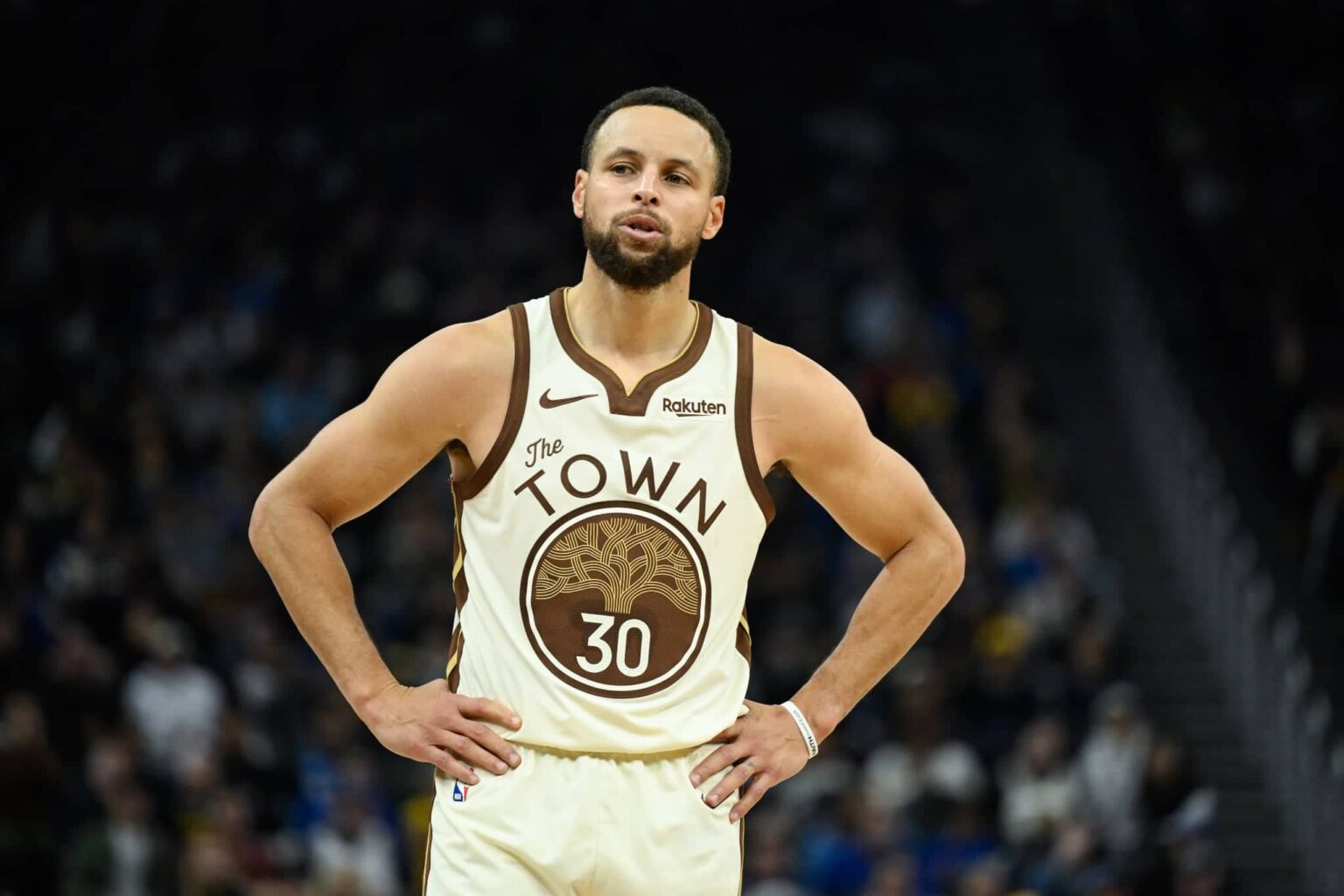
Stephen Curry is the reason any of this is still worth it. He averaged 26.6 points, 3.6 rebounds, and 4.7 assists this season, and he remains the one player on the roster who can still bend an entire defense by himself. He was also named a starter in the 2026 All-Star Game for his franchise-record 12th selection, and by late January had reached 26,528 career points, moving into 19th on the NBA’s all-time scoring list. Even in an uneven team season, the standard around the Warriors is still built on what Curry can create.
The problem is the age and the cap hit. Curry’s 2026-27 number is $62.6 million, which sits at 37.9% of the projected cap. That is the cost of having a star this late into his career, and the Warriors can live with it because he is still the only player on the team who makes elite offense feel natural. But it also means every mistake around him gets magnified. If the Warriors miss on rotation depth, miss on a trade, or misread the free-agent market, there is no spare room to cover it. Curry’s number is massive, but the bigger issue is that the roster around that number has not been sharp enough.
There is another layer here. Curry played only 43 games this season, his fewest since 2019-20, and he will open next year at 38. So the Warriors are not just managing cap around an aging star. They are managing urgency. They do not have time for a two-year experiment. Every contract on this roster has to be judged against one question: Does it help the Warriors win while Curry can still function as a No. 1 offensive engine? If the answer is no, the money becomes wasted fast.
Jimmy Butler Is The Biggest Swing Contract
Jimmy Butler is the most volatile number on the sheet. On talent, the idea made sense. Butler averaged 20.0 points, 5.6 rebounds, and 4.9 assists this season, and the team was 50-29 overall in regular-season and playoff games in which Butler played, including 18-12 this season. When Curry, Butler, and Green were all in the lineup, the Warriors were 40-17 all-time and 18-12 this season. That is real evidence that Butler, at his best, gives this team structure on both ends.
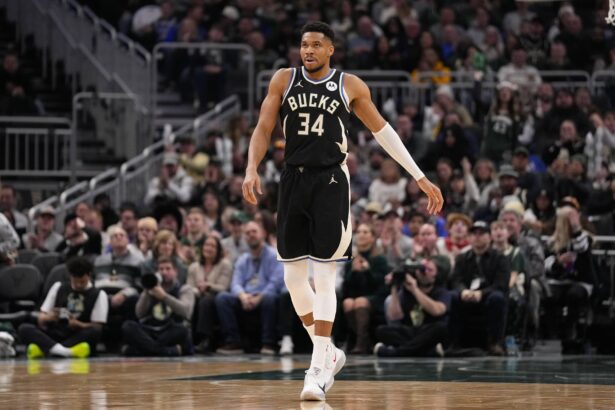
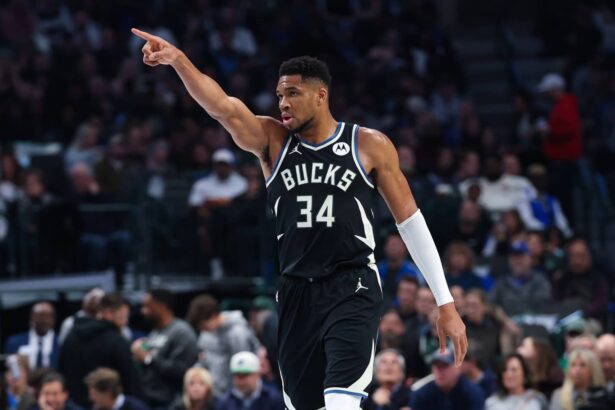
But the injury changes the whole reading. The Warriors announced on January 20 that Butler would miss the rest of the season with a torn right ACL suffered against the Heat, and he is now sitting on a $56.8 million cap hit for 2026-27. That is 34.4% of the projected cap for a player who will be 37 and coming off one of the hardest injuries in the sport. If Butler comes back near his old level, the Warriors can still argue for a serious veteran core. If he does not, that contract becomes the single clearest trade asset for another star like Kawhi Leonard or Giannis Antetokounmpo.
This is why Butler is more than just the second-biggest salary. He is the hinge point of the whole offseason. The Warriors do not have cap room to replace him if the recovery goes badly, and they do not have the roster depth to absorb another season where one of the top two salaries does not fully deliver. That makes his rehab timeline almost as important as any trade rumor. The Warriors need him to be a co-star again, or risk moving him with a ton of draft capital attached.
Draymond Green Is Part Of The Financial Pressure
Draymond Green averaged 8.4 points, 5.5 rebounds, and 5.5 assists this season, which still captures the basic truth of his career at this stage. He is not there to be a scoring solution. He is there to connect possessions, run handoff action, anchor the defense, and keep the system from falling apart. The Warriors can still function through Green in ways they cannot through almost anyone else on the roster, which is why his value to them is bigger than his raw stat line looks.
The contract, though, is a problem. Green’s 2026-27 player option is worth $27.7 million, and the deadline is June 29. At 36, that is a lot of money for a player whose offensive limitations are real and whose trade market would almost certainly be narrower than his importance inside the Warriors’ own structure. This is the classic Warriors problem: Green is still essential to how the team plays, but because he is so system-specific, it is hard to let him go due to cap restraints, which makes him a difficult trade asset and an expensive necessity.
That is why Green’s number matters almost as much as Butler’s. It is not an obviously bad deal in a vacuum. It is a hard deal because of what else is on the books. Put Green next to Curry, and the basketball logic still works. Put Green next to Curry and Butler on a team already above the cap, and every other spot has to punch above its salary. That is the standard the Warriors are facing.
The Salaries That Remain Question Marks
Moses Moody was supposed to be one of the few mid-tier contracts that gave the Warriors real flexibility. He averaged 12.1 points, 3.3 rebounds, and 1.6 assists this season, and he is owed $12.5 million in 2026-27. Under normal circumstances, that is a fair number for a 24-year-old wing who can score, defend his spot, and still grow. But the torn left patellar tendon changes everything. Moody was ruled out for the season in late March, and the early recovery expectation around that injury puts him in danger of missing a large chunk of next season, too. That means the Warriors could go from March 2026 into deep 2026-27 without getting much, or any, on-court value from one of the few contracts that actually fit both the present and the future.
That is what makes the injury such a problem. The Warriors did not just lose a rotation wing. They may have lost one of their only tradable mid-sized salaries, one of their cleaner two-way pieces, and one of the few players young enough beyond the Stephen Curry timeline. Before the injury, Moody had shown real scoring growth, including a career-high 32 points against the Pelicans and a stretch from early February into March when he scored in double figures in 20 of 21 games. Now the question is much harsher: when he comes back, how much of that version is still there?
Brandin Podziemski is the opposite case. He averaged 13.8 points, 5.1 rebounds, and 3.7 assists, played all 82 games, and is set to make only $5.7 million next season. That is one of the few clear value contracts on the roster. He gives the Warriors production, durability, and a younger piece who can help now without crushing the cap. That also makes him one of the team’s best trade chips. So while Moody’s deal now comes with major injury risk, Podziemski’s contract looks even more important because it is one of the only clean numbers left on the board.
Cheap Deals That Outplayed Their Salaries
Gui Santos had a quietly useful season. He averaged 9.2 points, 3.9 rebounds, and 2.3 assists, and his 2026-27 cap hit is only $4.6 million. For the Warriors, that is a good rotation number. Santos is not a player who should decide a season, but he is the kind of cheap wing a team over the cap needs to hit on. If he is your eighth or ninth man, the cost makes sense. If he is being forced into a bigger nightly burden, that usually means the roster above him is not strong enough.
Al Horford is a different case. He averaged 8.3 points, 4.9 rebounds, and 2.6 assists, and his player option for next season is $6.0 million. On value alone, that is fine. On timeline, it is harder. Horford turns 40 next season, and that age matters on a team already leaning heavily on Curry, Butler, and Green. The Warriors can live with Horford as a smart veteran big who spaces the floor and knows every coverage. They cannot act like he solves the frontcourt long term. His number is reasonable. His age is the warning.
De’Anthony Melton is one of the smaller but more interesting pieces on the sheet. He averaged 12.3 points, 3.2 rebounds, and 2.6 assists, and his player option is $3.45 million. That is a useful number for a rotation guard, especially on a capped-out roster. The Warriors do not have many deals in this range that can outperform the money quickly, and Melton can do that if healthy. The key detail is that his player option decision is also due June 29, so his status is one of the first practical roster questions the Warriors have to settle.
Will Richard is the cheapest fully counted contract on the board, but that does not make him irrelevant. He averaged 6.4 points, 2.5 rebounds, and 1.3 assists, and his 2026-27 number is $2.15 million. On a normal team that might be background money. On the Warriors, it matters because they need cheap players who can survive rotation minutes. When the top of the payroll is this heavy, the bottom has to give you something real. Richard does not need to become a featured scorer. He needs to become playable enough that the Warriors are not spending minimum-level money on dead spots.
The Free-Agent Group Is A Sneaky Problem
Kristaps Porzingis is the biggest non-roster decision because he was one of the main talent bets on the team this season. He averaged 16.7 points, 5.2 rebounds, and 2.5 assists, but as of now, he is not on the Warriors’ 2026-27 active roster. He is an unrestricted free agent, and Spotrac lists his cap hold at $46.1 million through Bird rights. That hold is massive. It gives the Warriors the ability to re-sign him above the cap, but it also clogs the books while they are trying to make other decisions. So Porzingis is not just a basketball question. He is a cap-management question.
Gary Payton II and Seth Curry are also off the current 2026-27 roster table. Payton averaged 7.5 points, 3.6 rebounds, and 1.7 assists, while Seth Curry averaged 7.2 points, 1.2 rebounds, and 0.9 assists. Both are unrestricted free agents. Those are not star-level decisions, but they matter because the Warriors do not have enough easy depth to treat the lower half of the roster as disposable. On this team, keeping or losing a seventh or eighth man actually matters because the money above them is already fixed.
Quinten Post and Pat Spencer are the younger restricted decisions. Post averaged 7.7 points, 4.0 rebounds, and 1.4 assists. Spencer averaged 7.2 points, 2.4 rebounds, and 3.5 assists. Both will be restricted free agents, which gives the Warriors more control than they have with the unrestricted group. That control is a relief, because these are exactly the sort of low-cost, useful players a capped-out team should try to keep in the pipeline. They are not franchise pieces, but the Warriors are not rich enough in depth to dismiss them either.
The bigger point is this: the Warriors do not really have a finished roster for next season. They have a nine-man active board, three player options, and a free-agent group that includes one major frontcourt name and several rotation pieces. So any clean claim that “this is the Warriors roster” is incomplete. This is the Warriors roster before decisions. And on a team in this kind of cap position, those decisions are the story.
The Coaching Question Is The Biggest Issue
A normal roster article would stop at contracts. The Warriors cannot do that because Steve Kerr’s future is now part of the roster conversation. Kerr just finished his 12th season with the team and reached 600 regular-season wins in March, so his place in franchise history is already secure. The issue is what comes next.
After the play-in loss, there was real noise that Kerr could walk away, and that possibility matters because the Warriors are not simply deciding who stays on the roster. They may also be deciding who leads the next version of it. If Kerr leaves, a different direction could come for a team that clearly needs one.
That is why the coaching question matters so much. The Warriors do not only need better health and a cleaner cap sheet. They may need a different offensive idea. Stephen Curry himself has hinted the team needs to evolve, and the numbers back that up. The Warriors launched 44.1 threes per game this season, the highest mark in franchise history, yet still finished 37-45 and missed the playoffs. So this is not only about changing a few contracts around the edges. It is about whether the same core, under the same voice, can still produce a team that actually works, or whether the Warriors have finally reached the point where both the roster and the coaching philosophy need a reset.
Final Thoughts
The read is simple. The Warriors currently have nine players on the 2026-27 active roster: Curry, Butler, Green, Moody, Horford, Podziemski, Santos, Melton, and Richard. Porzingis is not on that list. Neither are Gary Payton II, Seth Curry, Quinten Post, or Pat Spencer, even though the Warriors still have paths to keep some of them. That is the starting point, and it matters because the cap is already tight before any of those decisions get made.
The harder truth is that the Warriors do not have one clean fix. They have an aging core, a huge payroll, a star in Curry who is still worth building around, and not much room for mistakes at the end of that timeline. The next season will be shaped by Butler’s recovery, Green’s option, Porzingis’ free agency, and Kerr’s future almost as much as by any outside move. That is why this offseason feels so heavy. The Warriors are not just filling out a roster. They are deciding how serious they still are about the last real stretch of the Curry era.