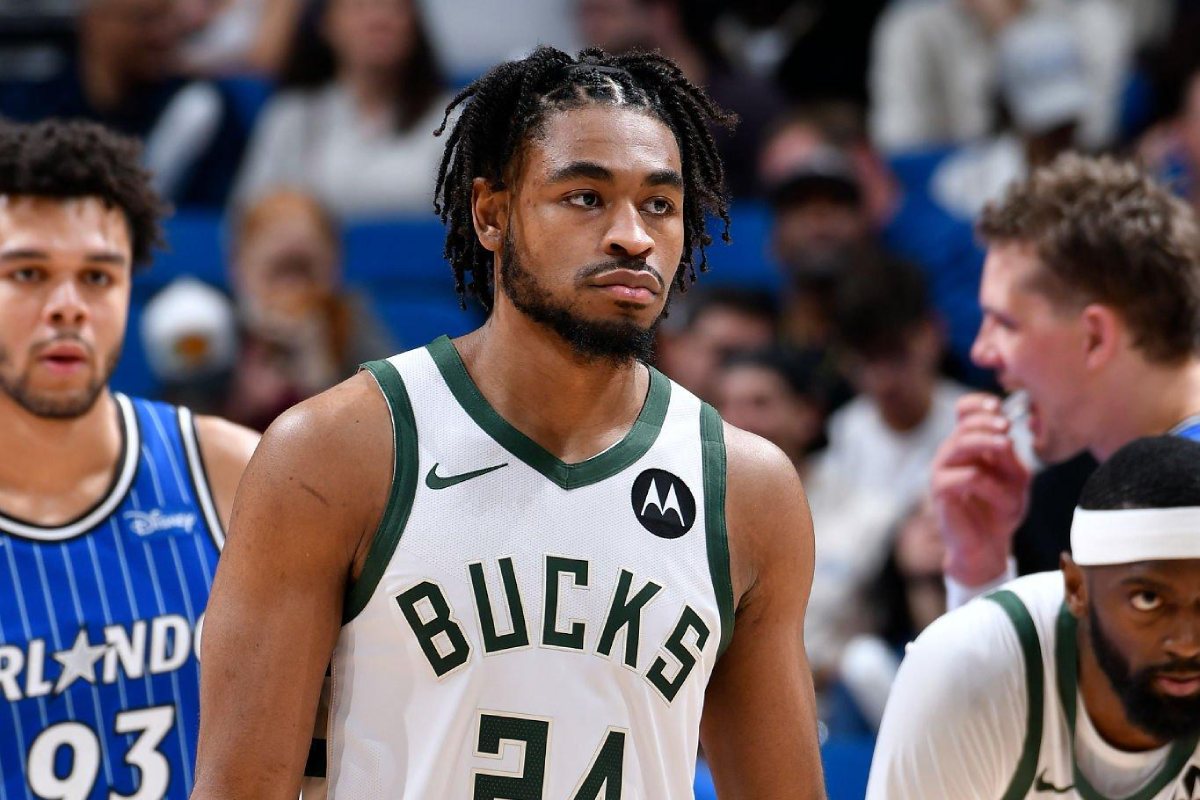
Cam Thomas went back into the spotlight for the wrong reason. The Bucks waived the 24-year-old guard on Monday after a short 18-game stint, ending another unstable chapter in what has become a turbulent season for one of the league’s more polarizing young scorers.
Thomas averaged 10.7 points in those 18 games in Milwaukee after joining the team in February, and the move came as the Bucks converted Pete Nance to a standard contract. Before that, Thomas had already been waived by the Nets earlier this season.
That sequence matters because this is the kind of roster churn that often defines the players who enter an uncertain offseason. Thomas is still young, and his scoring ability alone should keep him on the radar for teams looking for low-cost offense.
But the league gets more selective every year, especially with end-of-roster spots. Availability, role acceptance, defense, efficiency, and lineup fit all carry real weight when front offices make summer decisions. Thomas is not alone in that category.
Several veterans and fringe rotation players are heading toward an offseason where a guaranteed NBA job is far from certain. Here are five players who may not be in the league next season.
5. Marvin Bagley III
Marvin Bagley is still only 27, which makes him a different case from the aging veterans usually found on a list like this. But his NBA future is still far from secure because the league has already had years to decide what he is, and the answer has never been especially convincing.
Bagley has spent this season with the Wizards and Mavericks, averaging 10.1 points, 6.3 rebounds, and 1.4 assists in 53 games while shooting 61.4% from the field. On the surface, those are solid numbers for a reserve big. He can still finish plays, score around the basket, and provide energy in short stretches. He has also had a few productive games for the Mavericks since arriving in the Anthony Davis trade, which at least gives him a chance to finish the year on a better note.
The larger issue is that Bagley has now become the kind of player teams can usually replace without much difficulty. He is no longer viewed through the lens of being a former No. 2 pick. He is judged as a rotation big in a league that increasingly values defensive versatility, rim protection, decision-making, and lineup flexibility from frontcourt reserves. Bagley still gives teams some scoring punch inside, but he has never fully established himself as a reliable defender or a player good enough to lock down a long-term role.
That matters even more because he is on a one-year, fully guaranteed $3.1 million deal signed with the Wizards before being moved during the season. That type of contract is useful, but it also says a lot about where the market already sees him. He is not being treated like a long-term building block. He is being treated like a low-cost flyer.
There is still a path for Bagley to stay in the league. Bigs with size, touch, and finishing ability usually get chances. But his margin is thinner than it should be for someone with his pedigree. If a team believes it can find the same production in a younger, cheaper, more defensively reliable option, Bagley could easily be squeezed out. That is why he belongs on this list.
4. Pat Connaughton
Pat Connaughton has had a long and respectable NBA run. He carved out a real role as a reliable rotation wing, helped the Bucks win a title in 2021 with 6.8 points and 4.8 rebounds that season, and built value as the kind of veteran coaches usually trust. But this is also the point in a career when reputation stops carrying as much weight as current production, and that is where his case starts to get shaky.
Connaughton is now 33, and his role has shrunk dramatically this season. In 35 games, he has averaged 2.9 points, 1.5 rebounds, and 0.5 assists in just 7.4 minutes per game while shooting 44.9% from the field and 39.6% from three. The three-point percentage is still respectable, but the overall workload tells the real story. He is no longer a regular part of a team’s rotation, and when that happens for an older role player, the league can move on very quickly.
That is the key issue here. Connaughton’s path to staying in the league has always depended on doing the little things well enough to justify a roster spot. He is not a player that teams are bringing in to create offense. He is there to space the floor, defend, rebound from the wing, and avoid mistakes. When the minutes disappear, that usually means teams no longer see enough impact in those areas to keep prioritizing him.
The contract situation is the main piece. Connaughton signed a two-year rest-of-season deal with the Hornets in February, and that contract includes a 2026-27 club option. That gives the Hornets flexibility, not Connaughton security. A team option at this stage is essentially a franchise-controlled decision on whether he is still worth keeping around, and players in that category are rarely safe.
There is still a case for him to stick. Veteran wings who understand their role, defend responsibly, and hit open threes can survive longer than expected. Connaughton also has playoff credibility, which can matter on the margins. But the league gets younger every year, and teams are constantly searching for cheaper, longer, and more versatile wings. Once a veteran rotation player slips into fringe-roster territory, the drop can be steep. Connaughton is firmly in that zone now, which is why he belongs on this list.
3. Killian Hayes
Killian Hayes is still only 24, which is why his name stands out on a list like this. Players that young are usually discussed as developmental projects, not as candidates to fall out of the league. But Hayes is already at the stage where upside matters less than whether a team still believes he can help an NBA rotation in real terms.
He is currently with the Kings after signing a rest-of-season deal in March, and that alone says a lot about where his market stands. The Kings first brought him in on a 10-day contract before committing to a two-year minimum deal that includes only $444,658 guaranteed and a club option for 2026-27. That is not the structure of a player that a team views as a long-term answer. It is the structure of a low-risk flyer.
The production has not done much to change that. In 2025-26, Hayes has averaged 5.1 points, 2.6 rebounds, and 3.4 assists while shooting just 30.6% from the field. Even in a limited role, that level of inefficiency is difficult to carry for a guard who does not put major pressure on defenses as a scorer. The playmaking remains real, and Hayes can still defend, compete, and organize an offense better than some younger guards fighting for the same roster spots. But the offensive limitations are still severe, and that has been the story of his career for years.
That is the central issue. Hayes has now had multiple chances to establish himself, and the same concerns keep following him. He was the No. 7 pick in 2020, yet he has never developed into even an average scorer by NBA guard standards. Teams can live with shaky shooting from a lead guard only if the defense is exceptional or the playmaking is high-end enough to shift a game consistently. Hayes has shown flashes in both areas, but not enough to make the offensive tradeoff easy to justify.
There is still a path for him because age will keep working in his favor for a little longer. But roster spots for defense-first guards with major scoring issues are always fragile. If the Kings decline that option, Hayes could enter the summer needing to fight for another minimum deal again rather than being viewed as a clear NBA rotation piece. That is why he belongs on this list.
2. Markelle Fultz
Markelle Fultz has already lived one version of life outside the league, and that is what makes his case feel more serious than a normal end-of-bench question. Before the Raptors signed him to a 10-day contract on Monday, Fultz had gone essentially a full season without holding an NBA roster spot. He spent part of that stretch trying to work his way back through Raptors 905, where he averaged 9.8 points, 5.3 assists, and 2.5 rebounds in six games before the Raptors gave him another look.
Fultz is no longer being evaluated like a former No. 1 pick. He is being evaluated like a reclamation guard who has to prove he can still help an NBA team right now. The talent has never been the main question. Fultz is still a capable ball-handler, still has size for the position, and still knows how to get a team into offense. But the league has already shown how limited the market becomes when a guard cannot stay healthy enough or productive enough to lock down a clear role. He last played in the NBA with the Kings in 2024-25, when he averaged 2.7 points, 1.0 rebounds, and 1.3 assists in 8.8 minutes across 21 appearances. That is not the profile of a player that teams line up to sign.
The Raptors’ move is important, but it also needs to be framed honestly. This is a 10-day contract, not a guaranteed long-term commitment, and it comes with an expiration date on April 2. In other words, the Raptors are giving him an audition, not security. If he plays well, maybe that turns into another short-term deal or a summer opportunity. If not, he could be right back where he was before, waiting for another call that may not come quickly.
There is still a path here because Fultz is only 27, and guards with his physical tools usually get more than one chance. But the fact that he already spent so much time out of the league tells the real story. Once a player crosses that line, the climb back gets much steeper. Fultz has the name value and the pedigree, but at this stage, neither guarantees anything. That is why he clearly belongs on this list.
1. Cam Thomas
Cam Thomas is the clearest example on this list of a player who could get another NBA contract and still enter the summer with a surprisingly weak market. Talent is not the issue here. Thomas can score; he has real shot-creation ability, and at 24, he is still young enough to interest teams looking for upside. But the way this season unfolded has made his situation much more complicated than his age or raw scoring talent would suggest.
The first warning sign came last offseason, when his restricted free agency never developed into the kind of market many expected. Instead of landing a meaningful long-term deal, Thomas returned to the Nets on a one-year, $6.0 million qualifying offer, a move that set him up to become an unrestricted free agent in 2026. That was already a signal that teams were not eager to invest in him at a higher number.
Then the season did little to strengthen his case. Across 42 games between the Nets and Bucks, Thomas averaged 13.5 points, 2.6 assists, and 1.7 rebounds while shooting 41.0% from the field and 31.0% from three. For a guard whose value is built almost entirely on scoring, those efficiency numbers are a real problem.
He needed this year to reestablish himself after the contract drama and show that he could be a dependable offensive piece. Instead, the season was interrupted by instability, and the production was not efficient enough to force teams to overlook the rest of his profile.
The most damaging part may be what happened this month. The Bucks waived Thomas after just 18 games, choosing to convert Pete Nance to a standard deal instead. They had just signed Thomas in February, so moving on that quickly is difficult to ignore, as Doc Rivers compared him with Jamal Crawford and Lou Williams just two games into his Bucks tenure. It does not prove that no NBA team wants him, but it does suggest that even in a low-cost setting, teams may not view him as worth prioritizing.
That is why Thomas belongs here. Someone will likely consider him on a deal below full midlevel money, simply because young shot-makers usually get another chance. But if the market was already cold last summer, and this season ended with two teams cutting him loose, it is fair to wonder whether the rest of the league sees him as a real rotation investment at all. If that answer is no, Thomas could be one of the more surprising names left without a clear NBA home.