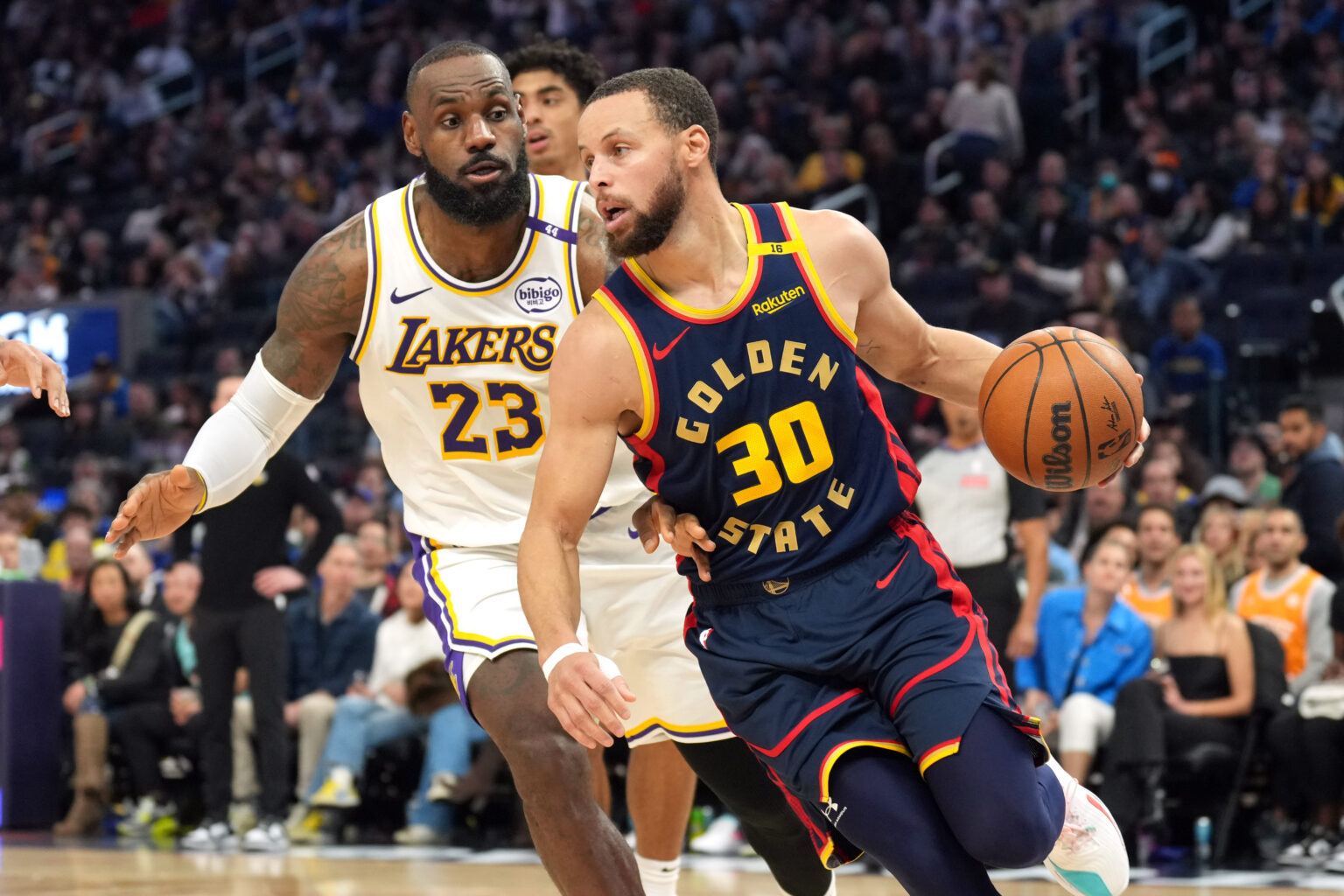
The Golden State Warriors are not entering this offseason as contenders. They arrive with Stephen Curry still playing at a high enough level to demand urgency, yet no longer capable of masking every roster deficiency on his own.
That is the difficult reality they face this summer. After finishing 37-45 and losing in the Play-In Tournament to the Suns, the Warriors have now missed the top six in the Western Conference for three consecutive seasons. Curry remains a difference-maker, but the margin for error has disappeared.
The organization understands this. According to ESPN, the Warriors are prepared to pursue significant moves, including gauging LeBron James’ interest and re-engaging the Clippers regarding Kawhi Leonard’s availability. The targets reflect the Warriors’ mindset: they are still determined to add another star alongside Curry before this era ends.
Steve Kerr’s return on a new two-year contract provides coaching continuity, but it does not fix the roster. The Warriors need another creator, greater size, and players equipped to handle the physical demands of the West. Free agency will not offer a flawless solution, but it presents practical opportunities they must aggressively pursue.
Here are the 10 best free-agent targets the Warriors should chase in the 2026 offseason to give Stephen Curry more size, scoring, and playoff-ready help.
10. John Collins
Contract Status: Unrestricted Free Agent ($26.6 Million Salary In 2025-26)
John Collins is not a star-level acquisition, but he represents a sensible frontcourt target for the Warriors if their bigger pursuits fall short.
The 28-year-old forward will enter unrestricted free agency in 2026 after completing a five-year, $125 million contract. His next deal is difficult to project. He will not command his previous $26.6 million annual salary from most teams, but he is also far from a minimum-salary player. A realistic offer from the Warriors would likely start with the non-taxpayer mid-level exception, roughly three years and $45 million, provided they remain below the second apron.
The Warriors could use their full mid-level exception, about 15 million dollars, plus the 5.5 million dollar bi-annual exception. That path works if Collins accepts a lower annual salary for a more meaningful role alongside Stephen Curry.
The basketball fit is clear. In the 2025-26 season, Collins averaged 16.2 points, 7.8 rebounds, 1.8 assists, 1.0 steals, and 0.6 blocks per game while shooting 52.6% from the field and 36.4% from three. He is not a franchise-changing talent, but he provides a forward who can finish at the rim, rebound, run in transition, and space the floor enough to play next to Draymond Green or a traditional center.
The Warriors have too often created advantages with Curry only for possessions to die when the ball reaches the frontcourt. Collins would help solve that issue. He can slip screens, catch lobs, attack closeouts, and make enough corner threes to keep defenses honest.
The main concern is defense. Collins is athletic but lacks the consistency to be a lockdown wing or primary rim protector. The Warriors would need to use him as a power forward in finishing roles, not as the lone big on the floor. His ideal workload would be 24 to 28 minutes per game, with Curry boosting his efficiency and Green directing the toughest defensive assignments.
If Collins demands more than the mid-level exception, the situation grows complicated. A sign-and-trade would hard-cap the Warriors and likely require a Draymond Green trade to match salaries. For a player of his level, that cost is rarely ideal.
The best approach is straightforward: offer him a defined role, the full mid-level exception, and the chance to rebuild his value on a team that urgently needs size and finishing around Curry.
9. Rui Hachimura
Contract Status: Unrestricted Free Agent ($18.3 Million Salary In 2025-26)
The Warriors could find a practical and realistic target in Rui Hachimura, provided his price does not climb too high.
The forward played this past season on an $18.3 million salary and heads into unrestricted free agency. That number aligns well with what the Warriors can offer using the full non-taxpayer mid-level exception, assuming they stay below the first apron. A realistic deal would likely fall in the three-year, $45 million to $48 million range (around $16 million per year). Anything notably higher would almost certainly require a sign-and-trade with the Lakers.
The fit on the court is straightforward. Hachimura averaged 11.5 points, 3.3 rebounds, and 0.8 assists while shooting 51.4% from the field and 44.3% from three. His rebounding and playmaking are modest, so he is not an all-around forward.
What matters is the shooting, which has proven consistent and represents a genuine leap. He can slide in cleanly next to Stephen Curry, stay in the corner, punish help defense, attack late closeouts, and give the Warriors a bigger, more physical wing body than most of their current options.
The downside is that Hachimura does not fix multiple problems at once. He is not a high-level creator, elite defender, or rim protector. The Warriors would need to use him primarily as a power forward alongside Draymond Green, Kristaps Porzingis, or another defensive big. In that role, he can space the floor, finish through contact, guard bigger forwards in spots, and provide secondary scoring without requiring a designed play every time.
If his asking price stays near the mid-level, the Warriors should have real interest. A three-year, $45 million contract feels fair. If he pushes for $20 million or more annually, they should only engage through a sign-and-trade, and even then the return package must remain light: matching salary, a young piece, and second-round value at most.
A realistic version would be Moses Moody, Gui Santos, and a 2030 second-round pick for Hachimura on a deal that keeps the trade close to salary-neutral and avoids using Butler, Green, or Porzingis for a mid-tier forward.
Hachimura is a solid rotation upgrade who brings size, reliable shooting, and playoff experience. Good enough for a No. 9 target, but not worth overpaying.
8. Norman Powell
Contract Status: Unrestricted Free Agent ($20.5 Million Salary In 2025-26)
Norman Powell would not solve the Warriors’ size problem, but he could give them something they have lacked: a proven second scorer who can drop 18 points without grinding the offense to a halt.
The veteran wing turns 33 before next season, but that age actually fits the Warriors’ current reality. If they are pushing to win now alongside Stephen Curry, Jimmy Butler, and Draymond Green, they are operating in a tight window where immediate help matters more than long-term upside.
Powell averaged 21.7 points, 3.5 rebounds, and 2.5 assists this past season with the Heat while shooting 47.0% from the field, 38.0% from three, and 82.7% from the line. His 60.9% true shooting percentage stands out most. He is efficient, does not waste possessions, and can attack closeouts, run simple pick-and-rolls, hit shots off the catch, and punish smaller defenders on switches.
Landing him in straight free agency will not be easy. Powell earned $20.5 million in 2025-26 and just had a strong scoring year, so the Warriors’ full mid-level exception, around three years and $48 million, might fall short. That offer only works if his market cools or if he prioritizes a meaningful role on a contending Curry team. If he commands closer to $20-22 million annually, the conversation shifts to sign-and-trade.
In a trade scenario, the Warriors could offer the same package built around Moses Moody, Gui Santos, and the 2030 second-round value on a new deal starting near $21 million. Moody’s injury makes this mostly salary matching rather than losing a key rotation piece. The deal would hinge on the Heat preferring younger, cheaper assets over paying Powell deeper into his mid-30s.
The risks are clear. Powell is a strong wing but not an elite defender against top Western Conference scorers, and he does little to improve ball movement. That keeps him outside the Warriors’ top-tier targets. Still, his offensive skill set is a genuine fit. He offers direct scoring, reliable shooting, and the ability to attack defenses already stressed by Curry. For a team that has grown too dependent on one creator, that kind of help carries real value.
7. Quentin Grimes
Contract Status: Unrestricted Free Agent ($8.7 Million Salary In 2025-26)
The Warriors could look at Quentin Grimes because they need someone who can play on the perimeter and do things on both offense and defense. Grimes played for the 76ers on a deal that paid him $8.7 million for the 2025-26 season, and now he is going to be an unrestricted free agent.
Grimes is not a superstar who can create shots for himself. It is clear what he can do. He can guard the point guard and the shooting guard, play with Stephen Curry, shoot from outside, and keep the ball moving.
In 2024-25 with the 76ers, Grimes had a good stretch where he averaged 21.9 points, 5.2 rebounds, 4.5 assists, and 1.5 steals in 28 games after his Mavericks trade, and he made 46.9% of his shots and 37.3% of his three-pointers. The Warriors do not need him to play that well all the time. If he could score 13 to 15 points per game and play good defense, that would be helpful.
It should be easy for the Warriors to get Grimes. They could try to sign him to a deal that pays him around $45.0 million to $50.0 million for three years. That is the way to do it. If Grimes wants $18.0 million to $20.0 million per year, it gets harder for the Warriors. Then they would have to work out a trade with the 76ers. They should not give up too much.
The good thing about Grimes is that he gives the Warriors a player who fits with Curry’s timeline and is not too old. Quentin Grimes is 25. He is big enough to play in the playoffs. He can play without the ball. He does not fix the Warriors’ problem with their frontcourt. He would make the perimeter group more stable and not rely so much on Curry to create every shot.
6. Coby White
Contract Status: Unrestricted Free Agent ($12.9 Million Salary In 2025-26)
Next up is the first name on this list who could actually provide guard creation, rather than depth within the rotation. Coby White enters unrestricted free agency off a three-year, $36.0 million contract with a $12.9 million salary in 2025-26.
The Hornets snagged him at the deadline from the Bulls, and averaged 18.6 points, 4.7 assists, and 3.7 rebounds before moving to a bench role in Charlotte. That is the kind of production the Warriors lack outside of Stephen Curry.
It is pretty straightforward here. White has the ability to knock down shots off the catch, run second unit offense, play alongside Curry, and drive into a defense tilted against them. He is not going to be a true point guard, but the Warriors do not need him to be.
They just need another guard who can put up 16 to 20 points per game, run pick-and-roll, and destroy teams when they double down on Curry. Additionally, he provides pace. He is a sneaky rebounder, which is a big help for a team whose easiest offense has yet to come in their current system.
Price is the sticking point. You can assume White will not demand nearly as much as he did previously. However, a reasonable offer should start at four years, $90.0 million to $100.0 million, at least.
The problem is that this figure makes no sense through standard mid-level deals, and thus, the Warriors would need to go the sign-and-trade route. Plus, the Hornets also appear interested in retaining White, as he said he loved his fit with the club, and was in free agency with no restrictions for the first time since being drafted.
In the sign-and-trade scenario, something like Moses Moody, Gui Santos, and that 2030 second-round value could get them White on a new contract starting in the $22.0 million range. Of course, Moody has been out because of injury.
In that case, this will be all about moving money, not making a healthy rotational change. Any request by the Hornets for a first-round draft pick should end things immediately. White is helpful, but not at that price tag.
That is the pure basketball case. Curry needs another guard who can create space and points for himself. White is 26 years old, capable of putting up points from any level, and has enough shooting ability to remain on the floor alongside either Curry or Butler. Defensively, he is average at best, and the salary can be difficult. Offensively, however, the Warriors absolutely need his scoring.
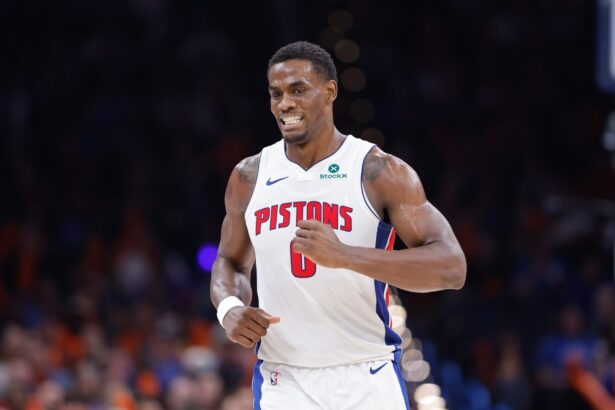
5. Jalen Duren
Contract Status: Restricted Free Agent ($9.0 Million Qualifying Offer)
Jalen Duren would be hard to land, but he matches perfectly what the Warriors need. He is 22 years old, highly athletic, efficient, and an excellent rebounder. During the 2025-26 season, he posted an average of 19.5 points, 10.5 rebounds, 2.0 assists, 0.8 steals, and 0.8 blocks in 70 games while shooting 65.0% from the field and 74.7% from the free-throw line.
It may seem that Duren does not have a three-point shot, but it will not deter the Warriors from targeting him. They need a center that can get buckets, set screens, rebound, defend the rim, and play his role effectively without having to run plays for him.
The main issue would be with his contract situation. Duren is a restricted free agent, meaning that the Pistons could match his salary. His next contract will likely be substantially more expensive than desired, as he might push for a maximum $239.4 million deal.
Therefore, the Warriors will lack the available cap space to sign him outright. Signing and trading him will likely require a massive trade involving several key players to convince the Pistons to let go of their young star.
The estimated cost of such a trade would put Duren’s salary between $38.0 million to $41.2 million per season. One such proposal could involve Kristaps Porzingis in a sign-and-trade, a young player like Brandin Podziemski, and the No. 11 draft pick for Duren, assuming that the Pistons are interested in getting another stretch center to pair up with Cade Cunningham in addition to some salary savings by trading Duren, as his playoff collapse might have destroyed his max deal chances.
The basketball reason to attempt is obvious. Duren would offer the Warriors a vertical center who would play alongside Curry, Butler, and Green. Curry relies on players who generate contact and finish strongly inside. Butler requires an interior presence to punish help defenders down low. Finally, Green would benefit greatly from the frontcourt help that can rebound sufficiently to avoid spending most games as a center. Also, it seems that losing too many defensive boards has become an ongoing issue for the Warriors recently.
Spacing is the main issue here, as Duren lacks a three-point shot. His playing style and physical profile may make the court rather cramped when he is on the floor with Green, forcing the Warriors to find shooters at the other three spots.
However, Duren’s age, rebounding, finishing ability, and physical strength make him one of the best frontcourt options available this offseason despite a high price tag.
4. Walker Kessler
Contract Status: Restricted Free Agent ($7.1 Million Qualifying Offer)
The Warriors have spent too many seasons asking smaller lineups to survive center minutes they were not built to handle. Walker Kessler would be the opposite type of bet. He would not come to score 20. He would come to end possessions, protect the rim, set real screens, and let Draymond Green stop playing so much regular-season center.
His 2025-26 season ended after five games because of a torn labrum in his left shoulder, but even that small stretch showed the profile: 14.4 points, 10.8 rebounds, 3.0 assists, 1.4 steals, and 1.8 blocks in 30.8 minutes. His last full sample was stronger defensively. In 2024-25, he averaged 11.1 points, 12.2 rebounds, 1.7 assists, and 2.4 blocks in 30.0 minutes while shooting 66.3% from the field.
The contract is the hard part. Kessler made $4.9 million in 2025-26 and is a restricted free agent this summer, so the Jazz can match any offer. A realistic contract would be around four years and $96.0 million, starting near $22.3 million in 2026-27 and rising.
That is starter money, but not crazy money for a 24-year-old center who can rebound and block shots at this level.
The Warriors would almost certainly need a sign-and-trade. Kristaps Porzingis could go away on a new two-year, $50.0 million deal, starting around $24.0 million, plus the No. 11 pick in the 2026 NBA Draft and the Lakers’ 2026 second-round pick at No. 54.
Porzingis is also a 2026 free agent, so he should also be a sign-and-trade piece. The Warriors are projected with $181.5 million committed to nine players, so they do not have a cap-space path.
That is already a high price. I would not add an unprotected future first. If the Jazz demand more, the Warriors could make the 2028 first-round pick top-20 protected, but that should be the ceiling. With the Jazz already having Lauri Markkanen and Jaren Jackson Jr. on max money in the frontcourt, they’d be more than welcome to let Kessler go before the roster gets too pricey.
Kessler does not shoot, the shoulder medicals have to be right, and paying around $24.0 million per year for a non-shooting center might be a risk. But this is the kind of swing that at least changes a real problem. The Warriors have enough guards and half-wings. They need a center who can make the game bigger.
3. Austin Reaves
Contract Status: $14.9 Million Player Option In 2026-27 ($13.9 Million Salary In 2025-26)
Austin Reaves is here because he is one of the few free-agent guards who can actually change the Warriors’ offense. Not as a No. 1 option. Not as a franchise player. But as a real secondary creator next to Curry. That is a different level from just adding another shooter.
Reaves has a $14.9 million player option for 2026-27, but he is widely expected to decline it. His next deal should be closer to star money than role-player money. A realistic range is four years, $140.0 million to $150.0 million, starting around $32.0 million to $34.0 million in 2026-27.
The production supports that price. Reaves averaged 23.3 points, 4.7 rebounds, and 5.5 assists in 51 games in 2025-26. He shot 49.0% from the field, 36.0% from three, and 87.1% from the free-throw line, with a 64.1% true shooting mark. That is not empty scoring. That is great offense with real playmaking gravity for the Lakers.
For the Warriors, the basketball fit is strong. Reaves can handle the ball when Curry sits. He can play next to Curry because he shoots well enough off the catch. He can attack closeouts, run pick-and-roll, draw fouls, and keep the offense alive when the first action gets stopped.
That last part is the key. The Warriors had too many possessions where Curry created the advantage and nobody else could extend it. Reaves can. He is patient, strong with the ball, and comfortable playing out of the middle of the floor. He is not just a spot-up guard.
The problem is the path. The Warriors are not signing Reaves with normal cap space. If he leaves the Lakers, it almost surely has to be through a sign-and-trade. That means the Lakers must decide they would rather get value back than pay him $35.0 million per year.
A realistic structure would be Austin Reaves to the Warriors on a four-year, $144.0 million deal, starting around $33.0 million. The Lakers could receive Kristaps Porzingis on a new two-year, $58.0 million sign-and-trade contract, starting around $28.0 million, plus Brandin Podziemski and the No. 11 pick in the 2026 NBA Draft.
The Warriors would be paying for a 27-year-old guard who just produced above 23 points per game on strong efficiency. Porzingis gives the Lakers a veteran stretch big if they do not want to commit long-term to Reaves for that big of a price. Podziemski gives them a younger guard. The No. 11 pick is the asset that makes the conversation interesting.
Reaves would give the Warriors more creation, more free throws, and a second guard who can play playoff offense without needing Curry to set up every shot. The defense is not perfect, and the salary would be big. Still, if the Warriors want a younger offensive piece who can help now and still hold value after the Curry era, Reaves is one of the best names on the board.
2. Kristaps Porzingis
Contract Status: Unrestricted Free Agent ($30.7 Million Salary In 2025-26)
Kristaps Porzingis is the easiest frontcourt target because the Warriors can re-sign him without needing cap space. He made $30.7 million in 2025-26 and is now an unrestricted free agent. The Warriors have his Bird rights, so the path is simple: negotiate a new deal and manage the apron.
His Warriors sample was uneven. After arriving from the Hawks, Porzingis averaged 16.1 points, 5.3 rebounds, and 1.1 blocks in 15 games while shooting 43.3% from the field and 31.1% from three. The three-point number was not good enough, but the profile still fits. A 7-foot-2 big man who can shoot, block shots, and play next to Draymond Green is not easy to replace.
The right contract would be short. Something around two years and $52.0 million makes sense, starting at $25.0 million in 2026-27 and rising to $27.0 million in 2027-28. That keeps him close to his previous salary range but avoids long-term risk. Porzingis is still useful, but his injury history makes a three- or four-year deal dangerous.
Porzingis gives the Warriors a big man who can pull centers away from the paint, open driving lanes for Curry and Jimmy Butler, and still give them shot-blocking behind the play. He is not a bruiser, and he will not fix the rebounding alone. But he gives the Warriors a frontcourt shape that makes more sense than playing small all season.
If the number gets close to $30.0 million per year again, the Warriors should hesitate. If it stays near $25.0 million per year on a short deal, he is one of their best realistic options. Porzingis is not the star move. He is the practical move: size, shooting, rim protection, and no trade cost.
1. LeBron James
Contract Status: Unrestricted Free Agent ($52.6 Million Salary In 2025-26)
LeBron James is the obvious No. 1 because the Warriors do not get another chance like this very often. He is not 30 anymore, but he is still a top-level offensive player and the best realistic free-agent name tied to their offseason.
In 2025-26, he averaged 20.9 points, 6.1 rebounds, and 7.2 assists in 60 games while shooting 51.5% from the field, 31.7% from three, and 73.7% from the line. That is still star production, even with the age and games missed.
The Warriors’ interest is not new. ESPN’s Ramona Shelburne and Anthony Slater reported that the Warriors are expected to test the waters again on LeBron while also looking at other big swings. Marc Stein also reported that the Warriors have had long-standing interest in bringing him to Northern California. The idea is not hard to understand: put another elite passer and scorer next to Stephen Curry before the window closes.
The direct free-agent path is only possible if LeBron takes a major pay cut. The Warriors are not opening $40.0 million or $50.0 million in cap space. If he wants to come on a discount, the conversation changes. But if he wants anything close to his old number, this becomes a sign-and-trade with the Lakers.
The simplest version would be Jimmy Butler and the No. 11 pick in the 2026 NBA Draft for LeBron on a new one-year deal starting around $50.0 million. Butler is owed $56.8 million in 2026-27, so the salary works in the right range. That is not a perfect return for the Lakers with Butler still recovering from his ACL tear, but it gives them an expiring star salary and a lottery pick.
I would not add another unprotected first. LeBron is still great, but he is entering his age-42 season. The Warriors should be aggressive because Curry and LeBron together would instantly change the offense. They should not empty the last serious assets for one season.
The fit is still the best on the list. LeBron gives the Warriors another creator, another passer, more size, and a second player who can control playoff possessions. Curry could work off the ball more. Draymond Green would not need to be the only frontcourt passer. The half-court offense would stop depending on Curry to create the first and second advantage every night.
This is not a long-term move. It is a one-year swing. But if the Warriors want one last real push with Curry, LeBron is the strongest free-agent target available.