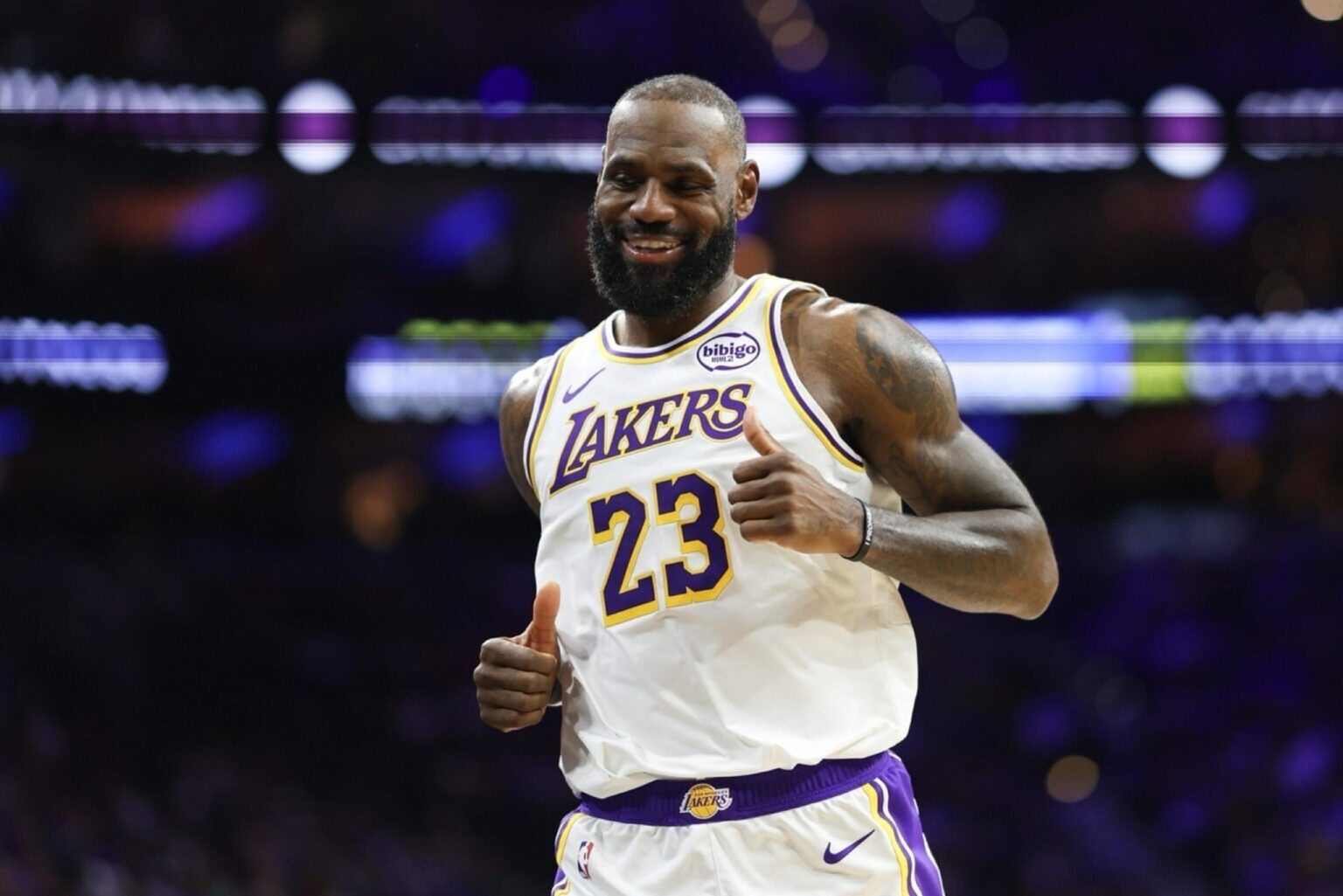
LeBron James’ playoff career has reached a point where normal player comparisons do not really work anymore. Most stars are measured against other stars. LeBron is now being measured against full franchises. That is the level of his postseason legacy. He has played through different eras, different teammates, different coaches, and different versions of his own game, and he has remained one of the safest bets in playoff basketball.
The most impressive part is not only the longevity. It is how long he stayed at the center of winning. With the Cavaliers, he carried teams that often had no business going that far. With the Heat, he became the best player in the league and reached four straight Finals. With the Lakers, he added another title and kept stretching a career that already looked impossible to extend. He has been to 10 NBA Finals, which puts him in a very small historical group.
This is why the stat is so strange. Since the start of this century, no NBA team has won more playoff games than LeBron. Not the Lakers. Not the Spurs. Not the Warriors. Not the Heat. One player has stacked more postseason wins than every franchise in the league during that span.
It sounds almost fake, but it also explains his career well. LeBron has not just been great for a long time. He has been great in the part of the season where wins are hardest to get. That is why the team comparison hits so hard. Since the 2000 postseason, no NBA franchise has more playoff wins than LeBron. Here is the full ranking he still sits above:
1. LeBron James – 187 wins
2. Celtics – 160 wins
3. Lakers – 154 wins
4. Spurs – 154 wins
5. Heat – 149 wins
6. Warriors – 118 wins
7. Cavaliers – 110 wins
8. Mavericks – 97 wins
9. Pacers – 93 wins
10. Thunder – 92 wins
11. Pistons – 76 wins
12. Nuggets – 74 wins
13. 76ers – 73 wins
14. Suns – 70 wins
15. Bucks – 68 wins
16. Rockets – 62 wins
17. Nets – 61 wins
18. Raptors – 59 wins
19. Clippers – 56 wins
20. Hawks – 53 wins
21. Jazz – 49 wins
22. Magic – 44 wins
23. Knicks – 44 wins
24. Trail Blazers – 42 wins
25. Bulls – 40 wins
26. Timberwolves – 39 wins
27. Grizzlies – 38 wins
28. Kings – 35 wins
29. Wizards – 30 wins
30. Pelicans – 22 wins
31. Hornets – 14 wins
The Stat Sounds Fake, But It Is Real
The number feels almost impossible because playoff wins are not easy to collect. A team needs four wins just to survive one round. A player needs to stay healthy, make the playoffs, play heavy minutes, and be good enough to keep going. One bad matchup can end a run. One injury can end a season. One weak roster can remove a whole year from the count.
LeBron has played through all of that and still ended up ahead of every team.
The context makes it even stronger. The 2000 cut gives every franchise a head start, because LeBron did not enter the league until 2003 and did not play his first playoff game until 2006. The Celtics, Lakers, Spurs, and Heat were all already collecting wins before he had any. The Spurs won the 2003 title before LeBron ever played a playoff game. The Lakers won three straight titles from 2000 to 2002. The Heat started building toward their 2006 championship. The Celtics later built a title team with Kevin Garnett, Paul Pierce, and Ray Allen.
LeBron still passed all of them.
That is what separates this stat from a normal longevity record. It is not only about playing forever. It is about being good enough to make those years count. There are many veterans who stayed in the league for a long time without adding real playoff value late in their careers. LeBron is still playing 30-plus minutes in high-pressure games and still deciding series.
His full playoff record is now 187-109. That is a full career by itself. Most stars never even play 200 playoff games. LeBron has played 296 and won almost two-thirds of them.
The Rockets Series Shows How Dominant He Still Is
The current first-round series against the Rockets is a good reminder of why the number is not just history.
The Lakers had a 3-0 lead after Game 3 and were one win away from sweeping the Rockets. LeBron is 41 years old, in his 23rd season, and still got close to end another playoff series in four games. The Rockets avoided it with a 115-96 win in Game 4, cutting the Lakers’ lead to 3-1, but the bigger point did not change. LeBron is still in a position where opponents are trying to survive against him, not just respect his past.
Game 4 was ugly for him. He had 10 points on 2-of-9 shooting, missed all three of his 3s, finished with nine assists, and had eight turnovers. The Lakers committed 24 turnovers, and the Rockets turned those into 30 points.
But the first three games are why the stat matters. Before Game 4, LeBron was averaging 25.3 points, 9.7 rebounds, and 8.7 assists in the series while shooting 47.4% from the field and 43.8% from 3. He had 29 points, 13 rebounds, and six assists in Game 3, helping the Lakers take control of the series.
That is not a symbolic veteran role. That is not a player standing in the corner while younger stars do the work. That is still a major playoff engine without Luka Doncic and Austin Reaves. He is still reading defenses, still getting into the paint, still creating shots, and still forcing teams to build the game plan around him.
This Is Why LeBron’s Longevity Feels Different
Longevity by itself can be empty. Playing for a long time does not always mean controlling games for a long time.
LeBron’s case is different because his playoff value has changed shape without disappearing. In his first Cavaliers years, he carried huge offensive loads. He had the ball all the time, attacked the rim every possession, and had to create something from very little spacing. With the Heat, he became a more complete machine. He defended at an elite level, played power forward, ran offense, and punished teams in transition. In his second Cavaliers run, he became the full half-court system. In the 2020 Lakers title run, he played more as a big point forward next to Anthony Davis and controlled the pace.
Now, he is older, but he still understands the game better than everyone on the floor.
That is why the playoff wins keep coming. He does not need to be the same athlete from 2009. He does not need to play every possession at full speed. He can choose his moments, slow the game down, find the weak defender, and keep the offense organized. When he has enough shooting and size around him, the game still bends toward his decisions.
This is also why his mistakes stand out more now. Game 4 against the Rockets was a reminder that he is not immune to age or fatigue. The Rockets’ pressure bothered him. Their length made passing lanes smaller. Their speed turned mistakes into points. A younger LeBron could erase some of that with pure force. At 41, he has to win more with timing, angles, and control.
But that is still the point. A bad LeBron playoff game at 41 is news because he is still expected to lead a team through a series. Most players his age are retired, coaching, working on TV, or far away from real playoff minutes. LeBron is still carrying the expectation that the Lakers should close the Rockets and move to the next round.
He Has Been Bigger Than Dynasties
The team comparison is also important because NBA teams go through cycles. They rise, win, get expensive, get older, and fall. The best organizations reload faster than others, but no team stays at the top forever.
The Spurs were the model of stability for almost two decades. The Lakers had the Shaquille O’Neal and Kobe Bryant era, then the Kobe Bryant and Pau Gasol era, then the LeBron and Anthony Davis era. The Heat had Dwyane Wade, then the Big Three, then the Jimmy Butler years. The Warriors built one of the best teams ever around Stephen Curry, Klay Thompson, and Draymond Green.
LeBron outlasted all of those single-team windows.
That is the core of the stat. He did not win all those games in one perfect system. He won with the Cavaliers, Heat, and Lakers. He won as a young scorer, as a peak two-way force, as a veteran playmaker, and now as a 41-year-old forward who still plays main playoff minutes.
There is also a strange Cavaliers layer. Since 1999-00, the Cavaliers have 110 playoff wins, and most of that number comes from LeBron’s time there. Without him, the Cavaliers are not even close to this conversation. So when LeBron is listed above the Cavaliers, it is not only that he beat them in the ranking. He built most of their total too.
The same applies in a smaller way to the Heat and Lakers. The Heat already had playoff history before him, but their four straight Finals trips from 2011 to 2014 were LeBron years. The Lakers already had one of the strongest playoff records in league history, but their 2020 title and later playoff wins were also tied to LeBron’s late-career stretch.
That is why this stat is more than a funny graphic. It explains how much of the NBA playoff map has had LeBron in it.
The Lakers Still Need To Finish The Job
The Rockets’ Game 4 win also keeps the story from becoming too straightforward.
The Lakers were close to a sweep, but they did not get it. They had the chance to finish the series early and rest. Instead, they gave the Rockets life. Game 5 now matters more than it should have. The Lakers still have control, but the tone is different after a 19-point loss.
For LeBron, every extra game asks more from his body. He is 41. The Lakers do not want a long first-round series. They do not want him playing heavy minutes again and again before the next round. They need to close the Rockets as soon as possible, not just because of the standings, but because of the bigger playoff path.
This is where the stat and the current series meet. LeBron has more playoff wins than any team this century because he has always handled these moments. Up 3-1, at home, with a chance to end a series, this is exactly the kind of game that has built the number.
The Rockets will not make it easy. They found something in Game 4 with pressure, pace, and activity. They played without Kevin Durant and still produced their best game of the series. The Rockets still defended better, shot better, and played with a higher motor.
The Lakers need the opposite version of Game 4. Fewer live-ball turnovers. Better spacing. More patience against switches. More touches near the elbows and in early offense. LeBron does not have to score 35, but he has to control the game again. When the Lakers are organized, the Rockets have to defend longer possessions and make harder reads. When the Lakers are careless, the Rockets can run, pressure, and turn the game into chaos.
That is the line for Game 5. If LeBron controls the pace, the Lakers should close it. If the Rockets turn him and the Lakers over again, the series can get uncomfortable.
Final Thoughts
LeBron having more playoff wins than every NBA team since the 1999-00 postseason is one of those stats that sounds too big to be useful, but it actually tells the story well.
He has not just lasted. He has won. He has not just won in one place. He has won in different roles, with different teams, and in different versions of the league. He has been the young carry job, the best player alive, the veteran champion, and now the 41-year-old still trying to close a playoff series.
The Rockets slowed the Lakers down in Game 4, and LeBron looked human. That should be part of the story. He is not above age, pressure, or bad nights. But even after that loss, the Lakers are still up 3-1, and he is still the player expected to guide them through it.
That is why the stat hits so hard. The Celtics, Lakers, Spurs, Heat, and Warriors have all had great runs this century. LeBron has had one long run that somehow covers almost all of them.