The playoffs change player value fast. Regular-season numbers still mean something, but they do not always hold up when defenses get tighter, and every weakness is targeted. This stock market is about that shift. It looks at which players are gaining trust, which players are losing ground, and which performances may change how teams view them moving forward.
The focus is not on one good game or one bad shooting night. It is role, efficiency, decision-making, defense, and how much a player can be trusted when the series gets tighter. Some players are raising their value in real time. Others are showing limits that are hard to ignore. The playoffs make those answers clear.
5 Players Whose Stock Is Rising In The NBA Playoffs
5. Marcus Smart
Marcus Smart has become more than a stopgap for the Lakers. He has become a playoff problem for the Rockets. With Luka Doncic and Austin Reaves sidelined, Smart has given the Lakers real two-way production instead of just veteran minutes. Through two games, he is averaging 20.0 points, 7.5 assists, 3.0 steals, and 2.0 rebounds while shooting 52.0% from the field and 50.0% from three.
His Game 2 was the clearest example. Smart had 25 points, seven assists, five steals, and went 5-for-7 from three in the Lakers’ 101-94 win. The value was not only the scoring. He pressured Kevin Durant, helped force rushed decisions, and gave the Lakers the defensive edge they needed in a low-margin game. Durant finished with 23 points but also had nine turnovers. That is the kind of playoff impact Smart was signed to provide.
Smart’s stock is rising because his role looks sustainable. He does not need to be a star. He needs to defend, make open shots, control possessions, and bring force. Right now, he is doing all of it.
4. Luke Kennard
Luke Kennard’s value is simple. He changes spacing, and in the playoffs, that travels. The Lakers needed shooting with Doncic and Reaves out. Kennard gave them more than that. He gave them scoring volume, efficiency, and confidence.
Kennard opened the series with a career playoff-high 27 points in the Lakers’ 107-98 Game 1 win over the Rockets. He hit five 3-pointers and helped the Lakers shoot 60.6% from the field and 52.6% from three. That was not a small role-player night. That was the difference between surviving injuries and taking control of a series.
Through two playoff games, Kennard is averaging 25.0 points, 5.0 rebounds, and 2.5 assists in 40.0 minutes. He is shooting 65.4% from the field and 72.7% from three. Those numbers will cool off, but the point is bigger than the percentage. The Rockets have to guard him as a real scoring threat. That opens cleaner driving lanes and keeps help defenders attached.
Kennard is not rising because he suddenly became a complete player. He is rising because his one elite skill is holding up under pressure. In a playoff series, that is enough to swing games.
3. CJ McCollum
CJ McCollum has moved from steady veteran to series-shaping scorer. The Hawks are up 2-1 on the Knicks, and McCollum has been one of the main reasons. Through three games, he is averaging 27.0 points, 3.7 rebounds, and 2.7 assists while shooting 50.8% from the field and 39.1% from three.
His best work has come late. In Game 2, McCollum scored 32 points and hit the go-ahead step-back jumper with 34 seconds left in a 107-106 win. In Game 3, he had 23 points and made another key jumper with 12.7 seconds left in a 109-108 win. That is not empty scoring. That is end-of-game shot creation against a defense built to win playoff possessions.
McCollum’s stock is rising because the Hawks are getting exactly what playoff teams pay guards to do. When the first action stalls, he can still create a clean midrange look. When the defense switches, he can punish a matchup. When the game slows down, he does not look rushed.
This matters for how McCollum is viewed beyond this series. He is no longer just a regular-season scorer at this moment. He is carrying late-clock offense in wins against one of the best defenses and a clear title contender like the Knicks.
2. VJ Edgecombe
VJ Edgecombe is moving fast. The 76ers’ rookie had a quiet enough Game 1 by playoff standards, then changed the tone of the series in Game 2. Edgecombe had 30 points, 10 rebounds, two assists, and two steals in 35 minutes in the 76ers’ 111-97 win over the Celtics. He shot 12-for-20 from the field and 6-for-10 from three.
The context is what pushes his stock higher. The 76ers were coming off a Game 1 loss. Joel Embiid was not available. The Celtics still had the personnel and size to steamroll over Tyrese Maxey. Edgecombe did not play it safe. He attacked, shot with no hesitation, and handled playoff physicality after taking a hard fall.
Through two playoff games, Edgecombe is averaging 21.5 points, 6.5 rebounds, 2.5 assists, and 2.0 steals. He is shooting 50.0% from the field and 40.0% from three. That is already strong. For a rookie in a first-round series against the No. 2 seed Celtics, it is different-level proof.
Edgecombe’s stock is rising because he looks playable in every kind of possession. He can run, cut, shoot, rebound, and defend. That gives the 76ers another real postseason option, not just another young player getting minutes in a series where they suddenly look ready for an upset.
1. Scoot Henderson
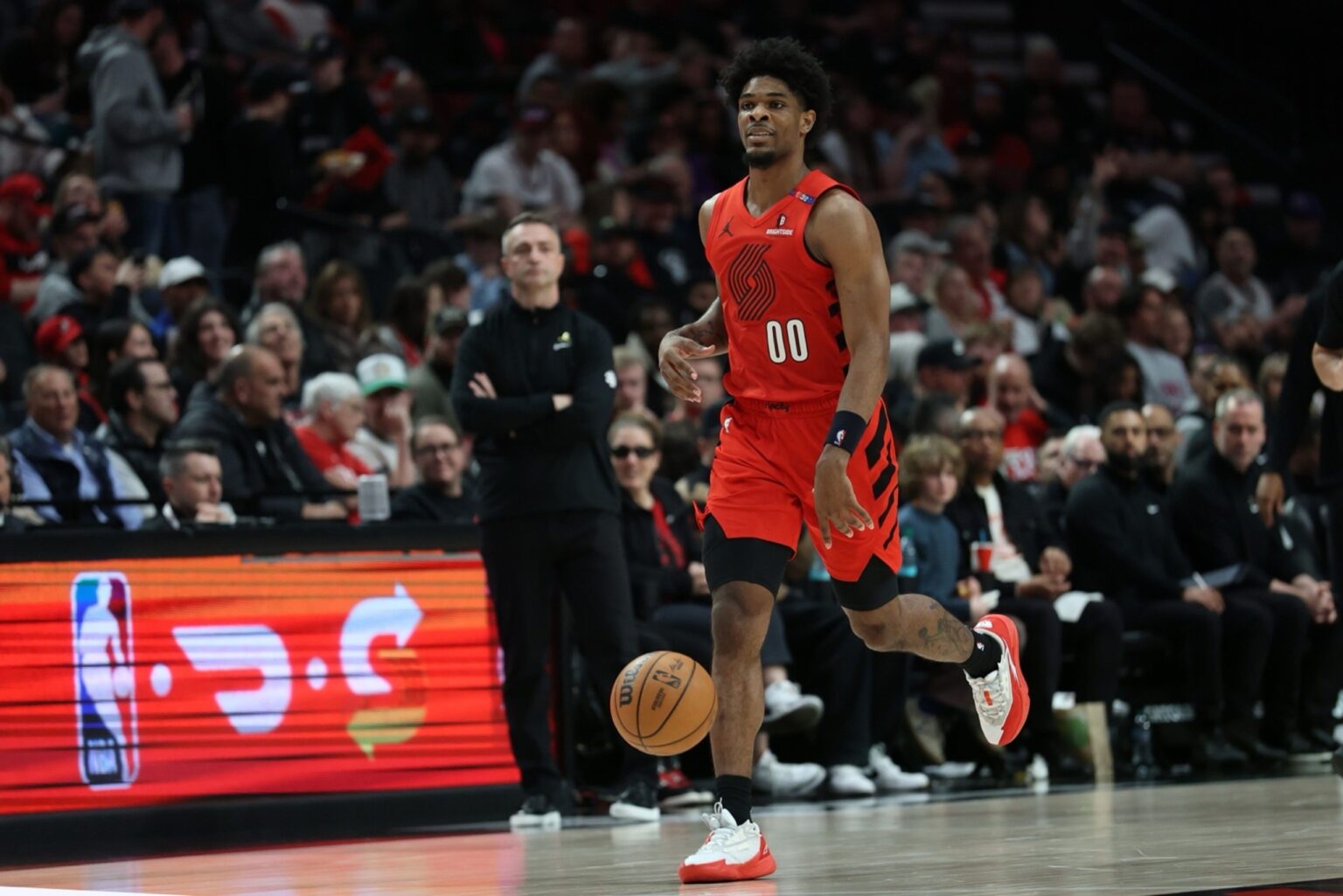
Scoot Henderson has the biggest jump on this list because his playoff start directly changes the way his ceiling is discussed. The Trail Blazers are tied 1-1 with the Spurs, and Henderson has looked like a lead guard who can bend a playoff game with speed and shot-making.
Through two games, Henderson is averaging 24.5 points, 2.0 rebounds, and 1.5 assists while shooting 64.3% from the field and 53.8% from three. His Game 2 was the breakout. He scored 31 points in 38 minutes, went 11-for-17 from the field and 5-for-9 from three, and led the Trail Blazers to a 106-103 win.
The Spurs had the series lead. Victor Wembanyama left Game 2 after entering concussion protocol. The game was there for the Trail Blazers to take, and Henderson took it. He scored in every quarter, started fast, and closed with enough control to make the win feel less like a surprise and more like a statement coming back to Portland for the next two games.
Henderson’s rise is not only about one scoring night. It is about a statement. He is getting downhill, but he is also making the Spurs pay for going under screens. That changes the scouting report. If defenders have to respect the jumper, Henderson’s burst becomes harder to contain in a series where the Spurs are already on a tightrope.
That is why he is No. 1 here. Smart, Kennard, McCollum, and Edgecombe have all raised their value. Henderson may be changing the conversation around his future if he keeps excelling in this first-round series.
5 Players Whose Stock Is Falling In The NBA Playoffs
5. Jerami Grant
Jerami Grant is not falling because the Trail Blazers are in trouble. He is falling because his playoff role has become smaller than his contract, resume, and regular-season profile suggest.
Grant averaged 18.6 points, 3.5 rebounds, and 2.1 assists in the regular season while shooting 45.3% from the field and 38.9% from three. That is high-end forward production. In the playoffs, through two games against the Spurs, he is averaging 5.0 points, 0.5 rebounds, and no assists in 20.0 minutes. He is shooting 21.4% from the field and 20.0% from three.
That is a sharp drop. Grant has taken 14 shots in two games and made three. He also has one rebound and no assists in 40 total minutes. The Trail Blazers do not need him to run the offense, be a primary scorer, or play the hardest on-ball defense. Deni Avdija is the guy for that franchise role. They do need him to space the floor, punish smaller defenders, and give them reliable wing scoring on the side.
Right now, that is not happening. Grant’s stock is falling because he looks more like a limited veteran option than a major playoff piece, when his regular season was far better than this output.
4. Desmond Bane
Desmond Bane’s case is direct. The Magic need him to be an efficient perimeter scorer against the best interior defense in the league. Through two games against the Pistons, he has not been that.
Bane averaged 20.1 points, 4.1 rebounds, and 4.1 assists in the regular season. He shot 48.4% from the field, 39.1% from three, and 90.8% from the line. In the playoffs, he is at 14.5 points, 5.0 rebounds, and 3.5 assists, but the efficiency has dropped hard. He is shooting 29.0% from the field and 20.0% from three.
Game 2 made it worse. Bane finished with 12 points on 2-for-11 shooting in the Magic’s 98-83 loss. He was minus-22. The Magic do not have enough clean half-court creation to absorb that kind of night from one of their best shooters.
Bane still has defensive value, and his shooting history still opens gaps for Franz Wagner and Paolo Banchero. But playoff stock is about current pressure. Right now, his jumper has not answered, even if the Magic managed to steal Game 1 on the road.
3. Jalen Duren
Jalen Duren had a strong regular season, an All-Star selection, and became a crucial part. That is why this playoff start stands out.
Duren averaged 19.5 points, 10.5 rebounds, and 2.0 assists in 70 games. He shot 65.0% from the field and 74.7% at the line. Those numbers made him one of the Pistons’ biggest regular-season advantages. In the playoffs, he is averaging 9.5 points, 8.0 rebounds, and 2.5 assists through two games against the Magic.
The problem is not only scoring. Duren has six turnovers in two games. He is shooting 50.0% from the field, which is low for his role and shot diet, and 55.6% from the line. In Game 1, he had eight points and seven rebounds and finished minus-21 with just 4 field goals attempted. He was better in Game 2 with 11 points, nine rebounds, and four assists, but the overall drop is still clear.
Duren’s stock is falling because the Magic’s floor-shrinking strategy is making his touches harder. He is still rebounding. He is still a physical presence. But the easy points have not been there, and the Pistons need his interior efficiency to look closer to his regular-season level.
2. Alperen Sengun
Alperen Sengun’s raw numbers are not bad. That is not the issue. The issue is what the Rockets need from him in a series against a diminished Lakers team that is missing their two main engines.
Sengun averaged 20.4 points, 8.9 rebounds, and 6.2 assists in the regular season while shooting 51.9% from the field. Through two playoff games against the Lakers, he is averaging 19.5 points, 9.5 rebounds, and 5.5 assists. On the surface, that looks fine. The efficiency tells a different story. He is shooting 38.5% from the field, 0.0% from three, and has a 44.0% true shooting percentage.
In Game 1, Sengun had 19 points, eight rebounds and six assists, but shot 6-for-19. In Game 2, he had 20 points, 11 rebounds and five assists, but shot 9-for-20. The Rockets are down 0-2, and the Lakers have made his scoring possessions feel crowded and slow.
Sengun is supposed to be more than a secondary option if Kevin Durant is not available, like Game 1 showed. The Rockets got Durant back and still lost Game 2, but Sengun has to be the long-term offensive hub regardless. If he is inefficient in the paint and not forcing defensive overreaction, the Rockets become easier to guard due to their lack of shooting.
His stock is falling because the standard is higher now. Good box-score numbers are not enough when the series is slipping, and the Rockets came in as the early favorites against a Lakers team relying on a 41-year-old LeBron James to carry the load.
1. Brandon Ingram
Brandon Ingram is No. 1 because the Raptors need him to be one of their main answers, and he has not played like it in the entire series against the Cavaliers.
Ingram averaged 21.5 points, 5.6 rebounds, and 3.7 assists in 77 regular-season games. He shot 47.7% from the field and 38.2% from three. In his last three playoff games, he is averaging 12.0 points, 3.0 rebounds, and 3.0 assists. That is not close to enough for a player who was named an All-Star and led the Raptors to a No. 5 seed for the first time since 2022.
The low point came in Game 2 after demanding more touches in Game 1’s press conference. Ingram scored seven points on 3-for-15 shooting and had five turnovers as the Cavaliers took a 2-0 series lead. The Raptors pointed to the Cavaliers’ physical defense, and Darko Rajakovic said Ingram had his support. But the result was still clear. He did not control the game, and he did not force enough pressure at the line.
Game 3 did not fully change the picture. The Raptors won 126-104, but Scottie Barnes and RJ Barrett each scored 33 points. Collin Murray-Boyles added 22. Ingram scored 12. He was part of the win, but he was not the reason for it.
That is why his stock is falling fastest. Ingram’s value is tied to shot creation and playoff scoring. Right now, the Raptors are getting more force from Barnes and Barrett. Ingram has time to respond, but his first three games have raised real questions.